Complete Muktinath Travel Guide: Best Time, Cost, Route & Itinerary (2026/27)
By Royal Nepal Holidays On 27 Jul 2026
Quick Contact
By Royal Nepal Holidays On 27 Jul 2026
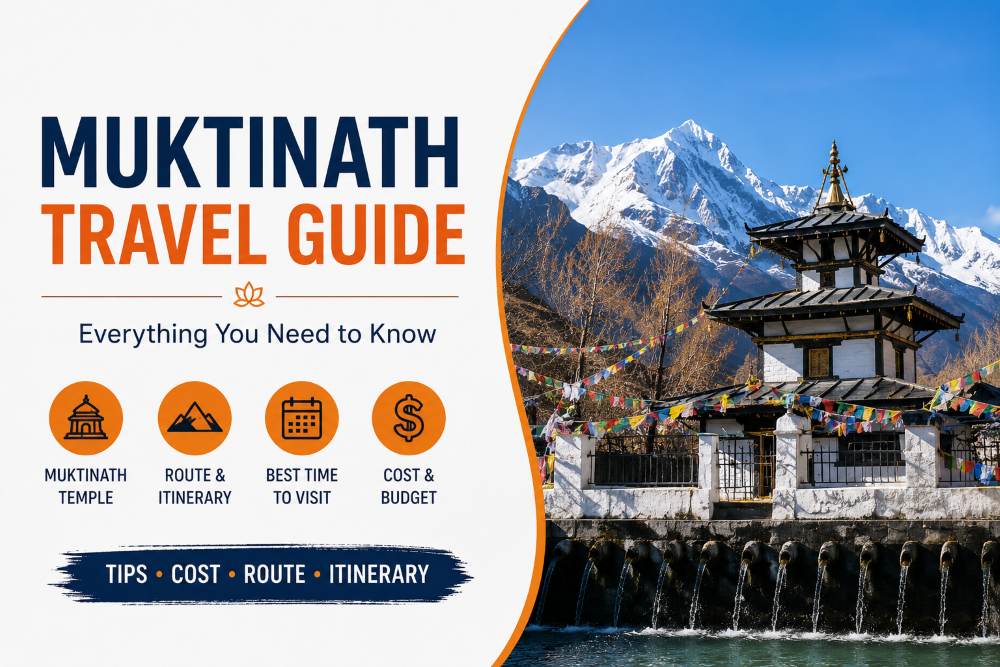
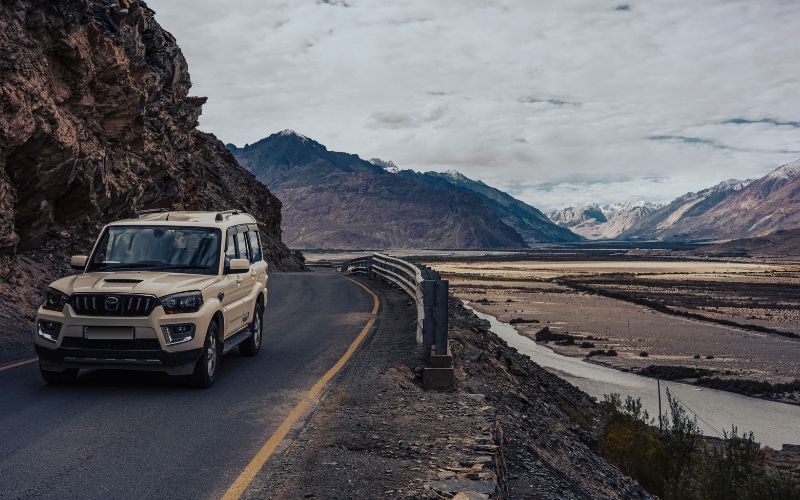
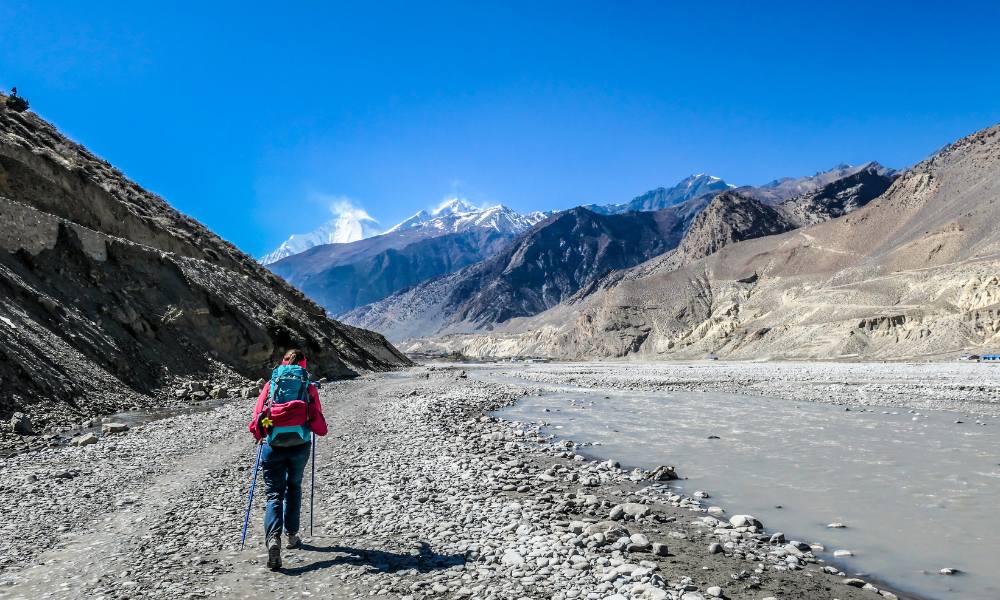
There is a particular moment on the road to Muktinath — somewhere past Jomsom, where the Kali Gandaki River widens into a pale, braided sheet of water and the wind starts pushing sand across the valley floor — when most travelers go quiet. The Annapurna range is behind you. Nilgiri is catching the last light. And ahead, at 3,710 meters, sits a temple that has drawn pilgrims across two of the world's great religions for over a thousand years.
| Information | Details |
|---|---|
| Destination | Muktinath Temple, Mustang, Nepal |
| Province | Gandaki Province |
| District | Mustang |
| Elevation | 3,800 m (12,467 ft) |
| Best Time to Visit | March–May & September–November |
| Suitable For | Pilgrims, Families, Couples, Senior Citizens, Adventure Travelers |
| Nearest Airport | Jomsom Airport |
| Nearest City | Pokhara |
| Religion | Hinduism & Buddhism |
| Famous For | Muktinath Temple, 108 Water Spouts, Jwala Mai Temple |
That's the pull of a Muktinath tour. It isn't just a trip to a temple. It's a journey through one of the most dramatic landscapes in Nepal — from the subtropical terraces around Pokhara, through the deep gorge of the Kali Gandaki (the world's deepest), into the high, wind-carved desert of Lower Mustang, a place that looks and feels more like the Tibetan plateau than anything typically associated with Nepal.
This guide covers everything you need to plan a Muktinath trip properly: when to go, how to get there, what it costs, what to pack, how altitude affects the journey, and where people usually get it wrong. It's written from years of running trips into this exact region, so the advice here reflects what actually happens on the ground — not just what looks good in a brochure.
If you're comparing a Muktinath tour package, deciding between Kathmandu and Pokhara as your starting point, or simply trying to understand what a Muktinath tour cost should realistically look like, you're in the right place.
The best time to visit Muktinath Temple is March–May or September–November, when mountain views are clearest and roads are most reliable. Most travelers reach Muktinath via a Muktinath tour from Kathmandu (4–7 days, combining a flight or drive to Pokhara with an overland or flight route through Jomsom) or directly from Pokhara. Expect to budget USD 500–900 per person depending on group size, transport mode, and season.
Every year, thousands of travelers try to plan a Muktinath trip on their own and run into the same handful of problems. Understanding these upfront will save you time, money, and a fair amount of frustration.
The "Muktinath by road vs. flight" confusion. Search results are full of conflicting information about whether the Jomsom–Muktinath road is passable, how long it takes, and whether flights are reliable. The honest answer is that both routes work, but they serve very different trip styles — and the right choice depends on your time, budget, and tolerance for long jeep rides on rough mountain roads.
Underestimating the altitude. At 3,710 meters, Muktinath sits high enough that altitude-related headaches and fatigue are common, even though this isn't a trek in the technical sense. Travelers who fly in and skip acclimatization sometimes have a miserable day at the temple instead of an inspiring one.
Seasonal misunderstanding. Mustang is a rain-shadow region — it stays dry even during Nepal's monsoon, which makes it one of the few places in the country that's genuinely trekkable in July and August. Most generic Nepal travel guides don't mention this, and travelers either avoid Mustang unnecessarily in summer or don't realize how cold and windy it gets in winter.
Treating it as "just a temple visit." Muktinath sits inside the Annapurna Conservation Area, on the ancient salt-trade route through Lower Mustang. Travelers who rush straight to the temple and back miss Kagbeni's medieval alleys, Marpha's whitewashed apple-orchard streets, and one of the most striking high-desert landscapes in the Himalaya.
A well-planned Muktinath pilgrimage tour solves all four of these problems before they happen — which is really the difference between a trip that goes smoothly and one that doesn't.
Muktinath sits at 3,710 meters (12,172 ft) in the Mustang District of Nepal, in the shadow of the Thorong La pass, on the eastern edge of the region known as Lower Mustang. It's roughly 18 km from Jomsom, the district's main airstrip town, and about 200 km northwest of Pokhara by road.
Geographically, Muktinath marks the point where the lush, forested Annapurna region gives way to the high, arid Tibetan-influenced plateau. The transition is abrupt — within a single day's drive from Jomsom you go from pine forest to bare, wind-scoured hills that would look at home in Ladakh or western Tibet.
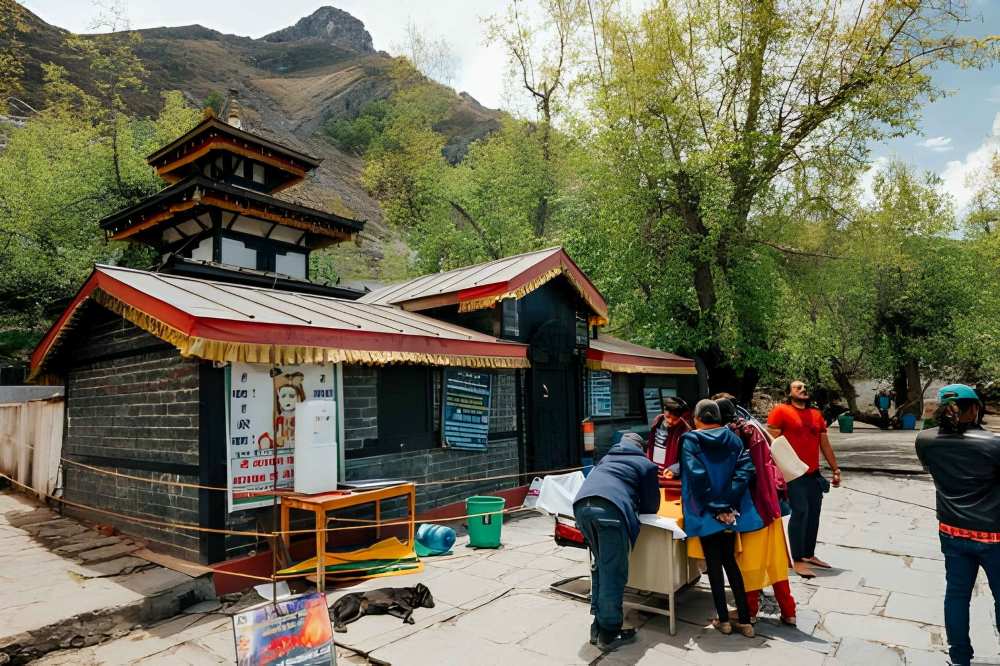
Muktinath is one of the rare pilgrimage sites in the world venerated jointly by two major religions, each with its own name and interpretation of the site's meaning.
This dual reverence is visible the moment you arrive: Hindu sadhus and Tibetan Buddhist monks often circumambulate the same courtyard, and the temple complex includes both the Vishnu temple and Buddhist gompas within the same compound.
The most photographed feature at Muktinath is the semicircular wall of 108 bull-head-shaped water spouts, each channeling icy water believed to originate from sacred glacial sources. Pilgrims traditionally bathe under all 108 spouts as part of the purification ritual — a bracing experience given the water temperature rarely rises above a few degrees Celsius, even in summer.
A short walk from the main spouts is the Jwala Mai Temple, home to Muktinath's most unusual natural phenomenon: a perpetual natural gas flame that burns above a small spring, meaning fire and water occur together in the same spot. This coexistence of fire, water, earth, and air is precisely what makes Muktinath significant in Tantric Buddhist cosmology — it's regarded as a natural expression of all four elements in one place.
There are two realistic starting points for a Muktinath trip, and the route you choose shapes the entire itinerary.
Muktinath Tour from Kathmandu
Most international travelers start in Kathmandu. From there, the journey typically runs:
A Muktinath tour package 5 days built around this route is the most popular option we run, because it balances a manageable pace with enough time to actually experience Lower Mustang rather than just transiting through it.
Pokhara to Muktinath
If you're already in Pokhara, or prefer to skip Kathmandu's traffic, going directly from Pokhara shortens the trip by a day and is a smart choice for travelers on a tighter schedule.
| Feature | Road Tour | Flight Tour |
|---|---|---|
| Duration | 5 Days | 3–5 Days |
| Cost | More Affordable | Higher |
| Scenic Views | Excellent | Excellent |
| Weather Dependency | Low | High |
| Village Stops | Yes | Limited |
| Best For | Families & Groups | Time-Conscious Travelers |
| Factor | By Flight (Pokhara–Jomsom) | By Road (Jeep) |
|---|---|---|
| Duration | ~20 minutes | 8–10 hours to Jomsom |
| Reliability | Weather-dependent; frequent morning-only departures, occasional delays | More reliable, but rough and dusty in places |
| Scenery | Dramatic aerial views of Annapurna/Dhaulagiri | Ground-level views of Kali Gandaki gorge, villages |
| Comfort | Short, physically easy | Long, bumpy, tiring for some travelers |
| Cost | Higher | Lower |
| Best for | Time-limited travelers, those prioritizing comfort | Budget travelers, those wanting the full valley experience |
Neither option is objectively "better" — it depends on what kind of trip you want. Many of our clients choose to fly one direction and drive the other, getting the best of both without doubling the discomfort.
A Muktinath trip is as much about the villages along the way as the temple itself.
| Route | Distance | Travel Time |
|---|---|---|
| Kathmandu → Pokhara | 205 km | 7–8 Hours |
| Pokhara → Beni | 80 km | 2.5 Hours |
| Beni → Jomsom | 90 km | 5–6 Hours |
| Jomsom → Muktinath | 20 km | 1 Hour |
| Kathmandu → Muktinath | Approx. 375 km | 12–15 Hours (Road) |
| Pokhara → Muktinath | Approx. 170 km | 8–10 Hours |
| Season | Months | Conditions |
|---|---|---|
| Spring | March–May | Warm days, cold mornings, good visibility, rhododendrons blooming at lower elevations |
| Summer/Monsoon | June–August | Rain-shadow effect keeps Mustang largely dry even as the rest of Nepal gets monsoon rain; hazy mountain views |
| Autumn | September–November | The most popular season — crisp air, the clearest mountain views of the year, stable weather |
| Winter | December–February | Very cold, strong winds, possible snow closing high passes; flights more prone to cancellation |
Autumn (September–November) is generally considered the best time to visit Muktinath, offering the most reliable weather and sharpest mountain views of Dhaulagiri, Nilgiri, and the Annapurna range. Spring (March–May) is a close second and tends to be less crowded on the trail.
What surprises most first-time visitors is that summer is a legitimate option here, unlike almost anywhere else in Nepal. Because Mustang sits in the rain shadow of the Annapurna and Dhaulagiri massifs, monsoon clouds rarely dump significant rain on the region, making it one of the only reliable trekking and touring destinations in Nepal during July and August.
Muktinath's elevation (3,710 m) puts it well above the point where altitude starts to matter physiologically, though it's low enough that serious altitude sickness is uncommon for most healthy travelers arriving via a gradual road or short flight-plus-acclimatization schedule.
Typical conditions:
Because Jomsom's airstrip is affected by afternoon winds funneling up the valley, flights operate almost exclusively in the early morning. This is worth planning around rather than fighting against — build flexibility into your schedule rather than booking a tight same-day onward connection.
| Month | Weather | Crowd | Recommendation |
|---|---|---|---|
| January | Cold | Low | Good |
| February | Cool | Low | Good |
| March | Pleasant | Moderate | Excellent |
| April | Warm | High | Excellent |
| May | Mild | High | Excellent |
| June | Warm | Moderate | Good |
| July | Rainy | Low | Fair |
| August | Rainy | Low | Fair |
| September | Clear | Moderate | Excellent |
| October | Sunny & Dry | Very High | Best |
| November | Cool | High | Excellent |
| December | Cold | Moderate | Good |
After years of running trips through this route, a few patterns come up again and again. Here's what we'd tell a friend before they go.
These are the same details our guides — including Bashu, Chandra, and Uttam, who've led this route more times than they can count — walk every group through before departure.
| Day | Route | Highlights |
|---|---|---|
| 1 | Kathmandu → Pokhara | Flight or scenic drive; evening at Phewa Lake |
| 2 | Pokhara → Jomsom (flight) → Muktinath (drive) | Mountain flight views, Kagbeni detour, temple visit and ritual bathing |
| 3 | Muktinath → Marpha | Explore the temple complex at sunrise, drive back through Jomsom to Marpha; apple orchard walk |
| 4 | Marpha → Pokhara | Return drive or flight from Jomsom, free afternoon in Pokhara |
| 5 | Pokhara → Kathmandu | Return flight or drive |
This mirrors the structure of our Muktinath Tour Package 5 Days, which is the most balanced option for travelers who want the full experience — temple, villages, and landscape — without an overly rushed schedule. For travelers with less time, our shorter Muktinath Tour Package (4 days) compresses this into a tighter loop, while those wanting to combine the pilgrimage with more of Nepal often extend into a broader Nepal Tour Packages itinerary.
Accommodation along the route ranges from comfortable tourist-standard hotels in Pokhara to simple but clean guesthouses in Jomsom, Marpha, Kagbeni, and Muktinath village itself. Rooms are basic at higher elevations — expect hot showers (sometimes solar, sometimes bucket), simple bedding, and reliable but not luxurious heating. Booking ahead during autumn is important, as guesthouse capacity in Muktinath and Jomsom is limited.
Muktinath's altitude is moderate by Himalayan standards, but travelers coming directly from sea level should still take it seriously:
Muktinath tour cost varies significantly based on group size, transport mode (flight vs. road), season, and trip length. As a general guide:
| Group Size | Approx. Cost per Person (5-Day Package) |
|---|---|
| Solo traveler | USD 780–900 |
| 2 people | USD 640–720 |
| 3–6 people | USD 570–650 |
| 7+ people | USD 520–580 |
These figures typically include accommodation, ground transport, a private guide, and core sightseeing — domestic flights and personal expenses are usually quoted separately given how much flight availability and pricing fluctuates by season. For an exact, current quote, it's worth checking directly against our Muktinath Tour Package and Muktinath Tour Package 5 Days pages, since pricing is reviewed regularly against flight and permit costs.
Muktinath itself, within the Annapurna Conservation Area, requires an ACAP (Annapurna Conservation Area Permit) and TIMS card, both straightforward to arrange through a registered operator. Travelers wanting to continue north into Upper Mustang (beyond Kagbeni) need a separate restricted-area permit, which is a different process with its own cost and minimum group requirements — worth clarifying early if that's part of your plan.
Food along the route reflects Thakali culture, the ethnic group native to the Kali Gandaki region and renowned across Nepal for its cuisine. A proper Thakali thali — a set meal built around rice, lentils, seasonal vegetables, and often meat, all cooked with a distinctive blend of spices — is a highlight of the trip in its own right, and Marpha in particular is known for excellent Thakali kitchens. Beyond food, expect a strong Tibetan-Buddhist cultural presence the further north you travel — prayer flags, chortens, and gompas become more prominent from Kagbeni onward.
Muktinath remains, first and foremost, an active pilgrimage site for both Hindus and Buddhists. Responsible visitors dress modestly within temple grounds, ask before photographing pilgrims performing rituals, and support the local economy by staying in locally-run guesthouses and eating at Thakali-owned kitchens rather than bypassing the local economy entirely. The Annapurna Conservation Area also depends on permit fees for conservation work, so traveling with a permit and a registered operator directly supports the region's upkeep.
Muktinath is famous as one of the holiest pilgrimage sites shared by Hindus and Buddhists, known for its 108 sacred water spouts, the eternal natural flame at Jwala Mai Temple, and its role as a sacred Vishnu temple and Buddhist Tantric site.
Most travelers fly or drive from Kathmandu to Pokhara, then continue to Jomsom by flight or jeep, followed by a short drive to Muktinath. The full route typically takes 4–5 days round trip when done comfortably.
Yes. Pokhara to Muktinath is a shorter route than starting from Kathmandu, usually done via a Jomsom flight followed by a road transfer, or entirely by jeep on a longer overland route.
September to November offers the clearest skies and most stable weather, followed closely by March to May. Both are considered the best time to visit Muktinath.
Yes — Mustang sits in a rain shadow, so it remains largely dry even during Nepal's monsoon (June–August), unlike most other regions of the country.
It's accessible, but winter (December–February) brings strong winds, cold temperatures, and a higher chance of flight cancellations. It's manageable for prepared travelers but less comfortable than spring or autumn.
Muktinath sits at 3,710 meters (12,172 feet) above sea level.
Mild symptoms like headache or fatigue are possible, especially if traveling quickly from lower elevations, but serious altitude sickness is uncommon at this elevation with sensible pacing and hydration.
Most travelers need 4–5 days for a comfortable round trip from Kathmandu or Pokhara, including time in Marpha and Kagbeni.
Standard packages include accommodation, ground transport, a private guide, permits, and core sightseeing; flights and personal expenses are usually quoted separately.
Costs generally range from roughly USD 520 to USD 900 per person depending on group size, season, and whether flights or road transport are used.
Flying is faster and offers dramatic mountain views but is weather-dependent; driving takes longer but is more reliable and lets you see more of the Kali Gandaki valley along the way.
indproof outerwear, warm layers, sturdy footwear, sun protection, a first-aid kit, cash, and a power bank are the essentials — wind protection matters as much as cold-weather gear.
Yes, an ACAP permit and TIMS card are required, as Muktinath lies within the Annapurna Conservation Area. These are straightforward to arrange through a registered tour operator.
Pilgrims bathe under all 108 spouts as an act of purification believed to grant liberation (moksha) in Hindu tradition; the number 108 holds broader spiritual significance across Hindu and Buddhist practice.
Shaligram are black ammonite fossil stones found in the Kali Gandaki riverbed, believed by Hindus to be a natural form of Lord Vishnu, adding to Muktinath's religious importance.
Yes, Muktinath welcomes visitors of all backgrounds. Respectful behavior and modest dress within the temple grounds are appreciated given its active pilgrimage status.
Marpha (known for apple orchards and Thakali architecture) and Kagbeni (a medieval gateway village to Upper Mustang) are the two most rewarding stops along the route.
Yes, when done via flight and private vehicle rather than trekking on foot, the trip is manageable for most reasonably fit travelers, including families and older visitors, provided the altitude is approached gradually.
Yes — many travelers combine Muktinath with Pokhara sightseeing, Kathmandu's UNESCO sites, or broader itineraries covering Chitwan and Lumbini as part of a longer Nepal Tour Package.
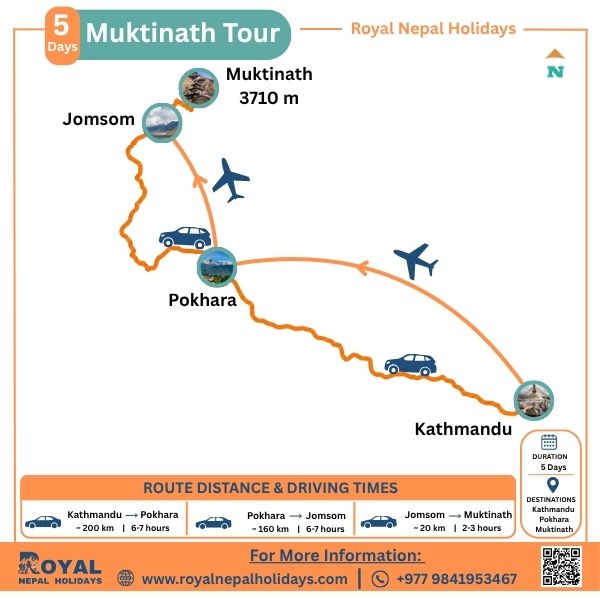
Follow the complete Muktinath Tour route from Kathmandu through Pokhara, Beni, Jomsom, Kagbeni, and the sacred Muktinath Temple. This route map helps you visualize the journey, driving distances, and major stops along the way.
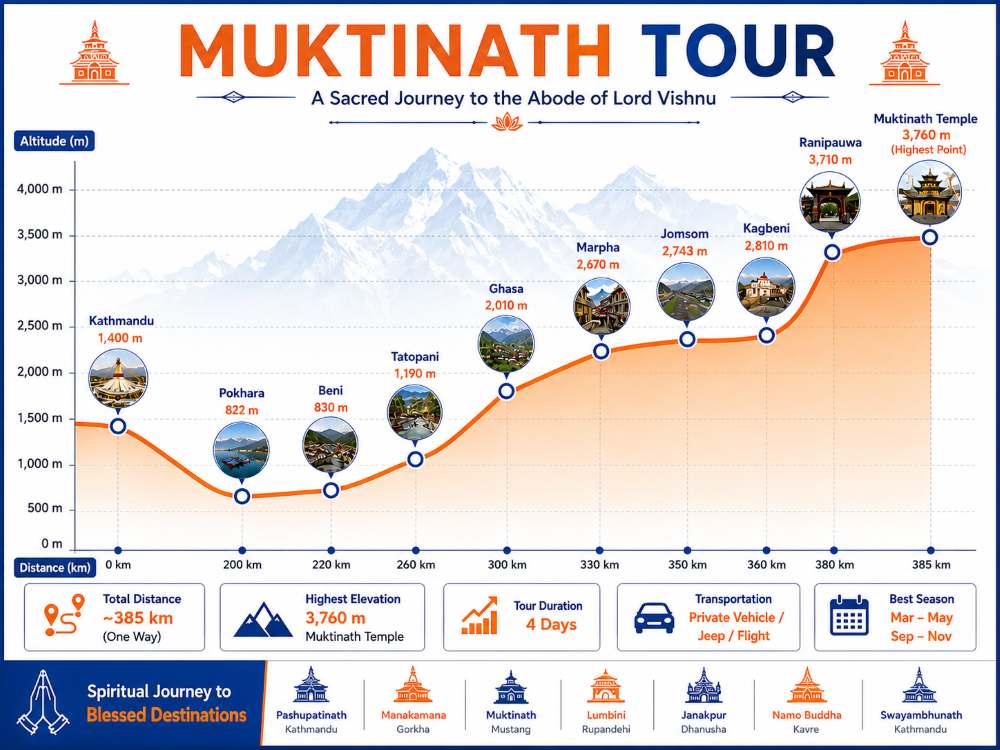
View the altitude changes throughout the journey, from Kathmandu (1,400 m) to Muktinath Temple (3,800 m). Understanding the elevation profile helps you prepare for the trip and enjoy a safe, comfortable pilgrimage.
| Location | Elevation |
|---|---|
| Kathmandu | 1,400 m |
| Pokhara | 822 m |
| Beni | 899 m |
| Tatopani | 1,190 m |
| Ghasa | 2,010 m |
| Marpha | 2,670 m |
| Jomsom | 2,743 m |
| Kagbeni | 2,810 m |
| Muktinath Temple | 3,800 m |
Muktinath is one of those places that's genuinely difficult to overhype. The temple itself is moving regardless of your faith — watching Hindu pilgrims and Buddhist monks share the same sacred ground is a rare thing to witness anywhere in the world. But it's the journey there, through the Kali Gandaki gorge and the whitewashed lanes of Marpha and Kagbeni, that turns this from a single-site visit into one of Nepal's most complete travel experiences.
Plan around the wind, respect the altitude, and give yourself enough time to actually experience Lower Mustang rather than just passing through it. Whether you go by flight, by road, or a combination of both, the trip rewards travelers who plan it properly.
If you're ready to put a Muktinath trip on the calendar, our Muktinath Tour Package 5 Days and Muktinath Tour Package options are built around exactly the itinerary and pacing described in this guide — with local guides, transparent pricing, and flexible departures. For a broader look at combining this with the rest of the country, our Nepal Tour Packages and Nepal Travel Guide are good starting points as well.
Discover more articles that match your interests! Explore these similar blogs packed with insights, tips, and stories to keep you inspired.