Trip Durations
14 Days

Quick Contact
4.9  | 14 Days | Kathmandu - Annapurna Region - Kathmandu
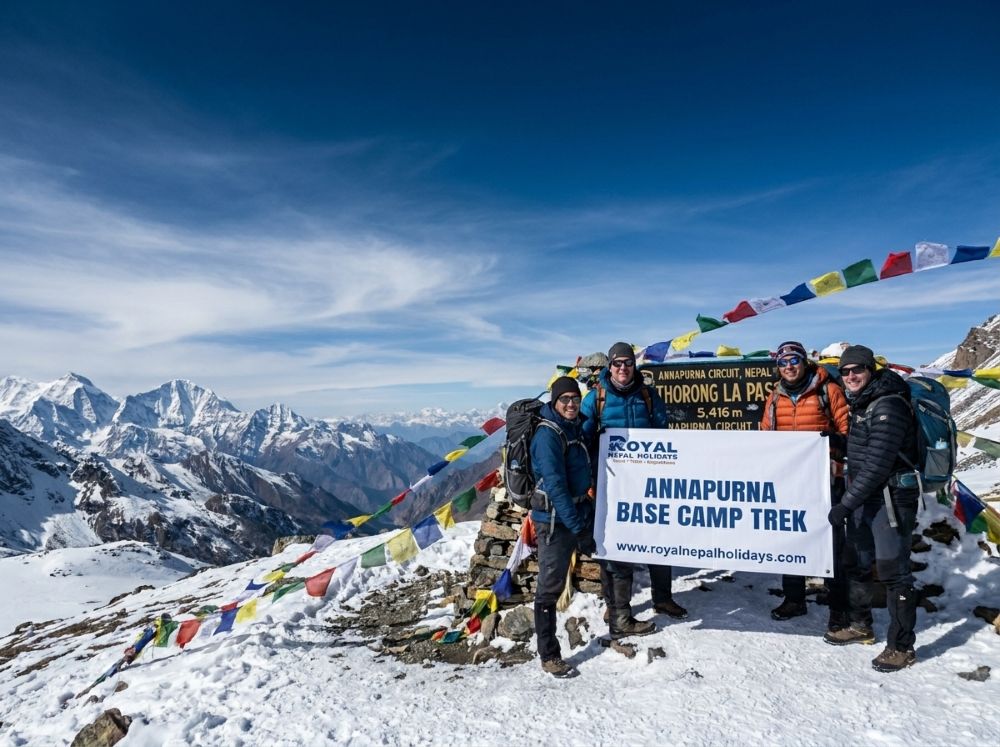
Experience the legendary Annapurna Circuit Trek in 14 days, crossing the spectacular Thorong La Pass at 5,416 meters, exploring the high Manang valley and the dry Trans-Himalayan landscapes of Mustang, visiting the sacred Muktinath Temple, and walking through some of the most diverse mountain scenery in Nepal. Royal Nepal Holidays runs this trek with licensed guides, experienced porters, and a carefully paced itinerary built for proper acclimatization.
Price from US$999 per person (for more than 10+ person)| Duration: 14 Days / 13 Nights | Max Altitude: 5,416 m
| Trip Fact | Information |
|---|---|
| Trip Name | Annapurna Circuit Trek – 14 Days |
| Duration | 14 Days / 13 Nights |
| Region | Annapurna Region, Nepal |
| Difficulty | Moderate to Challenging |
| Maximum Altitude | 5,416 m / 17,769 ft (Thorong La Pass) |
| Trek Start | Besisahar / Dharapani (route dependent) |
| Trek End | Jomsom / Pokhara (route dependent) |
| Accommodation | Hotel in Kathmandu & Pokhara, Teahouse/Lodge on trek |
| Meals | Breakfast in Kathmandu; Breakfast, Lunch & Dinner during the trek |
| Best Season | March–May and September–November |
| Transportation | Private vehicle, tourist jeep, and tourist bus |
| Group Size | 1 to 15+ (private and group departures available) |
| Guide | Licensed, English-speaking trekking guide |
| Permits Required | ACAP (Annapurna Conservation Area Permit) + TIMS Card |
| Highest Pass | Thorong La Pass – 5,416 m |
Permit fees change from time to time. Royal Nepal Holidays keeps permit costs updated in line with the Nepal Tourism Board's current published rates rather than quoting a fixed figure here — please confirm the latest ACAP and TIMS fees with our team at the time of booking.
The Annapurna Circuit Trek is one of the most celebrated long-distance treks in the world, looping around the Annapurna massif through a chain of landscapes that shift from terraced farmland and subtropical forest to alpine meadow and high-altitude desert. Few treks anywhere pack this much variety into a single route. Within roughly two weeks you pass through Gurung villages in the lower Marsyangdi valley, Tibetan-influenced settlements in Manang, the wind-scoured plateau below Thorong La, and the apple orchards and Thakali villages of the Kali Gandaki valley on the Mustang side.
Royal Nepal Holidays designed this 14-day itinerary to be the practical, balanced version of the classic circuit. It keeps the sections that matter most for acclimatization, scenery, and cultural exposure, while using road transportation on the lower sections that are now largely motorable — the same sections most trekkers no longer walk in full. The result is a trip that respects your time without cutting corners on safety or experience.
This route is suitable for trekkers with reasonable fitness and some prior hiking experience. It is not a technical climb, but it does involve consecutive days of walking at altitude and one high, cold pass crossing, so honest preparation matters more than raw athletic ability.
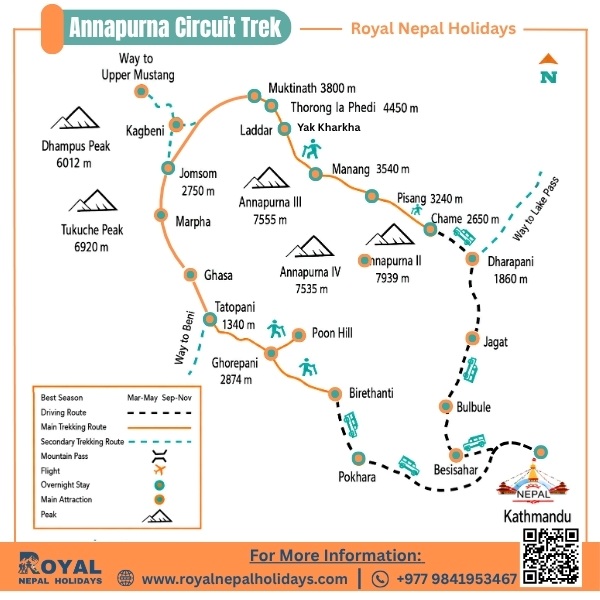
Route direction: Kathmandu – Besisahar – Chame – Manang – Thorong La Pass – Muktinath – Jomsom – Pokhara – Kathmandu Highest point: Thorong La Pass, 5,416 m Approximate trekking distance: Varies by exact road usage and side trips, generally in the 110–160 km range Accommodation: Hotel in Kathmandu and Pokhara; teahouse/lodge accommodation throughout the trekking section Transportation: Private vehicle or tourist jeep for road sections, on foot for the trekking sections
We don't just say we offer "the best service" — every item above is something our team actually does on this trek, from the way we schedule acclimatization to the way we brief you before departure.
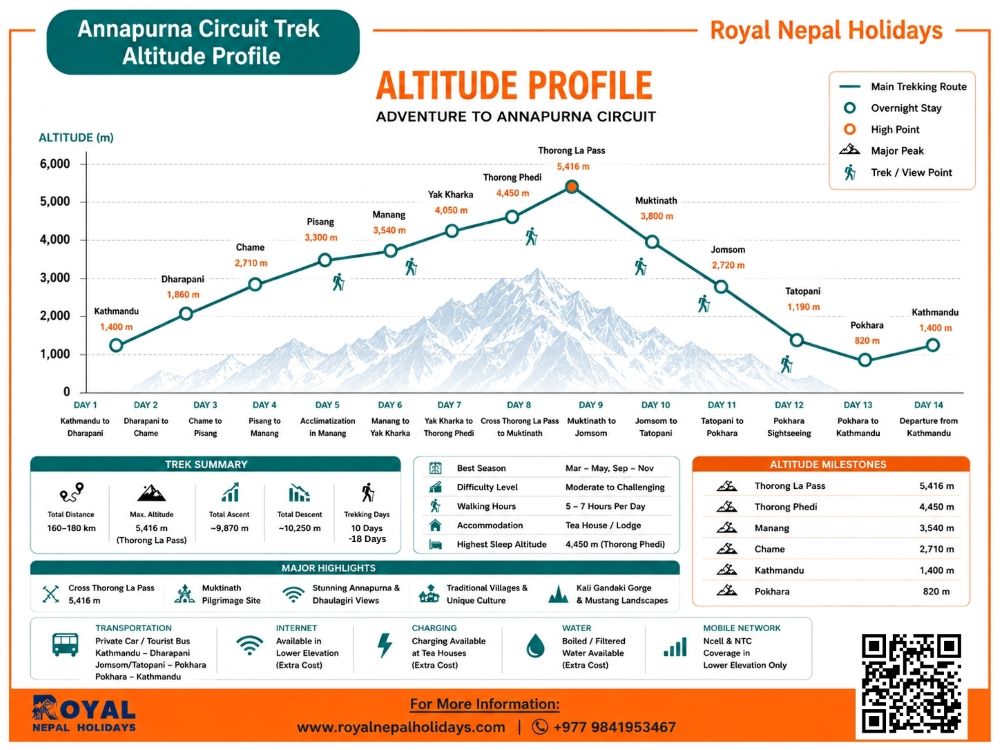
The Annapurna Circuit Trek gradually climbs from Kathmandu at 1,400 m to the highest point, Thorong La Pass at 5,416 m, before descending through Muktinath, Jomsom, Tatopani and Pokhara. The profile highlights the major altitude changes, acclimatization point at Manang (3,540 m), and the challenging Thorong La crossing.
Altitude: 1,860 m
Driving Duration: Approximately 7–9 hours
Accommodation: Teahouse/Lodge
Meals: Breakfast, Lunch & Dinner
Your Annapurna Circuit adventure begins early in the morning with a scenic drive from Kathmandu toward Besisahar. The journey follows the Prithvi Highway before continuing along the Marsyangdi River valley. As you travel westward, the landscape gradually changes from busy urban areas and agricultural settlements to green hills, waterfalls and mountain valleys.
After reaching Besisahar, continue by local/private 4WD transportation toward Dharapani, depending on current road conditions. Dharapani is a traditional mountain settlement and the gateway to the higher Annapurna region.
Overnight at Dharapani.
Altitude: 2,710 m
Trekking Duration: 5–6 hours
Distance: Approximately 15 km
Accommodation: Teahouse/Lodge
Meals: Breakfast, Lunch & Dinner
After breakfast, begin trekking through the beautiful Marsyangdi Valley. The trail passes through pine and fir forests and several traditional villages. You will gradually gain elevation as the Himalayan scenery becomes more impressive.
The route passes through Bagarchhap, Danaque and Timang, where you can enjoy views of Lamjung Himal, Annapurna II and other surrounding peaks.
Continue toward Chame, the administrative center of Manang District. Chame is known for its mountain views, traditional houses and natural hot springs.
Overnight at Chame.
Altitude: 3,300 m
Trekking Duration: 5–6 hours
Distance: Approximately 13 km
Accommodation: Teahouse/Lodge
Meals: Breakfast, Lunch & Dinner
Today's trail follows the Marsyangdi River through a dramatic mountain landscape. The valley gradually becomes narrower, with impressive cliffs and forests surrounding the trail.
You cross several suspension bridges and pass through Bhratang, a settlement famous for its apple products. From here, the landscape changes noticeably as you enter the drier upper Manang region.
Continue toward Pisang, where the spectacular peaks of Annapurna II, Annapurna III and Pisang Peak become increasingly prominent.
Depending on the route and weather, you may have the opportunity to explore Upper Pisang and its traditional monastery.
Overnight at Pisang.
Altitude: 3,540 m
Trekking Duration: 5–7 hours
Distance: Approximately 15 km
Accommodation: Teahouse/Lodge
Meals: Breakfast, Lunch & Dinner
Today is one of the most scenic days of the trek. You have two possible routes from Pisang toward Manang. The upper route through Ghyaru and Ngawal is more challenging but offers magnificent panoramic views of the Annapurna range.
The trail passes through traditional Tibetan-influenced villages and dry alpine landscapes. As you approach Manang, you will notice the dramatic transition from forested valleys to high-altitude terrain.
Manang is one of the largest settlements in the region and an important acclimatization point.
After arriving, take some time to explore the village and enjoy views of Annapurna II, Annapurna III, Gangapurna and other surrounding peaks.
Overnight in Manang.
Altitude: 3,540 m
Hiking Duration: 3–5 hours, optional
Accommodation: Teahouse/Lodge
Meals: Breakfast, Lunch & Dinner
Today is dedicated to acclimatization. Rather than remaining completely inactive, a short hike is recommended to help your body adjust to the increasing altitude.
Depending on your fitness and weather conditions, you can hike toward Gangapurna Lake, Praken Gompa or nearby viewpoints.
The day also provides an opportunity to experience local life in Manang. Visit the old village, monasteries and local shops, or simply relax while enjoying the Himalayan scenery.
Your guide will monitor your condition and provide advice about altitude, hydration and the following days of trekking.
Overnight in Manang.
Altitude: 4,050 m
Trekking Duration: 4–5 hours
Distance: Approximately 10 km
Accommodation: Teahouse/Lodge
Meals: Breakfast, Lunch & Dinner
Leave Manang and continue toward the higher alpine region. The vegetation becomes increasingly sparse as you gain altitude.
The trail passes through Tengi and Gunsang before continuing toward Yak Kharka. The views of Gangapurna, Annapurna III and surrounding mountains remain impressive throughout the journey.
Because you are now above 4,000 meters, the pace becomes slower and steady. Take regular breaks, drink plenty of water and follow your guide's recommendations.
Yak Kharka is a small settlement surrounded by dramatic Himalayan landscapes.
Overnight at Yak Kharka.
Altitude: 4,450 m
Trekking Duration: 4–5 hours
Distance: Approximately 8 km
Accommodation: Teahouse/Lodge
Meals: Breakfast, Lunch & Dinner
Today's trek is relatively short but takes you to a significantly higher altitude.
Follow the trail toward Thorong Phedi, the base area for crossing Thorong La Pass. The route follows the eastern side of the valley with increasingly rugged and barren surroundings.
You may pass through Ledar before reaching Thorong Phedi. Depending on trail and accommodation conditions, your guide may recommend staying at Thorong Phedi or, where appropriate, continuing toward High Camp.
Spend the afternoon resting and preparing for the early start the following morning.
Overnight at Thorong Phedi.
Altitude: 5,416 m at Thorong La Pass
Trekking Duration: 7–9 hours
Accommodation: Teahouse/Lodge
Meals: Breakfast, Lunch & Dinner
Today is the most challenging and rewarding day of the Annapurna Circuit Trek.
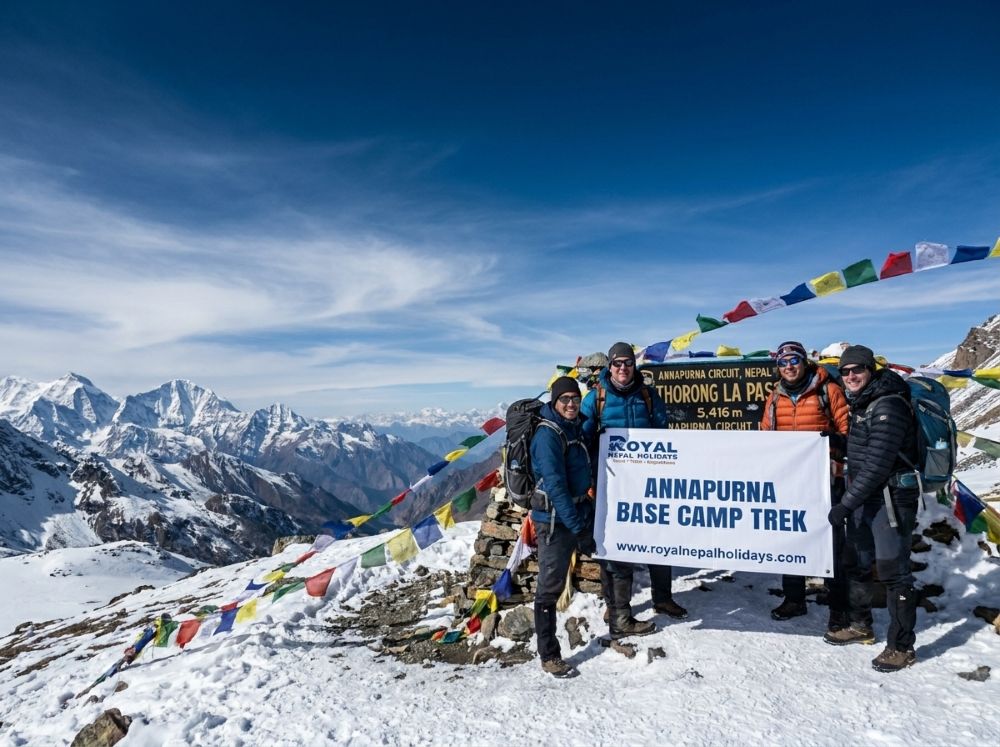
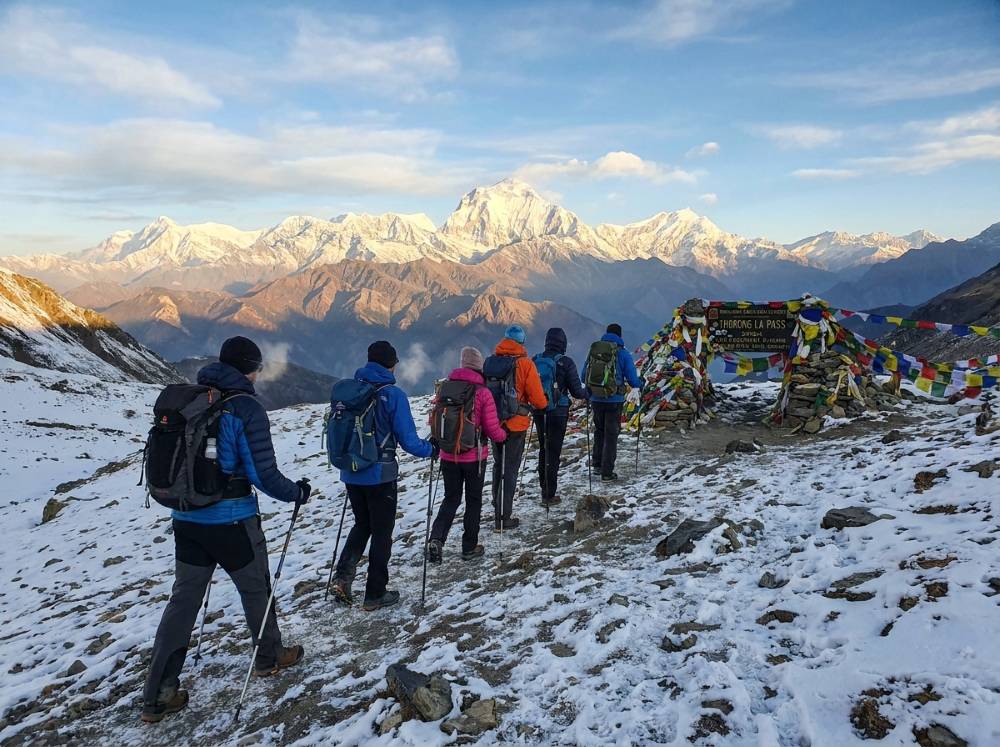
Start very early in the morning to cross Thorong La Pass at 5,416 meters (17,769 feet). The ascent is gradual but demanding because of the high altitude and cold conditions.
Your guide will set a comfortable pace with regular rest breaks. As you approach the pass, the surrounding landscape becomes increasingly spectacular.
After reaching Thorong La, celebrate the achievement and enjoy panoramic views of the Himalayan landscape before beginning the long descent toward Muktinath.
The descent is steep in places and can be tiring on the knees. Gradually, the landscape changes as you enter the drier Mustang region.
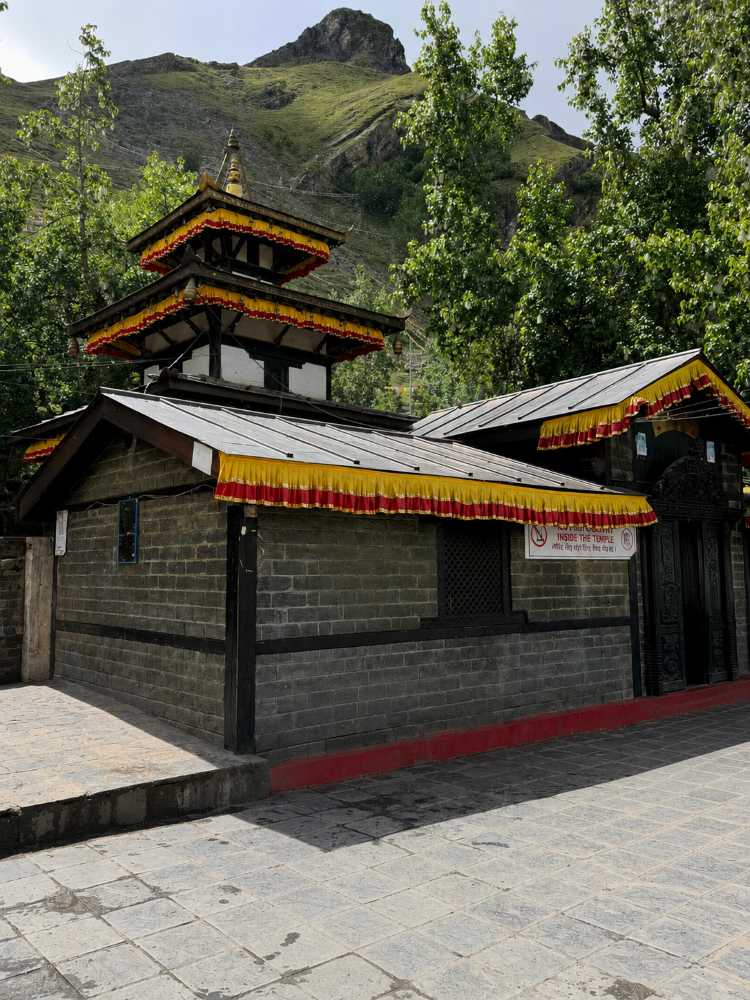
Muktinath is an important pilgrimage destination for both Hindus and Buddhists. After arriving, rest and explore the area if time and energy permit.
Overnight in Muktinath.
Altitude: 2,720 m
Trekking/Driving: Approximately 5–6 hours depending on transportation
Accommodation: Teahouse/Lodge
Meals: Breakfast, Lunch & Dinner
After breakfast, explore Muktinath before continuing toward the Kali Gandaki Valley.
You can visit the Muktinath Temple area, including the sacred water spouts and surrounding religious sites.
Continue toward Kagbeni, an ancient settlement with narrow alleys, traditional houses and strong Tibetan cultural influence. The village is also an important gateway toward Upper Mustang.
Continue to Jomsom, the administrative center of Mustang. The landscape here is markedly different from the green valleys on the eastern side of the circuit, with barren cliffs, strong winds and dramatic mountain scenery.
Depending on road conditions and the chosen itinerary, part of today's journey may be completed by 4WD transportation.
Overnight in Jomsom.
Altitude: 1,190 m
Driving Duration: Approximately 5–7 hours
Accommodation: Teahouse/Lodge
Meals: Breakfast, Lunch & Dinner
Today you descend significantly in elevation as you travel through the Kali Gandaki Valley.
The route passes through dramatic landscapes beneath the towering Dhaulagiri and Annapurna ranges. The environment gradually changes from dry high-altitude terrain to greener valleys.
Continue toward Tatopani, a famous settlement known for its natural hot springs.
After reaching Tatopani, relax and, if conditions permit, enjoy a refreshing soak in the natural hot springs after several demanding days in the mountains.
Overnight in Tatopani
Altitude: 822 m
Driving Duration: Approximately 5–7 hours
Accommodation: Hotel
Meals: Breakfast & Lunch
After breakfast, continue the scenic journey toward Pokhara.
The road follows the lower Kali Gandaki region through lush hills, villages, waterfalls and terraced farmland. As you descend further, the Himalayan climate becomes warmer and more humid.
Arrive in Pokhara, the beautiful lakeside city and one of Nepal's most popular tourist destinations.
After checking into your hotel, enjoy a well-deserved rest or explore the Lakeside area around Phewa Lake.
Overnight in Pokhara.
Altitude: 822 m
Sightseeing Duration: 5–6 hours
Accommodation: Hotel
Meals: Breakfast
Enjoy a relaxed sightseeing day in Pokhara after completing the high-altitude portion of the Annapurna Circuit.
Depending on your interests and available time, visit attractions such as:
You can also enjoy an optional boating experience on Phewa Lake.
The day provides an excellent opportunity to relax, enjoy good food and reflect on your Annapurna Circuit adventure.
Overnight in Pokhara.
Altitude: 1,400 m
Driving Duration: Approximately 6–8 hours
Accommodation: Hotel
Meals: Breakfast
After breakfast, depart Pokhara for Kathmandu by tourist bus or private vehicle.
The journey follows the scenic Prithvi Highway alongside rivers, hills and rural settlements. On arrival in Kathmandu, check into your hotel.
The rest of the day is free for shopping, relaxation or exploring Thamel.
Overnight in Kathmandu.
Meals: Breakfast
Your Annapurna Circuit Trek – 14 Days officially concludes today.
Depending on your international flight schedule, our representative will transfer you to Tribhuvan International Airport for your onward journey.
If you are staying longer in Nepal, Royal Nepal Holidays can also arrange additional tours, trekking packages, airport transfers or customized travel arrangements.
Farewell to Nepal, and we hope to welcome you again for another Himalayan adventure!
Are you interested on planning custom trip? It only takes 2 minutes.
| Group Size | Recommended Price |
|---|---|
| 1 Pax | US$1,499 |
| 2 Pax | US$1,299 pp |
| 3–6 Pax | US$1,199 pp |
| 7–10 Pax | US$1,099 pp |
| 11–15 Pax | US$999 pp |
These are good add-ons to display on the Royal Nepal Holidays booking page:
| Add-on | Recommended Option |
|---|---|
| Private Trek Upgrade | Private guide and porter arrangement |
| Single Room Upgrade | Single room in Kathmandu, Pokhara & available teahouses |
| Luxury Hotel Upgrade | Upgrade selected Kathmandu/Pokhara accommodation |
| Private Jeep Transportation | Private 4WD for selected road sections |
| Kathmandu Airport Transfer | Private arrival/departure transfer |
| Pokhara Sightseeing | Private sightseeing with vehicle and guide |
| Sarangkot Sunrise Tour | Early morning private tour |
| Tilicho Lake Extension | Add Tilicho Lake to the Annapurna Circuit |
| Extra Kathmandu Night | Additional hotel night with breakfast |
| Extra Pokhara Night | Additional hotel night with breakfast |
| Porter Upgrade | Additional porter service for heavier luggage |
| Trekking Gear Rental | Sleeping bag, down jacket and selected trekking equipment |
| Helicopter Emergency Evacuation | Available when medically required and covered/approved by insurance |
| Private Guide Upgrade | Dedicated guide for couples, families or private groups |
Response Time 0-2 Hours , Response Rate 100%
Trekkers often ask for a single distance figure, but the honest answer is that it depends on the route taken. The total distance of a 14-day Annapurna Circuit itinerary generally falls in the 110 to 160 km range, and it varies according to:
Rather than quoting one number as if every Annapurna Circuit itinerary is identical, Royal Nepal Holidays will confirm the exact day-by-day distances for your specific departure once your route is finalized.
At 5,416 meters (17,769 feet), Thorong La Pass is the highlight and the single biggest physical challenge of the Annapurna Circuit. The crossing typically begins from Thorong Phedi or High Camp with a pre-dawn departure, since winds on the pass tend to strengthen through the late morning and afternoon. The climb from Phedi or High Camp to the pass takes roughly four to six hours depending on conditions and pace, followed by a long, steep descent of over four hours to Muktinath.
Weather on the pass can change quickly, and temperatures well below freezing are normal even outside the winter months. Snow, ice, and strong wind are all possible even in the recommended trekking seasons. This is exactly why the days leading up to the crossing are built around gradual altitude gain and one full acclimatization day in Manang — arriving at Thorong Phedi already well-acclimatized is the single biggest factor in a safe, comfortable crossing. Our guides carry basic first-aid and oximeters to monitor the group, and they make the final call on timing and pacing based on real-time weather and everyone's condition.
The honest difficulty rating for this trek is moderate to challenging. It is not a technical trek requiring climbing skills or specialized equipment, but it should not be marketed as easy either. Several factors combine to make it demanding:
Trekkers who prepare with regular cardio and hiking training in the months before departure, and who take acclimatization seriously, generally find the trek very manageable. Those who arrive unprepared or try to rush the itinerary are the ones who struggle.
Altitude is the single biggest safety factor on the Annapurna Circuit, and it deserves its own explanation rather than a footnote. The Nepal Tourism Board's mountain-safety guidance recommends gradual increases in sleeping altitude above 2,500 m, with a rest day built in after roughly every 1,000 meters of elevation gain, and our itinerary is built around that principle.
The dedicated acclimatization day in Manang (Day 6) is the centerpiece of this approach. Rather than resting completely, trekkers are encouraged to take a guided day hike above the village — commonly toward Gangapurna Lake or one of the nearby viewpoints above 3,900 m — before returning to sleep at Manang's lower altitude. This "climb high, sleep low" pattern is one of the most effective ways to reduce the risk of Acute Mountain Sickness.
Signs of altitude illness to watch for include persistent headache, nausea, dizziness, loss of appetite, and unusual fatigue. Mild symptoms are common and usually resolve with rest, hydration, and slower pacing; symptoms that worsen or include confusion, severe headache, or difficulty breathing at rest require immediate descent. Your guide is trained to recognize these signs and will not hesitate to adjust the schedule, arrange descent, or coordinate evacuation if needed. Staying well hydrated, avoiding alcohol at altitude, and communicating honestly with your guide about how you feel are the most important things you can do.
| Season | Months | Recommendation |
|---|---|---|
| Spring | March–May | Excellent |
| Summer/Monsoon | June–August | Less ideal on many sections |
| Autumn | September–November | Excellent |
| Winter | December–February | Cold, high-pass challenges |
Spring and autumn are the two recommended trekking seasons for the Annapurna region, offering the most stable weather and clearest mountain views.
Annapurna Circuit Trek in March: Early spring brings blooming rhododendrons in the lower valleys and generally stable weather, though nights near Thorong La remain very cold.
Annapurna Circuit Trek in April: One of the most popular months, with warmer days, longer daylight, and excellent visibility on clear days.
Annapurna Circuit Trek in May: Late spring can bring haze and occasional pre-monsoon showers, but trails are quieter and lodges less crowded than peak April.
Annapurna Circuit Trek in September: The tail end of monsoon; trails are green and lush, though early-month rain is still possible in the lower valleys.
Annapurna Circuit Trek in October: The single most popular month for the circuit, with the clearest skies, stable weather, and the busiest teahouses.
Annapurna Circuit Trek in November: Consistently clear and cold, with excellent mountain visibility, though nights near the pass are significantly colder than October.
Winter trekking is possible for well-prepared, experienced trekkers, but Thorong La can close temporarily after heavy snowfall, and cold-related risk increases significantly. Monsoon season brings the added risks of slippery trails, leeches in the lower forested sections, and cloud cover that can obscure mountain views, though the upper Manang and Mustang sections sit in a rain shadow and see less rainfall than the lower valley.
Royal Nepal Holidays prices this 14-day Annapurna Circuit Trek according to group size, with better per-person rates for larger groups and a straightforward private option for solo travelers.
| Group Size | Recommended Price |
|---|---|
| 1 Pax | US$1,499 |
| 2 Pax | US$1,299 pp |
| 3–6 Pax | US$1,199 pp |
| 7–10 Pax | US$1,099 pp |
| 11–15 Pax | US$999 pp |
Private departures are available on any preferred date, and custom itineraries can be arranged on request.
What is included?
What is not included?
Additional and optional costs to budget for:
| Item | Approximate Cost |
|---|---|
| Hot shower | US$1–4 per shower |
| Device charging | US$1–3 per charge |
| Wi-Fi | US$2–5 per day |
| Bottled/boiled water | US$1–4 per liter, increasing with altitude |
| Snacks and extra drinks | US$3–8 per day |
| Laundry | Limited service, US$2–5 per load |
| Guide and porter tips | Customary, typically US$8–12 per trekker per day combined, at your discretion |
These figures are indicative and can vary by teahouse and season. Our guides can advise on realistic daily budgets once you're on the trail.
Two permits are required for this trek:
ACAP (Annapurna Conservation Area Permit): Required for entry into the Annapurna Conservation Area, which the entire circuit passes through. Fees support conservation and community development in the region.
TIMS Card (Trekkers' Information Management System): A safety and tracking document required for trekkers in the Annapurna region. The Nepal Tourism Board currently lists the Annapurna Circuit among routes that require both a guide and an agency-issued TIMS card.
Who arranges them?
Royal Nepal Holidays arranges both the ACAP permit and the TIMS card on your behalf as part of your package through the appropriate registered process — you simply provide passport details and photos in advance. Permit fees are updated periodically by the relevant authorities, so we always confirm current pricing at the time of booking rather than relying on outdated figures.
In Kathmandu: A comfortable, centrally located hotel in the Thamel area, typically 3-star or equivalent, on a bed-and-breakfast basis. Upgrades to boutique or higher-category hotels can be arranged on request.
On the trekking route: Teahouses and lodges run by local families, offering twin-sharing rooms with basic furnishings. Rooms are simple — typically a bed, blanket, and small table — and shared bathrooms are the norm, though some lower-altitude lodges offer attached bathrooms. Hot showers are usually available for an extra charge, generated by gas or solar heating, and can be limited or unavailable at the highest elevations such as Thorong Phedi or High Camp. Electricity is generally available for charging at a fee. Wi-Fi is increasingly common but slower and less reliable as you climb higher. Dining rooms are typically heated by a central stove in the evening and double as the social hub of each teahouse. We do not promise luxury facilities at high altitude — conditions become simpler the higher you go, and that's part of the authentic teahouse trekking experience.
Teahouse menus along the Annapurna Circuit are more varied than many trekkers expect, though choices narrow somewhat at higher elevations. Typical options include:
Vegetarian food is widely available and often recommended at altitude for easier digestion. Vegan and other dietary requirements can usually be accommodated with advance notice to your guide, though options become more limited the higher you climb. Let us know about any dietary restrictions when booking so your guide can plan accordingly.
Understanding exactly where you drive and where you walk is one of the most useful things we can tell you before booking, since many generic itineraries leave this vague.
Kathmandu to Chame: Covered entirely by private vehicle or jeep on Day 3 — this is the section of the "classic" full-walking circuit that has been progressively opened to road access over the past decade, and almost no commercial 14-day itinerary walks it in full anymore.
Chame to Thorong La to Muktinath: Walked in full, on foot, over five to six days — this is the heart of the trekking experience and includes the pass crossing itself.
Muktinath to Jomsom: A combination of walking and a short jeep transfer, depending on time and preference.
Jomsom to Pokhara: Either continued walking/jeep travel through Tatopani, or a direct jeep transfer, or a scenic mountain flight, depending on the option selected for your departure.
Pokhara to Kathmandu: By tourist bus, private vehicle, or a short domestic flight.
We're upfront about this because current itineraries across the industry vary considerably in how they present road versus walking sections, and we'd rather you know exactly what a 14-day version of this trek actually involves before you commit.
Clothing
Footwear
Sleeping Equipment
Backpack
Documents
Electronics
Personal Medicine
Water and Hydration
Trekking Accessories
A detailed, downloadable packing checklist is available on request from our team.
Comprehensive travel insurance that specifically covers high-altitude trekking up to at least 5,500 meters, including helicopter evacuation, is required for this trek. Standard travel insurance policies often exclude high-altitude activities, so please check your policy carefully before departure.
In the event of a medical emergency, your guide will assess the situation, coordinate descent where possible, and contact our Kathmandu office to arrange helicopter evacuation if needed. Evacuation and related medical costs are the responsibility of your insurance provider — we do not include evacuation costs in the trek price, and we do not claim that evacuation is automatically covered by booking with us. Our office maintains contact with your guide throughout the trek via phone or satellite communication where mobile coverage is unavailable, and we keep a contingency plan in place for weather delays, route changes, or medical situations.
Electricity for charging phones, cameras, and power banks is available at most teahouses along the route, typically for a small per-device fee that increases with altitude. Carrying a power bank charged in advance is a smart backup for the higher, more remote nights.
Wi-Fi is available at many teahouses for an additional daily or per-use fee, though speed and reliability drop noticeably above Manang. A local Nepali SIM card or eSIM with data can provide better connectivity in villages with mobile network coverage, though signal becomes patchy or disappears entirely near Thorong Phedi, High Camp, and the pass itself. Don't plan on reliable connectivity for the two days surrounding the pass crossing.
Carry sufficient Nepalese cash before starting the trek. ATMs are available in Kathmandu, Pokhara, and Besisahar, but become limited or unreliable once you're on the trekking route — Chame and Jomsom have occasional ATM access, but machines can be out of service or out of cash, so treat them as a backup rather than a plan. Withdraw enough cash before entering the higher sections of the route to comfortably cover meals not included in your package, hot showers, charging, Wi-Fi, snacks, drinks, and tips for your guide and porter. Small denomination notes are more useful than large ones in remote teahouses.
This 14-day itinerary does not include the side trip to Tilicho Lake, one of the highest lakes of its size in the world at over 4,900 meters. Want to visit Tilicho Lake as part of your trip? Ask Royal Nepal Holidays about our extended Annapurna Circuit with Tilicho Lake itinerary, which adds two to three additional days from Manang before rejoining the main circuit route toward Thorong La.
Yes, beginners can complete the Annapurna Circuit Trek, but genuine preparation matters. This is not a trek to attempt on a whim. We recommend:
We won't tell you that everyone can do this trek without effort — some days are genuinely demanding — but with preparation, a realistic pace, and proper acclimatization, most reasonably fit beginners complete it successfully.
Royal Nepal Holidays is a Kathmandu-based trekking and travel company operating out of Thamel, under the direction of owner Sushil Tiwari. Our strengths on this trek come down to a few concrete things:
Meet our trekking team: Guides including Bashu, Chandra, and Uttam lead our Annapurna departures, each licensed and experienced across the region's major routes. Visit our team page to learn more about the guides who could be leading your trek.
Royal Nepal Holidays asks all trekkers to help protect the Annapurna Conservation Area for the communities and environment that depend on it:
| Duration | Best For |
|---|---|
| 10 Days | Travelers with limited time |
| 12 Days | A faster, more compressed itinerary |
| 14 Days | Balanced, flagship itinerary — our recommended standard |
| 16 Days | A more relaxed pace with room for side trips |
| 18–21 Days | The longer, more classic full-walking experience |
The 14-day format is one of the most commonly offered commercial versions of the Annapurna Circuit, balancing a manageable trip length with proper acclimatization time and the flexibility to add side trips like Tilicho Lake for trekkers who want them.
The Annapurna Circuit Trek is a long-distance Himalayan trek in Nepal that loops around the Annapurna massif, crossing the Thorong La Pass at 5,416 meters and passing through the Manang and Mustang regions.
The duration varies by route and transportation choices, but 14 days is one of the most widely offered commercial formats for the circuit, balancing time, acclimatization, and cost.
The highest point is Thorong La Pass, at 5,416 meters (17,769 feet).
Excellent
Most commercial itineraries run between 10 and 21 days depending on route and transportation choices. Royal Nepal Holidays' standard package is 14 days, which balances a complete, safe itinerary with a manageable trip length.
Yes. A 14-day itinerary covers the full route, including proper acclimatization in Manang and the Thorong La crossing, by using road transportation on the lower sections that are largely motorable today.
It is rated moderate to challenging, involving sustained high altitude, long walking days around the pass crossing, and steep ascents and descents, but it does not require technical climbing skills.
The highest altitude reached is 5,416 meters at Thorong La Pass.
Thorong La Pass sits at 5,416 meters (17,769 feet) above sea level.
October is generally considered the best single month, offering the clearest skies and most stable weather, though the broader March–May and September–November windows are both recommended.
Pricing depends on group size, starting from US$999 per person for groups of 11–15 up to US$1,499 for a solo traveler on a private departure. See the cost table above for full details.
With a licensed guide, a properly paced acclimatization schedule, and appropriate insurance, the trek is safe for most reasonably fit trekkers. The main risks are altitude-related and are actively managed throughout the itinerary.
Yes. Current Nepal Tourism Board regulations require a licensed guide and an agency-issued TIMS card for trekkers on this route.
Yes, a TIMS card is a mandatory safety and tracking document for this trek, arranged by Royal Nepal Holidays as part of your package.
You need the Annapurna Conservation Area Permit (ACAP) and a TIMS card, both arranged by our office before your trek begins.
Yes, with genuine physical preparation, some prior hiking experience, and a willingness to follow the guide's pacing and acclimatization schedule.
Solo trekking without a guide is not permitted under current regulations, but solo travelers are very welcome to join as an individual private departure or a group trip with full guide support.
Many older trekkers complete this route successfully with good preparation and a realistic pace. We recommend a medical check-up before booking if you have any underlying health concerns.
Yes, at most teahouses for an additional fee, though it becomes slower and less reliable at higher elevations, especially near Thorong Phedi and High Camp.
Yes, most teahouses offer charging for a small fee, generally increasing with altitude.
Yes, though we recommend carrying a power bank as backup for the highest, most remote nights.
Cards are generally not accepted once you leave Kathmandu and Pokhara. Carry sufficient cash for the trekking days.
ATM access is limited and unreliable past Besisahar. Withdraw cash before entering the higher sections of the trek.
Teahouse menus include dal bhat, noodles, momos, soups, Tibetan bread, potatoes, eggs, and basic pasta dishes, with more variety at lower altitudes.
Yes, vegetarian options are widely available and often recommended for easier digestion at altitude.
Yes. This 14-day itinerary uses jeep or private vehicle transportation on the lower Marsyangdi valley section and offers a jeep option between Muktinath and Jomsom.
Yes, ask about our extended Annapurna Circuit with Tilicho Lake itinerary, which adds a side trip from Manang.
Your guide monitors symptoms throughout the trek and will adjust pace, arrange descent, or coordinate evacuation if symptoms worsen, based on standard high-altitude safety protocols.
Your guide will assess conditions and may delay the crossing, adjust the schedule, or, in rare cases, arrange an alternative route. Building in some schedule flexibility before your onward travel is a good precaution.
Yes, comprehensive travel insurance covering high-altitude trekking up to at least 5,500 meters, including helicopter evacuation, is required.
See our full packing list above, covering clothing, footwear, sleeping equipment, documents, electronics, medicine, and trekking accessories.
Yes, itineraries can be adjusted for extra acclimatization days, side trips like Tilicho Lake, alternate start and end points, or a different pace, on request at booking.
Response Time 0-2 Hours , Response Rate 100%
You may also like
Experience The Annapurna Base Camp Trek With Royal Nepal Holidays. Discover Detailed Itinerary, Cost, Route, Permits, Difficulty, Map, And Booking. View Details →
Join The 5 Days Annapurna Base Camp Trek From Pokhara With Royal Nepal Holidays. Reach ABC At 4,130m, Explore The Annapurna Sanctuary And Relax At Jhinu Danda Natural Hot Spring. View Details →
 7-9 Hours
 Lodge and Tea Houses
 Breakfast + Lunch + Dinner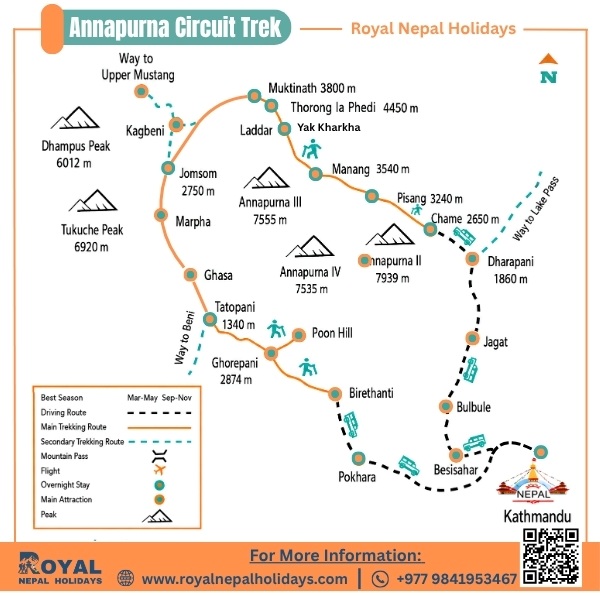




My First Himalayan Circuit Was Better Than I Imagined
The Annapurna Circuit Was My First Himalayan Trek, And I Was Impressed By How Much The Landscape Changed Throughout The Journey. From The Green Valleys Around Dharapani To The Dry Mountain Scenery Of Manang And Mustang, Every Few Days Felt Completely Different. The Acclimatization Day In Manang Was Particularly Helpful Before Heading Higher.
Crossing Thorong La Pass At 5,416 Meters Was The Biggest Challenge, But Chandra Prasad Puri Kept Our Pace Comfortable And Regularly Checked How We Were Feeling. He Also Explained The Local Villages, Mountains And Traditions Along The Way. Sushil Tiwari Was Very Helpful Before The Trek And Made The Arrangements Straightforward. The Combination Of Scenery, Culture And Careful Guidance Made This A Very Memorable Experience.
Excellent Organization From Kathmandu To Thorong La
What I Appreciated Most About Royal Nepal Holidays Was The Organization. Sushil Tiwari Communicated Clearly Before The Trek, And The Transportation, Permits, Accommodation And Guide Arrangements Were Handled Smoothly.
Uttam Timilsina Was An Excellent Companion On The Trail. He Understood That The Altitude Required Patience And Never Pushed Us Unnecessarily. The Gradual Ascent Through Chame, Pisang And Manang Made The Transition To Higher Elevations Much Easier To Manage. Thorong Phedi And The Crossing Of Thorong La Were Demanding, But Having An Experienced Guide Made A Big Difference.
The Route Itself Was Fantastic, Especially The Contrast Between The Annapurna Side And The Dry Landscapes Around Muktinath And Jomsom. Overall, It Was A Well-organized Trek With Very Good Local Support.
From Green Valleys To The High Desert Of Mustang
What Stayed With Me Most From The Annapurna Circuit Was The Changing Landscape. We Started Surrounded By Green Hills, Forests And Rushing Rivers, And Gradually Climbed Into The Much More Rugged World Around Manang. By The Time We Reached The Thorong La Region, The Scenery Felt Almost Otherworldly.
Standing At The Thorong La Pass At 5,416 Meters Was A Particularly Special Moment. The Cold Wind, Enormous Mountains And Sense Of Achievement Made The Long Climb Worthwhile. Chandra Prasad Puri Was Calm And Knowledgeable Throughout The Trek And Gave Us Plenty Of Information About The Places We Passed.
The Descent To Muktinath Brought Another Dramatic Change In Scenery, And I Especially Enjoyed The Atmosphere Around The Old Villages And Kali Gandaki Valley. Sushil Tiwari And The Royal Nepal Holidays Team Made The Arrangements Feel Easy From The Beginning.
A Well-Paced Circuit For A Solo Traveler
I Joined The Annapurna Circuit As A Solo Traveler, So Having Reliable Local Support Was Important To Me. From The First Communication With Sushil Tiwari, I Felt That The Arrangements Were Clear And Well Organized.
The Trek Had A Great Rhythm. There Were Challenging Walking Days, Relaxed Evenings In The Teahouses And Plenty Of Opportunities To Meet Other Trekkers Along The Route. I Particularly Enjoyed The Acclimatization Day In Manang Because It Gave Me Time To Explore Without Feeling Rushed.
Uttam Timilsina Was Very Practical And Attentive On The Trail. He Kept An Eye On Our Pace And Made Sure We Were Prepared For The Thorong La Crossing. Reaching The Pass And Then Descending Toward Muktinath Felt Like A Real Achievement. I Also Loved The Quieter Atmosphere Around Jomsom After The High-altitude Section. For A Solo Traveler, The Combination Of Independence And Local Support Worked Very Well.
Professional Service And An Incredible Annapurna Route
I Have Completed Mountain Treks In Several Countries, And The Annapurna Circuit Stands Out For Its Remarkable Variety. Within One Journey, You Experience Forests, Traditional Mountain Villages, High Alpine Terrain, Thorong La Pass And The Dry Landscapes Of Mustang.
Royal Nepal Holidays Handled The Logistics Professionally, And Communication With Sushil Tiwari Before The Trek Was Clear And Efficient. Chandra Prasad Puri Brought Strong Local Knowledge To The Trek And Was Particularly Helpful During The Higher-altitude Sections.
The Crossing Of Thorong La Was Certainly The Most Demanding Part, But The Preparation And Steady Pace Made It Manageable. I Also Appreciated The Cultural Side Of The Trek, Particularly Manang And Muktinath. The Route Offers Much More Than Mountain Views, And The Local Guidance Made The Experience Considerably Richer.