Trip Durations
18 Days

Quick Contact
4.9  | 18 Days | Kathmandu - Everest Base Camp & Island Peak - Kathmandu

The Everest Base Camp Trek with Island Peak Climbing is Royal Nepal Holidays' flagship 18-day adventure for trekkers who want more than a walk to base camp — they want to stand on top of a genuine Himalayan summit. This trip combines the world-famous trek through the Khumbu Valley to Everest Base Camp (5,364m) and Kala Patthar with a guided ascent of Island Peak, known locally as Imja Tse, which rises to 6,189 meters above the Chhukung Valley.
Rather than treating the two experiences as separate products stitched together, our 18-day itinerary is designed as a single progressive journey. The EBC portion builds altitude tolerance gradually through Namche Bazaar, Tengboche, Dingboche, and Lobuche before the trek reaches Everest Base Camp and the panoramic viewpoint at Kala Patthar. By the time our climbers turn toward Island Peak Base Camp, their bodies have already spent nearly two weeks adapting to thin air — a significant advantage over shorter Island Peak-only itineraries that compress acclimatization into a handful of days.
| Trip Facts | Details |
|---|---|
| Trip Name | Everest Base Camp Trek with Island Peak Climbing – 18 Days |
| Trip Type | Everest Base Camp Trek & Peak Climbing |
| Duration | 18 Days / 17 Nights |
| Difficulty | Challenging / Technical |
| Maximum Altitude | 6,189 m / 20,305 ft |
| Everest Base Camp Altitude | 5,364 m / 17,598 ft |
| Island Peak | 6,189 m / 20,305 ft |
| Peak Name | Island Peak (Imja Tse) |
| Trekking Region | Everest / Khumbu Region |
| National Park | Sagarmatha National Park |
| Best Season | March–May & September–November |
| Accommodation | Hotel, Tea House & Tented Camp |
| Meals | Breakfast, Lunch & Dinner |
| Trek Start | Lukla |
| Trek End | Lukla |
| Starting Point | Kathmandu, Nepal |
| Ending Point | Kathmandu, Nepal |
| Transportation | Domestic Flight & Trekking |
| Group Type | Private / Small Group |
| Group Size | 1–9+ Persons |
| Guiding Method | Licensed Trekking & Climbing Guide |
| Walking Duration | Approximately 3–9 hours per trekking day |
| Summit Day | Approximately 10–15 hours |
| Climbing Experience | Previous experience helpful; basic mountaineering training provided |
| Climbing Grade | Technical High-Altitude Peak |
| Peak Permit | Island Peak Climbing Permit Required |
| Trekking Permit | Sagarmatha National Park / Khumbu-area permits as applicable |
| Fitness Level | Good to Excellent |
| Accommodation During Climb | Tented Camp |
| Internet Access | Available at some tea houses for an additional fee |
| Electricity | Available at tea houses for an additional fee |
| Hot Shower | Available at selected tea houses for an additional fee |
| Emergency Support | Guide coordination & evacuation assistance |
| Travel Insurance | Mandatory / Strongly Required |
| Climbing Equipment | Personal & expedition equipment as specified in inclusions |
| Currency | USD |
| Trip Code | RNH-EBC-IP-18 |
| Private Departure | Available |
| Custom Departure | Available on Request |
Island Peak itself is not a technical rock or ice climb in the alpine sense, but it is genuine high-altitude mountaineering. Climbers cross a glacier, ascend a steep headwall using fixed ropes, and navigate an exposed summit ridge before reaching the top. Crampons, an ice axe, a climbing harness, and jumar are all used on summit day, and our climbing Sherpas fix ropes and manage the technical sections throughout.
Along the way, trekkers pass through Sherpa villages including Namche Bazaar, Khumjung, and Pangboche, visit the Tengboche Monastery, and walk beneath some of the highest peaks on Earth — Everest, Lhotse, Nuptse, and the iconic Ama Dablam. This is a trip that blends cultural immersion, high-altitude trekking, and technical peak climbing into one complete Himalayan experience, led by Royal Nepal Holidays' locally based guiding team out of Thamel, Kathmandu.
Whether you are an experienced trekker looking for your first 6,000-meter summit or a mountaineer seeking a well-organized, safety-first climb in the Everest region, this itinerary is built to get you to both Everest Base Camp and the summit of Island Peak with realistic pacing, proper acclimatization, and experienced climbing support at every stage.
Experience Everest Base Camp
Standing at the foot of the world's highest mountain, surrounded by the Khumbu Icefall and framed by Nuptse and Pumori, Everest Base Camp is one of trekking's genuine bucket-list moments. At 5,364m, it also serves as a crucial acclimatization milestone before the climbing phase begins.
Climb a 6,000-Meter Himalayan Peak
Island Peak gives trekkers with no prior mountaineering background a realistic, guided pathway to a legitimate Himalayan summit. Reaching 6,189m under the supervision of qualified climbing Sherpas is an achievement most travelers only dream about.
Better Acclimatization Through the EBC Route
Because the itinerary sends climbers through Namche, Tengboche, Dingboche, Lobuche, and Gorak Shep before the climb, the body has significantly more time to adjust to altitude than on Island Peak-only trips that fly in and climb within a week.
Experience Sherpa Culture and Khumbu Villages
The route passes through some of the most storied Sherpa communities in the world, offering monastery visits, prayer wheels, mani walls, and genuine mountain hospitality that no direct climbing expedition can replicate.
Learn Real Mountaineering Skills
Before summit day, our climbing guides run a full training session at Island Peak Base Camp covering crampon technique, ice axe use, jumaring on fixed rope, and basic rope safety — skills you will actually use on summit morning.
See Everest, Lhotse, Nuptse and Ama Dablam
From Kala Patthar and the Island Peak summit ridge, climbers get some of the most complete high-altitude panoramas in the Himalayas, including uninterrupted views of Everest's summit pyramid.
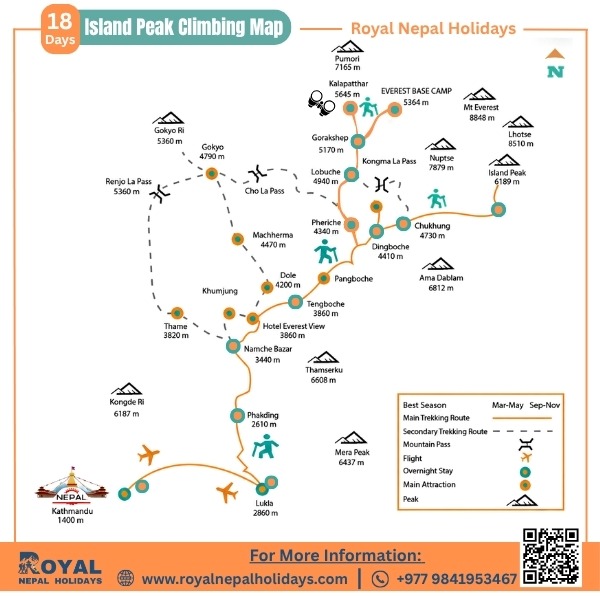
Route: Kathmandu → Lukla → Phakding → Namche Bazaar → Tengboche → Dingboche → Lobuche → Gorak Shep → Everest Base Camp → Kala Patthar → Dingboche/Chhukung → Island Peak Base Camp → Island Peak Summit → Chhukung → Namche Bazaar → Lukla → Kathmandu
| Location | Approx. Altitude |
|---|---|
| Kathmandu | 1,400 m |
| Lukla | 2,860 m |
| Phakding | 2,610 m |
| Namche Bazaar | 3,440 m |
| Everest View Hotel | 3,880 m |
| Tengboche | 3,860 m |
| Dingboche | 4,410 m |
| Nangkartshang Viewpoint | ~5,000 m |
| Lobuche | 4,940 m |
| Gorak Shep | 5,164 m |
| Everest Base Camp | 5,364 m |
| Kala Patthar | ~5,545 m |
| Chhukung | 4,730 m |
| Island Peak Base Camp | ~5,100 m |
| Island Peak Summit | 6,189 m |
The route follows a classic acclimatization pattern — steady gains in altitude broken up by rest and acclimatization days at Namche and Dingboche — before the trail branches from the main EBC route toward Chhukung and the Island Peak climbing zone.
The 18-day Everest Base Camp Trek with Island Peak Climbing begins in Kathmandu at 1,400 m and gradually ascends through Lukla, Namche Bazaar, Tengboche, Dingboche and Lobuche to Everest Base Camp at 5,364 m. After reaching Kala Patthar at approximately 5,545 m, the route continues toward Chhukung and Island Peak Base Camp before the ultimate ascent to Island Peak Summit at 6,189 m, the highest point of the journey. The trek then descends through Tengboche and Namche Bazaar to Lukla before returning to Kathmandu. Below is in Image:

| Day | Route | Max. Altitude |
|---|---|---|
| 1 | Arrival in Kathmandu | 1,400 m |
| 2 | Kathmandu – Lukla – Phakding | 2,860 m |
| 3 | Phakding – Namche Bazaar | 3,440 m |
| 4 | Acclimatization in Namche | ~3,880 m |
| 5 | Namche – Tengboche | 3,860 m |
| 6 | Tengboche – Dingboche | 4,410 m |
| 7 | Acclimatization in Dingboche | ~5,000 m |
| 8 | Dingboche – Lobuche | 4,940 m |
| 9 | Lobuche – Gorak Shep – EBC – Gorak Shep | 5,364 m |
| 10 | Kala Patthar – Dingboche | ~5,545 m |
| 11 | Dingboche – Chhukung | 4,730 m |
| 12 | Chhukung – Island Peak Base Camp | ~5,100 m |
| 13 | Island Peak Base Camp – Climbing Training | ~5,100 m+ |
| 14 | Island Peak Summit – 6,189 m – Chhukung | 6,189 m |
| 15 | Chhukung – Tengboche | 3,860 m |
| 16 | Tengboche – Namche | 3,440 m |
| 17 | Namche – Lukla | 2,860 m |
| 18 | Lukla – Kathmandu | 1,400 m |
Welcome to Nepal! Upon your arrival at Tribhuvan International Airport, a representative from Royal Nepal Holidays will meet you and transfer you to your hotel in Kathmandu.
After checking in, you can relax and recover from your journey. Depending on your arrival time, you may explore the nearby streets of Thamel.
In the evening, your trekking and climbing guide will conduct a detailed trip briefing. The team will review the itinerary, trekking conditions, altitude considerations, climbing equipment, safety procedures and the Island Peak summit plan.
Your climbing gear will also be checked to ensure that everything required for the expedition is ready.
Accommodation: Hotel in Kathmandu
Meals: Dinner
Activity: Airport transfer and expedition briefing
Early in the morning, take a scenic mountain flight toward Lukla, the gateway to the Everest region.
After landing at Lukla, meet the rest of the trekking crew and begin walking through the Dudh Koshi Valley.
The trail passes through small mountain settlements, stone walls, Buddhist prayer wheels and pine forests before reaching Phakding.
This is a relatively short first trekking day, allowing your body to begin adapting to the increasing altitude.
Trekking: Lukla – Phakding
Altitude: Lukla 2,860 m / Phakding 2,610 m
Walking: Approximately 3–4 hours
Accommodation: Tea house
Meals: Breakfast, Lunch & Dinner
Flight note: During busy trekking periods, Lukla flights may operate from Ramechhap/Manthali rather than Kathmandu depending on prevailing aviation arrangements.
After breakfast, continue along the Dudh Koshi River toward Namche Bazaar, the commercial and cultural center of the Khumbu region.
You will cross several suspension bridges and pass through Monjo, where the trail enters Sagarmatha National Park.
The trail gradually becomes steeper as you approach Namche. After crossing the famous Hillary Suspension Bridge, a sustained uphill climb through pine and rhododendron forests leads to Namche Bazaar.
On clear days, you may get your first distant views of Everest and other Himalayan peaks.
Trekking: Phakding – Monjo – Jorsalle – Namche
Altitude: 3,440 m / 11,286 ft
Walking: Approximately 5–6 hours
Accommodation: Tea house
Meals: Breakfast, Lunch & Dinner
Today is an important acclimatization day.
Rather than spending the entire day resting, we follow the principle of “climb high and sleep low.”
After breakfast, take a gradual hike toward the Everest View Hotel, located at approximately 3,880 m. From here, weather permitting, you can enjoy spectacular views of Everest, Lhotse, Nuptse, Ama Dablam and Thamserku.
You may also visit Khumjung Village and experience the traditional Sherpa way of life before returning to Namche.
The afternoon is reserved for rest, hydration and preparation for the higher elevations ahead.
Hiking: Everest View Hotel / Khumjung area
Maximum altitude: Approximately 3,880 m
Walking: Approximately 3–4 hours
Accommodation: Tea house in Namche
Meals: Breakfast, Lunch & Dinner
The trail leaves Namche and follows a scenic ridge with beautiful views of Everest, Ama Dablam, Lhotse and Nuptse.
After descending toward the Dudh Koshi River, cross the river at Phunki Tenga and begin climbing through beautiful rhododendron and pine forests.
The final ascent brings you to Tengboche, home to the famous Tengboche Monastery.
If timing permits, visit the monastery and observe the traditional Buddhist atmosphere of the Khumbu.
Trekking: Namche – Kyangjuma – Phunki Tenga – Tengboche
Altitude: 3,860 m / 12,664 ft
Walking: Approximately 5–6 hours
Accommodation: Tea house
Meals: Breakfast, Lunch & Dinner
After breakfast, descend through the forest toward Deboche and continue across the Imja Khola.
The trail passes through Pangboche and gradually enters the alpine landscape of the upper Khumbu.
As you approach Dingboche, the landscape becomes increasingly dry and rugged, with magnificent views of Ama Dablam, Island Peak and the surrounding Himalayan peaks.
Dingboche is an important acclimatization location before moving toward Everest Base Camp and Island Peak.
Trekking: Tengboche – Pangboche – Somare – Dingboche
Altitude: Approximately 4,410 m / 14,468 ft
Walking: Approximately 5–6 hours
Accommodation: Tea house
Meals: Breakfast, Lunch & Dinner
Another important acclimatization day is spent in Dingboche.
After breakfast, take a gradual hike toward Nangkartshang Peak/Viewpoint, reaching approximately 5,000 m depending on conditions and individual fitness.
This hike provides excellent views toward Makalu, Ama Dablam, Lhotse and Island Peak.
After spending some time at elevation, descend back to Dingboche for lunch and rest.
Your guide will also discuss the next stages of the expedition and assess how everyone is adapting to the altitude.
Hiking: Nangkartshang area
Maximum altitude: Approximately 5,000–5,083 m
Walking: Approximately 3–4 hours
Accommodation: Tea house
Meals: Breakfast, Lunch & Dinner
The use of Dingboche for acclimatization and a hike toward Nangkartshang is common in current EBC + Island Peak itineraries.
Today, the trail climbs toward the higher Everest region.
You pass through Dughla and climb the steep moraine section toward the terminal moraine of the Khumbu Glacier.
Along the way, you will encounter memorials dedicated to climbers and mountaineers who lost their lives in the Himalayas.
After reaching the top of the moraine, the trail becomes more gradual toward Lobuche.
The surrounding landscape is now distinctly alpine, with fewer trees and increasingly dramatic mountain scenery.
Trekking: Dingboche – Dughla – Lobuche
Altitude: Approximately 4,940 m / 16,207 ft
Walking: Approximately 5–6 hours
Accommodation: Tea house
Meals: Breakfast, Lunch & Dinner
Today is one of the most exciting days of the trek.
After breakfast, continue toward Gorak Shep, the last settlement before Everest Base Camp.
After a short break, continue along the Khumbu Glacier moraine toward Everest Base Camp.
The trail is rugged and undulating, and progress can be slow because of the high altitude.
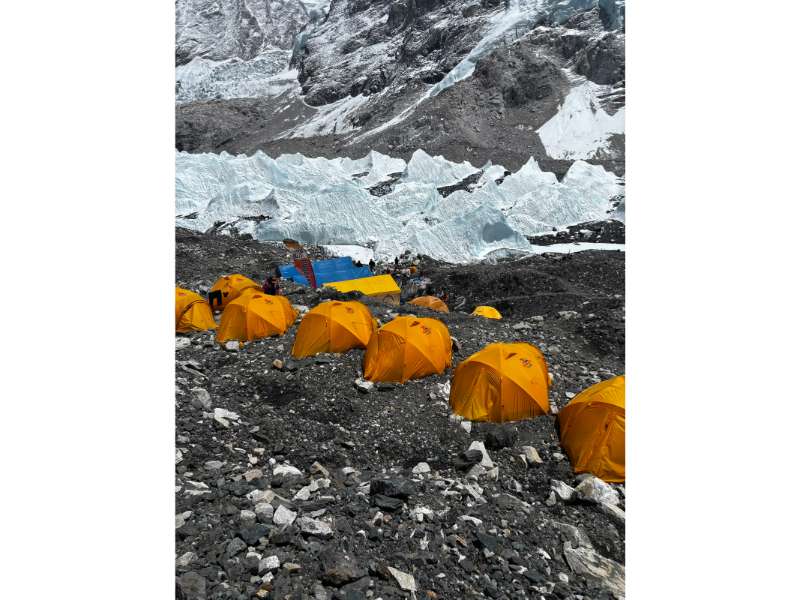
Upon reaching Everest Base Camp, celebrate this major achievement and take photographs of the surrounding Khumbu Glacier and mountains.
After spending time at Base Camp, return to Gorak Shep for the night.
Trekking: Lobuche – Gorak Shep – Everest Base Camp – Gorak Shep
Maximum altitude: 5,364 m / 17,598 ft
Walking: Approximately 7–9 hours
Accommodation: Tea house
Meals: Breakfast, Lunch & Dinner
Wake before dawn for the climb to Kala Patthar, one of the finest viewpoints in the Everest region.
The ascent is demanding because of the altitude, but reaching the viewpoint at sunrise provides an unforgettable panorama of Mount Everest, Nuptse, Lhotse, Pumori and the Khumbu Glacier.
After enjoying the mountain views, descend to Gorak Shep for breakfast.
Continue downhill toward Lobuche and eventually return to Dingboche.
The descent to a lower sleeping altitude is particularly valuable before the Island Peak climbing phase.
Trekking: Gorak Shep – Kala Patthar – Lobuche – Dingboche
Maximum altitude: Approximately 5,545–5,550 m
Walking: Approximately 7–9 hours
Accommodation: Tea house
Meals: Breakfast, Lunch & Dinner
Today we leave the main Everest Base Camp route and enter the Imja Valley toward Chhukung.
The walk is comparatively short, allowing the team to recover after the previous high-altitude days.
From Chhukung, you will have impressive views of Island Peak, Lhotse, Ama Dablam and surrounding peaks.
Your climbing guide will review the next stage of the expedition and prepare the team for Island Peak Base Camp.
Trekking: Dingboche – Chhukung
Altitude: 4,730 m / 15,518 ft
Walking: Approximately 3–4 hours
Accommodation: Tea house
Meals: Breakfast, Lunch & Dinner
Current EBC + Island Peak itineraries commonly use Chhukung as the staging point before moving toward Island Peak Base Camp.
Today marks the transition from trekking to mountaineering.
After breakfast, walk from Chhukung toward Island Peak Base Camp.
The trail gradually becomes more rugged as you approach the Imja Glacier and the mountain's moraine terrain.
Upon reaching Base Camp, our climbing crew will establish the tented camp and organize the climbing equipment.
In the afternoon, the climbing guide will conduct an orientation covering:
Trekking: Chhukung – Island Peak Base Camp
Altitude: Approximately 5,100–5,150 m
Walking: Approximately 4–5 hours
Accommodation: Tented camp
Meals: Breakfast, Lunch & Dinner
Today is dedicated to technical climbing preparation and final summit preparation.
Depending on weather, snow and route conditions, the climbing team may conduct practical training around Base Camp and, where appropriate, move toward higher ground.
You will practice using:
The climbing guide will explain the route, expected conditions and summit-day schedule.
Your equipment will be checked again, and the team will prepare clothing, climbing equipment, water and food for the early-morning summit attempt.
An early dinner and adequate rest are essential because summit day starts very early.
Maximum altitude: Approximately 5,100–5,600 m depending on training/conditions
Activity: Technical climbing training and preparation
Accommodation: Tented camp / High Camp as itinerary and conditions require
Meals: Breakfast, Lunch & Dinner
We commonly dedicate a pre-summit period to crampon, ice-axe and fixed-rope training before the summit attempt.
This is the most challenging and rewarding day of the expedition.
You will wake very early, usually around 1:00–3:00 AM, depending on weather, route conditions and the climbing team's assessment.
After a light meal, begin climbing under headlamp.
The route gradually moves onto glacial terrain. Your climbing guide will manage rope systems and technical sections according to the prevailing conditions.
The higher section includes steep snow/ice terrain and fixed-rope climbing. Crampons, harness and ascender techniques become essential.
After reaching the upper ridge, continue toward the summit of Island Peak (Imja Tse), 6,189 m.
From the summit, weather permitting, enjoy spectacular views toward Lhotse, Nuptse, Ama Dablam, Makalu, Baruntse and the surrounding Himalayan peaks.
After photographs and a short celebration, begin the long descent.
The descent requires as much concentration as the ascent because fatigue increases the risk of slips and mistakes.
Return to Base Camp/Chhukung according to conditions and the team's plan.
Summit: Island Peak / Imja Tse – 6,189 m
Walking/climbing: Approximately 10–15 hours
Accommodation: Tea house/camp according to the summit-day plan
Meals: Breakfast, Lunch & Dinner
Island Peak's summit involves genuine high-altitude climbing, including glacier travel and fixed-rope sections, so the exact route and timing depend on current mountain conditions and the climbing guide's assessment.
After successfully completing the Island Peak summit, begin the descent toward lower elevations.
The descent through the Imja Valley provides a welcome change after the demanding summit day.
Continue through Pangboche and onward toward Tengboche.
Reaching a lower altitude allows your body to recover after the high-altitude climbing phase.
Trekking: Chhukung – Pangboche – Tengboche
Altitude: Approximately 3,860 m
Walking: Approximately 6–7 hours
Accommodation: Tea house
Meals: Breakfast, Lunch & Dinner
After breakfast, descend through rhododendron and pine forests toward the Dudh Koshi Valley.
Cross Phunki Tenga and continue along the familiar trail toward Kyangjuma.
From Kyangjuma, the trail gradually climbs and descends toward Namche Bazaar.
Enjoy your final evening in the famous Sherpa town, where you can celebrate the completion of your Island Peak expedition with your trekking team.
Trekking: Tengboche – Phunki Tenga – Kyangjuma – Namche
Altitude: 3,440 m
Walking: Approximately 5–6 hours
Accommodation: Tea house
Meals: Breakfast, Lunch & Dinner
Today is the final full day on the Everest trekking trail.
The route descends from Namche toward Jorsalle and Monjo before following the Dudh Koshi River toward Phakding.
Continue through the forest to Lukla.
In the evening, enjoy a farewell gathering with your guides, porters and climbing team.
This is an opportunity to thank the local crew who supported you throughout the EBC and Island Peak adventure.
Trekking: Namche – Monjo – Phakding – Lukla
Altitude: Approximately 2,860 m
Walking: Approximately 6–7 hours
Accommodation: Tea house
Meals: Breakfast, Lunch & Dinner
After breakfast, transfer to Lukla Airport for your flight back to Kathmandu.
The short mountain flight provides one final aerial view of the Himalayas before returning to the capital.
Upon arrival in Kathmandu, our representative will assist with your transfer to the hotel or onward airport connection, depending on your travel arrangements.
If you have a late international flight, you can use the available time for shopping, relaxing or exploring Kathmandu.
Flight: Lukla – Kathmandu/Ramechhap depending on current operations
Flight duration: Approximately 35 minutes from Lukla to Kathmandu when operating directly
Meals: Breakfast
End of the Everest Base Camp Trek with Island Peak Climbing – 18 Days.
Are you interested on planning custom trip? It only takes 2 minutes.
Important: Travel insurance must cover high-altitude trekking, Island Peak climbing and emergency helicopter evacuation.
These are useful to display separately on your Royal Nepal Holidays page so customers can customize the trip.
| Add-On | Suggested Price |
|---|---|
| Kathmandu 4/5-Star Hotel Upgrade | USD 30–80/night |
| Single Room in Kathmandu | USD 30–60/night |
| Single Room During Trek | USD 30–50/night where available |
| Private Porter | USD 25–35/day |
| Additional Porter | USD 25–35/day |
| Lukla Helicopter Flight Upgrade | On Request |
| Kathmandu–Lukla Helicopter Charter | On Request |
| Private Airport Transfer | Included |
| Extra Kathmandu Night | USD 30–100/night |
| Climbing Gear Rental | USD 80–150/package depending on equipment |
| Sleeping Bag Rental | USD 2–5/day |
| Down Jacket Rental | USD 2–5/day |
| Extra Acclimatization Day | USD 50–100/person |
| Additional Guide | On Request |
| Private Vehicle for Kathmandu Sightseeing | On Request |
| Helicopter Rescue | As per actual cost/insurance |
| Emergency Evacuation Support | As per actual cost |
| Post-Trek Hotel Upgrade | On Request |
Note: Add-on prices should be treated as indicative and confirmed at the time of booking, particularly for helicopter services, gear rental and peak-season accommodation.
I recommend adding this section because it improves transparency and helps prevent customers from asking repeated questions.
| Expense | Recommended Budget |
|---|---|
| Nepal Visa | According to current immigration fee |
| Personal snacks/drinks | USD 5–15/day |
| Wi-Fi & charging | USD 2–10/day |
| Hot shower | USD 3–10 |
| Extra bottled water | USD 1–5/day |
| Tips | USD 100–200+ for the full trek, depending on service |
| Personal expenses | USD 100–250+ |
| Emergency reserve | USD 200–500+ |
I strongly recommend adding this table to your website because it prevents confusion about the climbing package.
| Equipment | Status |
|---|---|
| Climbing Rope | Provided by Company |
| Group Climbing Equipment | Provided |
| Crampons | Provided/Rental – Confirm at Booking |
| Ice Axe | Provided/Rental – Confirm at Booking |
| Climbing Harness | Provided/Rental – Confirm at Booking |
| Helmet | Provided/Rental – Confirm at Booking |
| Jumar/Ascender | Provided for Climbing Section |
| Carabiners | Provided as Required |
| Trekking Poles | Personal |
| Mountaineering Boots | Personal |
| Down Jacket | Personal / Rental Available |
| Sleeping Bag | Personal / Rental Available |
| Gloves | Personal |
| Goggles/Sunglasses | Personal |
| Headlamp | Personal |
| Technical Clothing | Personal |
Response Time 0-2 Hours , Response Rate 100%
Trek to Island Peak Base Camp
The approach to Base Camp follows the Imja Valley from Chhukung, gaining roughly 400m over moraine and glacial terrain. Base Camp sits at approximately 5,100m, with direct views of Island Peak's summit ridge.
Island Peak Base Camp Training
A dedicated training day is non-negotiable on this itinerary. Our climbing Sherpas walk every client through crampon fitting and walking technique, ice axe self-arrest basics, ascending and descending fixed rope with a jumar, and clipping in and out at anchor points — all skills used directly on summit day.
Island Peak Summit Day
Summit day begins in darkness, typically between midnight and 2 AM, to reach the summit and descend before afternoon weather deteriorates. Climbers cross a glacier roped together, reach Crampon Point where technical gear goes on, then ascend a steep snow-and-ice headwall secured by fixed ropes. Above the headwall, a narrow, exposed summit ridge leads to the top at 6,189m. The full round trip commonly takes 10–13 hours depending on group fitness, snow conditions, and weather.
Return from Island Peak
After summiting, climbers descend the same fixed-rope sections back to Base Camp, an experience that is often more physically demanding than the ascent due to accumulated fatigue. A hot meal and rest at Base Camp or Chhukung follow.
Contingency / Weather Day
Because Himalayan weather is unpredictable, our itinerary includes one full contingency day. If the first summit attempt is postponed by weather, this day allows a second attempt without forcing the group to rush the descent.
| Activity | Details |
|---|---|
| Trekking | Everest Base Camp route |
| Peak Climbing | Island Peak / Imja Tse |
| Summit Height | 6,189 m |
| Technical Training | Crampon, ice axe, harness, fixed-rope techniques |
| Major Viewpoints | Kala Patthar & Everest View Hotel |
| Major Landmark | Everest Base Camp |
| Main Climbing Area | Imja Valley |
| Climbing Base Camp | Island Peak Base Camp |
| Main Summit Challenge | High-altitude snow/ice climbing and fixed-rope sections |
| Culture | Sherpa villages & Buddhist monasteries |
| Major Peaks Seen | Everest, Lhotse, Nuptse, Ama Dablam, Makalu, Baruntse |
The EBC trekking portion is a non-technical but physically demanding walk, requiring good cardiovascular fitness and several consecutive days of 5–8 hour hiking at increasing altitude. The Island Peak climbing portion is a different category of challenge altogether: it involves glacier travel, fixed-rope ascent and descent, crampon and ice axe use, and a genuinely long, exposed summit day.
Prior technical mountaineering experience is not always mandatory for a fit, well-prepared climber joining a properly guided expedition. However, Island Peak should never be treated as "an easy walk-up." It involves real high-altitude climbing skills — glacier crossings, fixed-rope headwall climbing, and a long summit day at extreme altitude — and should only be attempted with qualified guides, proper training, and honest self-assessment of fitness and altitude tolerance. Our Base Camp training day exists specifically to prepare first-time climbers for these technical sections under close supervision.
Not strictly, but any prior experience with crampons, fixed ropes, or via ferrata-style climbing will make the Base Camp training day and summit day considerably easier and safer.
8–12 Week Fitness Preparation
We recommend starting a structured training plan at least two to three months before departure.
Cardio Training
Running, cycling, swimming, or stair-climbing three to four times per week to build aerobic base fitness for sustained multi-hour effort at altitude.
Strength Training
Leg and core strength work — squats, lunges, step-ups — to handle a loaded pack over long descents and the physical demands of summit day.
Hiking Training
Weekly hikes with a loaded backpack (8–10kg) on varied terrain, gradually increasing distance and elevation gain.
Stair Training
Repeated stair climbs with a pack are one of the most effective substitutes for mountain terrain if you live away from hills.
Altitude Preparation
Where possible, spend time at elevation before your trip, or use altitude training methods to familiarize your body with reduced oxygen.
Basic Mountaineering Skills
If available in your area, a one-day intro-to-mountaineering course covering crampon use, ice axe arrest, and rope basics is excellent preparation, though our Base Camp training day covers all essentials on-site.
| Day | Activity |
|---|---|
| Monday | Rest or light stretching |
| Tuesday | 45–60 min cardio |
| Wednesday | Strength training (legs/core) |
| Thursday | 45–60 min cardio |
| Friday | Rest |
| Saturday | Long hike with loaded pack (4–6 hours) |
| Sunday | Stair climbing or hill repeats |
Trekking Equipment: Trekking boots, trekking poles, daypack, sleeping bag (rated to -20°C), duffel bag
Climbing Equipment: Crampons, ice axe, climbing harness, jumar (ascender), figure-8 descender or ATC, locking and non-locking carabiners, climbing helmet, tape sling
Clothing: Down jacket, thermal base layers, fleece mid-layers, waterproof shell jacket and pants, insulated climbing gloves and liner gloves, warm hat and sun hat, gaiters
Sleeping Equipment: Four-season sleeping bag, sleeping bag liner, sleeping mat (provided at Base Camp)
Personal Items: Headlamp with spare batteries, sunglasses (glacier-rated), sunscreen, lip balm, water bottles/thermos, water purification tablets
Medical / First Aid: Personal medications, basic first-aid kit, Diamox (consult your doctor), blister care
Documents: Passport, visa, travel insurance details, passport photos, permits
Provided by Royal Nepal Holidays: Group climbing gear (fixed ropes, anchors, group first-aid and oxygen for emergencies), tents and camping equipment at Island Peak Base Camp, climbing permits, National Park entry permits
Client Should Bring: Personal climbing gear listed above (rental available in Kathmandu), personal clothing and trekking equipment, personal insurance
| Group Size | Recommended Price / Person | Positioning |
|---|---|---|
| 1 Pax | USD 2,699 | Competitive private expedition |
| 2 Paxes | USD 2,499 | Strong value |
| 3–6 Paxes | USD 2,199 | Best-selling target |
| 7–9 Paxes | USD 2,099 | Very competitive group rate |
Prices are per person in USD and subject to change based on season, group composition, and permit updates. Contact Royal Nepal Holidays for a current, itemized quote.
Lukla flights, Kathmandu and teahouse accommodation, meals during the trek, trekking guide and climbing guide fees, porter costs, Island Peak climbing permit, Sagarmatha National Park entry, local municipality fees, group climbing equipment, staff insurance and wages, Base Camp tented logistics, ground transportation, and a built-in contingency for weather delays.
Every climber requires several separate permits:
Permit pricing for Island Peak has changed in recent years, and many older listings online still show outdated figures. As of the most recent available guidance, NMA rates were reported at approximately USD 350 for spring and USD 175 for autumn, though these figures should always be confirmed directly with the relevant authority before finalizing your booking. Royal Nepal Holidays verifies and updates all permit costs before departure and includes them within your package price. Rules and permit procedures can change; we confirm the latest requirements before your departure.
For the Everest Base Camp trekking portion, Nepal's current TIMS (Trekkers' Information Management System) framework requires trekkers on routes including Everest Base Camp to trek with a licensed guide and an agency-issued TIMS card. Independent, unguided trekking on this route is not permitted under current regulations.
For Island Peak, the climb is never undertaken as an independent activity. It requires a valid climbing permit tied to a registered operator and a certified climbing guide, along with organized climbing logistics and safety support. Rules and permit procedures can change; Royal Nepal Holidays confirms the latest requirements before your departure.
| Month | EBC Conditions | Island Peak Conditions | Recommendation |
|---|---|---|---|
| March | Good | Good | Recommended |
| April | Excellent | Excellent | Highly Recommended |
| May | Excellent | Excellent | Highly Recommended |
| June | Monsoon begins | Poor | Not Recommended |
| July | Poor | Poor | Not Recommended |
| August | Poor | Poor | Not Recommended |
| September | Improving | Good later in month | Fair |
| October | Excellent | Excellent | Highly Recommended |
| November | Excellent | Excellent | Highly Recommended |
| December | Cold | Difficult | Not Recommended |
| January | Very Cold | Difficult | Not Recommended |
| February | Cold | Difficult | Fair, experienced climbers only |
Spring (March–May) and autumn (October–November) are consistently the strongest windows for both the EBC trek and the Island Peak summit attempt, offering the most stable weather and clearest skies.
| Location | Daytime Temp (Autumn/Spring) | Night Temp |
|---|---|---|
| Kathmandu | 20–25°C | 10–15°C |
| Namche Bazaar | 10–15°C | -2 to 5°C |
| Dingboche | 5–10°C | -10 to -5°C |
| Gorak Shep / EBC | 0–5°C | -15 to -10°C |
| Island Peak Base Camp | -5 to 0°C | -20 to -15°C |
| Island Peak Summit (pre-dawn) | -20 to -15°C with wind chill | — |
Weather directly shapes the whole trip: a delayed Lukla flight can shift the entire acclimatization schedule, and a poor forecast on the planned summit date is the most common reason the built-in contingency day gets used.
Two dedicated acclimatization days are built into this itinerary — at Namche Bazaar and Dingboche — following the well-established "climb high, sleep low" principle. Nepal's tourism authorities specifically caution against rushing acclimatization around Namche, and our schedule reflects that guidance. Beyond the scheduled rest days, our guides monitor hydration, oxygen saturation, and symptoms daily, and will adjust pace or, if necessary, descend a client showing signs of altitude sickness rather than pushing forward on schedule.
Acute Mountain Sickness (AMS) can affect trekkers and climbers at any altitude above roughly 2,500m, and risk increases significantly above 5,000m — putting both the EBC and Island Peak legs of this trip within range. Common symptoms include headache, nausea, dizziness, and disturbed sleep; more serious symptoms (confusion, severe shortness of breath, loss of coordination) require immediate descent.
Our guides are trained to recognize early symptoms and will not permit a climber showing signs of AMS to continue toward the summit. Acclimatization and gradual ascent reduce risk considerably, but they do not eliminate it entirely — this is why we build acclimatization days and a summit contingency day into every itinerary, and why proper travel insurance covering high-altitude evacuation is mandatory for all our clients.
Base Camp (5,100m) → Crampon Point → Glacier Crossing → Headwall (Fixed Rope) → Summit Ridge → Summit (6,189m) → Descent
Departure typically occurs between midnight and 2 AM to allow a summit and full descent before afternoon weather changes. After crossing the glacier roped to your climbing Sherpa, the group reaches Crampon Point, where technical gear goes on for the steep snow-and-ice headwall, climbed using a jumar on fixed rope. Above the headwall, a narrow and exposed summit ridge leads to the top. The full round trip commonly takes 10 to 13 hours depending on conditions, snow, and group pace, making it by far the most physically demanding single day of the trip. Hydration and steady nutrition throughout the climb are essential, and our guides make the turnaround call if time or weather conditions put a safe descent at risk.
Kathmandu: Comfortable hotel accommodation with private bathroom, hot shower, and Wi-Fi.
EBC Route: Teahouses/lodges with twin-sharing rooms, shared bathrooms (private available at lower altitudes), and dining halls with a wood or gas heater. Hot showers and Wi-Fi are usually available for an extra charge, becoming less reliable at higher elevations.
Island Peak Base Camp: Tented camp accommodation with sleeping mats provided, a communal dining tent, and basic camp facilities. This is more rustic than the teahouses lower down the valley.
Meals are included throughout the trek and climb — breakfast, lunch, and dinner. Menus typically include Dal Bhat (rice, lentils, vegetables), pasta, noodles, soup, eggs, porridge, and basic Western options such as pancakes and toast. Vegetarian and vegan options are widely available on the EBC route, and Indian-style meals can also be arranged at most teahouses. Tea, coffee, and hot lemon are available at every stop, and Base Camp meals during the climbing phase are prepared by our expedition kitchen crew.
The Kathmandu–Lukla sector is flown by small STOL aircraft to one of the world's most dramatic airstrips. During the busy spring and autumn seasons, flights are frequently operated out of Manthali Airport in Ramechhap rather than Kathmandu, requiring an early-morning road transfer of roughly 4–5 hours.
What happens if the Lukla flight is delayed? Mountain weather can ground flights for hours or, occasionally, days. Royal Nepal Holidays builds a buffer into the itinerary where possible and will arrange standby rebooking, road transfer to Manthali if needed, extra hotel nights in Kathmandu, or — in time-sensitive cases — a helicopter transfer at additional cost. We recommend keeping at least one extra unplanned day in Kathmandu at the end of your trip as a safety margin.
Travel insurance is mandatory for this trip and must specifically cover high-altitude trekking, technical peak climbing up to at least 6,200m, emergency medical treatment, and helicopter evacuation. Standard travel insurance policies frequently exclude activities above a certain altitude or technical climbing altogether — always confirm your policy's maximum covered altitude before departure, and carry proof of coverage with you.
If a client shows serious symptoms of altitude sickness or injury, our guides begin immediate descent and assessment, coordinate with our Kathmandu office, and arrange helicopter evacuation through your insurance provider where necessary. Every guide carries communication equipment and basic emergency oxygen. We do not make guarantees about the speed of rescue in poor weather, as helicopter access in the high Khumbu depends heavily on visibility and wind conditions — this is one of the key reasons proper insurance and honest fitness self-assessment matter before booking.
Suitable for: fit trekkers with multi-day hiking experience, travelers with prior high-altitude exposure, people comfortable with exposed terrain and fixed-rope climbing, and those mentally prepared for a long, cold summit day.
Not ideal for: first-time hikers with no multi-day trekking background, travelers with poor baseline fitness, people uncomfortable with heights or exposure, and anyone unwilling to use crampons and fixed ropes under guide instruction.
Experienced Local Team: Our trekking and climbing staff, including senior guides Bashu, Chandra, and Uttam, have led clients through the Khumbu and up Island Peak across multiple seasons, combining local knowledge with certified mountaineering training.
Licensed Guides: All our trekking guides hold government trekking licenses, and our climbing Sherpas hold NMA-recognized climbing qualifications.
Small Groups: We keep guide-to-client ratios tight, particularly on the climbing phase, so every climber gets close attention during the technical sections.
Safety First: Altitude monitoring, mandatory acclimatization days, and a built-in summit contingency day are standard on every departure — not optional upgrades.
Complete Logistics: Permits, flights, accommodation, climbing equipment, and staffing are all organized end-to-end by our Thamel-based office under owner Sushil Tiwari.
Personalized Itinerary: Private departures and custom pacing are available for individuals, families, and small groups.
Transparent Pricing: Our cost breakdown clearly separates what's included from what isn't, so there are no surprise charges on the trail.
24/7 Support: Our Kathmandu office remains reachable throughout your trek for coordination, emergencies, or itinerary questions.
Local Expertise: Royal Nepal Holidays is based in Thamel, Kathmandu, and has built its climbing and trekking operations around genuine on-the-ground experience in the Everest region.
| Feature | EBC + Island Peak | Island Peak Only |
|---|---|---|
| Everest Base Camp | Included | Not included |
| Kala Patthar | Included | Optional/varies |
| Acclimatization Time | Longer, gradual | Shorter, compressed |
| Island Peak Summit | Included | Included |
| Trip Duration | 18 days | Typically 10–14 days |
| Cost | Higher | Lower |
| Overall Experience | Trekking + Climbing | Mainly Climbing |
Choose the combined trip if you want the complete Everest region experience alongside your summit; choose Island Peak only if your priority is the climb itself and you're working with a tighter schedule or budget.
| EBC Only | EBC + Island Peak | |
|---|---|---|
| Everest Base Camp | Included | Included |
| Island Peak Summit | Not included | Included |
| Technical Climbing | None | Yes |
| Duration | Typically 12–14 days | 18 days |
| Difficulty | Moderate/Challenging | Challenging/Technical |
| Highest Point Reached | EBC (5,364m) | Island Peak Summit (6,189m) |
Eighteen days is enough time to complete both the EBC trek and Island Peak summit safely when the itinerary is intelligently paced, as ours is — with two dedicated acclimatization days, a Base Camp training day, and a built-in contingency day before the flight home. That said, mountain weather is never fully predictable, and additional buffer days (particularly around the Lukla flight) can reduce stress if your schedule allows flexibility. We do not offer a "100% summit guarantee" — no responsible operator can — but our pacing and contingency planning are specifically designed to maximize your realistic summit chances within 18 days.
Our itinerary is built around an EBC-first acclimatization strategy rather than a rushed climbing-focused schedule. We include a dedicated climbing training day at Base Camp rather than assuming prior experience, a genuine contingency day for the summit attempt, experienced climbing staff who work these routes every season, flexible private departure dates, and realistic daily walking distances rather than compressed itineraries designed purely to undercut competitors on price.
Royal Nepal Holidays follows responsible tourism practices throughout the Khumbu, including proper waste management and pack-out policies on the mountain, supporting local employment through Sherpa guides and porters from the region, minimizing single-use plastic on trek, respecting monastery etiquette and local customs in every village, and following Sagarmatha National Park and NMA conservation guidelines. Increased monitoring around Island Peak Base Camp, including permit verification and route safety oversight, reflects the broader push toward more responsible and better-regulated climbing in the region — a standard we fully support.
Royal Nepal Holidays regularly hosts Indian trekkers and climbers on this itinerary. Flights from major Indian cities to Kathmandu are short and frequent, and Indian nationals benefit from simplified entry arrangements into Nepal. Indian-style vegetarian meals, including Dal Bhat, are widely available throughout the trek, and our guides are experienced in supporting Indian clients with food preferences, payment logistics, and travel insurance guidance specific to Indian providers. If you're planning this trip from India, our Kathmandu office can help coordinate flights, currency questions, and emergency arrangements alongside the standard package.
| Peak | Altitude | Technical Difficulty | Glacier Travel | Typical Duration |
|---|---|---|---|---|
| Island Peak (Imja Tse) | 6,189m | Moderate-technical | Yes | 2–3 days climbing phase |
| Mera Peak | 6,476m | Moderate, less technical | Yes | 3 days climbing phase |
| Lobuche East | 6,119m | More technical, steeper | Yes | 2 days climbing phase |
| Yala Peak | 5,732m | Beginner-friendly | Minimal | 1–2 days climbing phase |
Island Peak sits in a good middle ground: higher and more technical than Yala Peak, but generally considered more approachable for first-time climbers than the steeper summit ridge of Lobuche East, while offering a shorter overall climbing phase than Mera Peak.
Royal Nepal Holidays' Khumbu operations are led by experienced local staff, including senior trekking and climbing guides Bashu, Chandra, and Uttam, all based out of our Thamel, Kathmandu office under owner Sushil Tiwari. Our guides combine years of Everest region experience with certified mountaineering training, and lead every stage of this itinerary personally — from the Lukla flight to the Island Peak summit ridge.
Excellent
Pricing ranges from approximately USD 2,099 to USD 2,699 per person depending on group size, with 3–6 person groups receiving the best per-person rate.
This itinerary runs 18 days, including arrival and departure days in Kathmandu.
Island Peak, also known as Imja Tse, reaches 6,189 meters above sea level.
It is a challenging, technical climb involving glacier travel, a fixed-rope headwall, and a long, high-altitude summit day, though it does not require prior mountaineering experience for a fit, well-prepared climber.
With proper training, fitness, and guided support, beginners can climb Island Peak, but it should never be treated as a casual add-on to the EBC trek.
No, but prior experience with crampons, fixed ropes, or high-altitude trekking is helpful and reduces risk.
Spring (March–May) and autumn (October–November) offer the most stable weather for both the trek and the climb.
An Island Peak climbing permit issued by the Nepal Mountaineering Association, a Sagarmatha National Park entry permit, and a Khumbu Pasang Lhamu Rural Municipality permit.
Everest Base Camp sits at 5,364 meters.
Kala Patthar is approximately 5,545 meters, offering the best close-up view of Everest's summit on the route.
Summit day typically takes 10 to 13 hours round trip from Base Camp, depending on conditions.
Crampons, ice axe, climbing harness, jumar, helmet, and appropriate high-altitude clothing, along with standard trekking gear.
Yes, most technical climbing gear can be rented in Kathmandu's Thamel district before departure.
Yes. Island Peak cannot be climbed independently — a certified climbing guide and valid permit tied to a registered operator are required.
Royal Nepal Holidays arranges standby rebooking, road transfer via Manthali where possible, and extra accommodation if needed to keep your trip on track.
Our guides prioritize safety over summiting. If conditions or health make the summit unsafe, we descend and, where the itinerary allows, may attempt again using the built-in contingency day.
An 8–12 week program combining cardio, strength training, and loaded hiking is recommended, alongside any available basic mountaineering instruction.
Travel insurance covering high-altitude trekking, technical climbing to at least 6,200m, and helicopter evacuation is mandatory.
Yes, private departures are available for solo travelers, couples, and small groups on flexible dates.
Yes, we run scheduled group departures during the spring and autumn seasons at our best per-person rates.
Dal Bhat, pasta, noodles, soup, eggs, and basic Western dishes, with vegetarian, vegan, and Indian-style options widely available.
In teahouses along the main EBC route, and in a tented camp at Island Peak Base Camp during the climbing phase.
From Chhukung to Island Peak Base Camp, across a glacier to Crampon Point, up a fixed-rope headwall, along an exposed summit ridge, to the 6,189m summit.
Yes. EBC is a non-technical trek, while Island Peak involves technical climbing skills, glacier travel, and significantly higher altitude.
Mera Peak is higher (6,476m) but generally less technical; Island Peak is slightly lower but involves a steeper, more technical headwall and summit ridge.
Yes, with proper acclimatization days and a summit contingency day, as built into this itinerary, though extra buffer time around your Lukla flight is always a good idea.
Response Time 0-2 Hours , Response Rate 100%
You may also like
Join The Everest Base Camp Trek 14 Days With Everest Helicopter Service. Explore Sherpa Villages, Stunning Himalayan Views, Kala Patthar, And Everest Base Camp. Expert Guides, Fixed Departures, And Best Price From USD 1,400 Per Person. View Details →
Experience The 10 Days Everest Base Camp Trek In Nepal With Expert Local Guides. Explore Namche Bazaar, Tengboche, Kala Patthar, And Everest Base Camp. View Itinerary, Cost, Permits, Best Time, And Book Your Unforgettable Himalayan Adventure Today. View Details →
Trek All Three Everest Passes In 17 Days With Royal Nepal Holidays. Cross Kongma La, Cho La & Renjo La, Visit EBC, Kala Patthar & Gokyo Lakes. Book Now. View Details →
 30 Minutes Drive
 Hotel in Kathmandu
 Welcome Dinner






From Everest Base Camp To The Summit Of Island Peak
Our 18-day Everest Base Camp And Island Peak Adventure Was An Incredible Experience From Beginning To End. The Trek Through Namche, Tengboche And Dingboche Gave Us Amazing Views Of The Himalayas, But Reaching Everest Base Camp And Later Standing On The 6,189-meter Island Peak Summit Were The Real Highlights.
Tashi Sherpa Was Excellent Throughout The Expedition. He Was Calm, Knowledgeable And Particularly Attentive During The Technical Climbing Sections And Summit Attempt. I Always Felt That Safety Came First. Sushil Tiwari Also Did A Great Job Organizing The Flights, Permits And Overall Logistics. For Anyone Looking For A Challenging Himalayan Adventure Combining Trekking And Peak Climbing, This Is An Experience I Would Highly Recommend.
A Journey That Changed My Perspective
This Journey Was About Much More Than Reaching Everest Base Camp Or Climbing A Mountain. Walking Through The Khumbu Villages, Seeing The Monasteries And Meeting Local People Gave The Trip A Special Meaning.
There Were Moments When The Altitude And Long Walking Days Were Difficult For Me, But Pasang Sherpa Was Incredibly Patient. He Never Rushed Me And Always Made Sure I Was Comfortable Before Continuing. That Support Gave Me The Confidence To Keep Going.
Sushil Tiwari Handled The Organization Very Professionally And Kept Everything Running Smoothly. Standing On Island Peak After Everything We Had Experienced Along The Way Was Emotional And Unforgettable. It Was One Of Those Journeys That Stays With You Long After Returning Home.
Exceptionally Well-Organized EBC And Island Peak Expedition
I Chose This Expedition Because I Wanted To Combine Everest Base Camp With A Genuine Himalayan Climbing Experience, And The 18-day Itinerary Provided A Good Balance Between Trekking, Acclimatization And Climbing Preparation.
The Acclimatization Schedule Was Particularly Useful. The Tea Houses Were Comfortable For The Region, And The Trekking And Porter Team Were Supportive Throughout The Route. Before Island Peak, Tendi Sherpa Carefully Explained The Use Of Crampons, Harnesses, Ropes And Other Climbing Equipment. His Instructions Gave Me Much More Confidence Before Summit Day.
Sushil And The Royal Nepal Holidays Team Were Also Very Organized With Permits, Flights And Logistics. The Expedition Was Physically Demanding, Especially Around The Summit, But The Professional Support Made A Significant Difference. I Would Recommend This Trip To Anyone Properly Prepared For High-altitude Trekking And Peak Climbing.
One Step At A Time To 6,189 Meters
The Adventure Began With The Exciting Flight To Lukla, But I Had No Idea How Many Unforgettable Moments Were Waiting For Us Beyond That Airport. Crossing Suspension Bridges, Walking Into Namche Bazaar, Seeing Ama Dablam From The Trail And Eventually Reaching Everest Base Camp All Felt Like Milestones.
Kala Patthar At Sunrise Was Another Unforgettable Morning. Then The Focus Shifted To Island Peak. As We Approached Base Camp, The Mountain Suddenly Felt Very Real.
Our Summit Morning Started In The Darkness And Cold. Tashi Sherpa Remained Calm And Focused Throughout The Climb, Encouraging Us When The Altitude And Steep Sections Became Difficult. Finally Reaching 6,189 Meters Was An Incredibly Emotional Moment.
Tiwari Had Organized The Journey Extremely Well, Allowing Us To Concentrate On The Trekking And Climbing Rather Than Worrying About Logistics. This Was Much More Than A Holiday—it Was A Personal Achievement I Will Remember For Years.
Professional Team And An Incredible Himalayan Experience
I Really Enjoyed The Combination Of Everest Base Camp Trekking And Island Peak Climbing. The Highlights For Me Were Reaching Everest Base Camp, Watching Sunrise From Kala Patthar And Eventually Climbing Island Peak To 6,189 Meters.
Pasang Sherpa Was Friendly, Experienced And Always Attentive To Our Safety. One Of The Hardest Parts For Me Was The Cold And Fatigue During The Early-morning Summit Attempt, But The Team's Encouragement Helped Me Keep Moving.
Sushil Was Also Very Responsive And Made Sure The Permits, Flights And Other Arrangements Were Well Organized. The Trek Was Definitely Challenging, But That Is Also What Made Reaching The Summit So Rewarding. I Would Recommend This Adventure To Anyone Looking For A Serious Trekking And Climbing Experience In Nepal.