Trip Durations
9 Days
Quick Contact
4.9  | 9 Days | Kathmandu - Everest Base Camp (5,364 M) & Kala Patthar (5,545 M) - Kathmandu (Helicopter Return From Gorakshep)
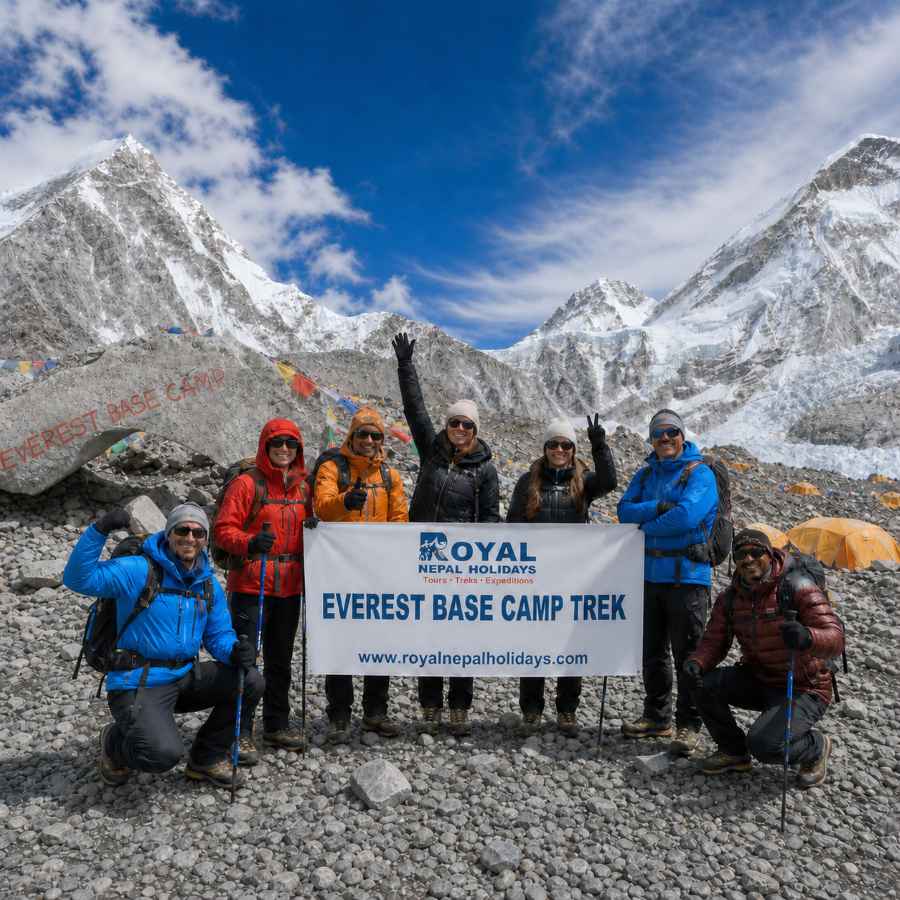
Standing at 5,364 meters, with the Khumbu Icefall tumbling down beside you and the black pyramid of Everest rising against the sky, is one of those moments that permanently rearranges how you see the world. For decades, the only way to earn that view was to walk in and walk back out — roughly 12 to 14 days of trekking each direction through the Khumbu region. The Everest Base Camp Trek with Helicopter Return changes that equation entirely. You still do the hard, honest work of trekking uphill to Base Camp and Kala Patthar, but instead of retracing four to five days of trail on tired legs, you step into a helicopter at Gorakshep and are back in Kathmandu, showered and drinking coffee, within a few hours.
This 9-day itinerary has become one of the most requested Everest packages we run at Royal Nepal Holidays, and for good reason. It solves the single biggest obstacle that keeps working professionals, older trekkers, and time-limited travelers from ever attempting Everest Base Camp: the calendar. Most people don't have 15 to 17 days of vacation to give to a single trip. This itinerary compresses the experience into nine days — including your Kathmandu arrival and departure — without cutting a single major highlight of the classic trek. You walk through Lukla, Phakding, Namche Bazaar, Tengboche, Dingboche, Lobuche, and Gorakshep exactly as classic trekkers do. You get the same acclimatization days, the same monastery visits, the same Sherpa villages, and the same sunrise from Kala Patthar. What you skip is the long, repetitive walk back down, which many past clients tell us is the least interesting part of the entire journey anyway.
There are three practical reasons trekkers choose this option over the traditional round-trip trek. First, it saves three to four full trekking days, which is often the difference between being able to take the trip at all and not. Second, the descent on foot is genuinely hard on the knees and joints, especially over multiple consecutive days after you're already fatigued from the ascent — the helicopter eliminates that physical toll entirely. Third, and this surprises many first-time trekkers, the helicopter flight itself becomes one of the most memorable parts of the whole trip. Flying at eye level with Everest, Lhotse, Nuptse, and Ama Dablam, watching Namche Bazaar shrink into the hillside below, is a completely different way to experience the Himalaya, and it's not something you can replicate on foot.
This itinerary is built for capable, reasonably fit trekkers who want the full Everest Base Camp achievement without the extended time commitment of the classic 12–14 day trek. It particularly suits business professionals with limited annual leave, trekkers in their 50s, 60s, and beyond who want to reduce cumulative strain on joints, honeymooners and couples wanting a shorter but still adventurous trip, and repeat visitors to Nepal who have already done long treks and want an efficient way to reach Base Camp again. It is not a shortcut for the unfit — you still need to trek uphill, at altitude, for six consecutive days — but it is the most time-efficient way to stand at the foot of the world's highest mountain.
Along the way you'll pass through Sagarmatha National Park, a UNESCO World Heritage Site protecting some of the most dramatic mountain scenery on Earth. Namche Bazaar, the unofficial capital of the Khumbu, offers your first real immersion into Sherpa culture, along with bakeries, gear shops, and a jaw-dropping first glimpse of Everest itself from the trail above town. Tengboche Monastery, perched on a ridge with Ama Dablam as a backdrop, is one of the most photographed religious sites in Nepal. Kala Patthar, at 5,545 meters, delivers what many trekkers consider a better Everest view than Base Camp itself, since Everest's summit is actually hidden from Base Camp by the shoulder of Nuptse. And Everest Base Camp, at the foot of the infamous Khumbu Icefall, remains the emotional high point of the trip — the literal and figurative base from which every historic Everest summit expedition has launched.
We are a government-registered Nepali trekking operator, which means your trip is run by people who grew up in this landscape, not a foreign agency subcontracting to a local ground handler you never meet. Every group on this itinerary is led by one of our senior guides — trekkers on this route have been guided by our team members Bashu, Chandra, and Uttam, each of whom has years of experience on the Khumbu trail and deep familiarity with altitude management, weather patterns, and the helicopter logistics that make this itinerary work smoothly. Our owner, Sushil Tiwari, personally oversees itinerary planning and safety protocols for every Everest departure, and our Kathmandu office maintains 24/7 contact with guides in the field throughout the trek. We keep group sizes intentionally small, build in genuine buffer days for weather, and never cut acclimatization time to save a day — we would rather adjust an itinerary than compromise a client's safety.
| Category | Details |
|---|---|
| Duration | 9 Days (Kathmandu to Kathmandu) |
| Trip Grade | Strenuous |
| Max Altitude | 5,545 m (Kala Patthar) |
| Walking Distance | Approx. 65 km one-way (Lukla to Gorakshep) |
| Daily Walking Hours | 4–7 hours |
| Accommodation | 3-star hotel in Kathmandu, tea houses on trek |
| Meals | All meals on trek (breakfast, lunch, dinner); breakfast only in Kathmandu |
| Transportation | Domestic flight Kathmandu–Lukla, private vehicle airport transfers |
| Helicopter Return | Gorakshep to Kathmandu (shared or private) |
| Trek Start | Lukla |
| Trek Finish | Gorakshep (fly out by helicopter) |
| Group Size | 2–12 people (private groups available) |
| Best Time | March–May, September–November |
| Airport | Tribhuvan International Airport (KTM) |
| Permits | Sagarmatha National Park Permit, Khumbu Pasang Lhamu Rural Municipality Permit |
| WiFi | Available at extra cost in most tea houses |
| Charging | Available at extra cost in most tea houses |
| Hot Shower | Available at extra cost at most stops |
| Guide | Government-licensed English-speaking trekking guide |
| Porter | Available (1 porter per 2 trekkers, carries up to 15 kg) |
| Fitness Level | Good cardiovascular fitness, prior hiking experience recommended |
The classic Everest Base Camp trek typically runs 12 to 14 days because trekkers walk both directions — up to Base Camp and back down to Lukla. This itinerary keeps every meaningful part of that experience while removing the return walk, and there are several concrete advantages to doing it this way.
It saves 3–4 trekking days. Walking from Gorakshep back to Lukla usually takes trekkers three to four days, retracing the same villages and trail sections they already passed through on the way up. Flying out by helicopter reclaims that time entirely, which matters enormously for anyone working with a fixed number of vacation days.
It's significantly less stressful on the knees. Descending is where most trekking injuries and joint pain actually happen, not ascending. Days of steep downhill walking on tired legs, often on uneven stone steps, place repeated impact stress on knees and ankles. Skipping the descent avoids this almost entirely, which is a major reason older trekkers and anyone with previous joint issues specifically request this itinerary.
The helicopter flight is genuinely scenic, not just functional. The route from Gorakshep to Kathmandu passes directly beneath and alongside some of the highest peaks on Earth. Trekkers consistently describe the flight as a highlight of the trip in its own right, not simply a convenient way to get home.
It's ideal for travelers with limited holiday time. Many working professionals simply cannot take 15–17 days off work. This 9-day structure makes Everest Base Camp achievable within a realistic single vacation block, including international travel time on either end.
It adds a genuine touch of luxury to an otherwise rustic trek. Trekking itself remains authentic — tea houses, mountain trails, simple meals — but capping the trip with a private or shared helicopter flight over the Himalaya gives the whole experience a memorable, five-star finish.
The aerial views of Everest are unlike anything seen from the ground. From the trail, Everest's summit is often partially obscured by neighboring peaks. From the helicopter, at altitude and in open air, you get an unobstructed, wide-angle view of the entire Everest massif that no ground-based viewpoint can match.
Government-registered local operator. We are fully licensed and registered with the Government of Nepal's Department of Tourism, which means our permits, guide certifications, and insurance coverage are all verifiable and compliant with current trekking regulations.
Experienced, licensed trekking guides. Every guide we assign to this trek — including our senior team members Bashu, Chandra, and Uttam — holds a government trekking guide license and has extensive first-hand experience managing altitude, weather, and helicopter logistics on the Khumbu route specifically.
24/7 emergency support. Our Kathmandu office remains in contact with your guide throughout the trek via satellite phone or local network coverage, and we maintain relationships with helicopter rescue operators and hospitals in both Kathmandu and Lukla for rapid response if ever needed.
Customizable itineraries. While this 9-day structure works well for most trekkers, we can extend acclimatization days, add extra rest days, or adjust the itinerary for private groups with specific needs.
No hidden costs. Our quoted price includes everything listed in our Cost Includes section below. We do not surprise clients with unexpected charges for permits, guide fees, or transportation once you're on the trail.
Flexible departure dates. We run this trek on both fixed group departures and private, custom-dated departures, so you're not locked into a rigid calendar.
Airport transfers included. From the moment you land at Tribhuvan International Airport to the moment you depart, all transfers are handled by our team.
High success rate. Because we build in a genuine acclimatization day at Namche Bazaar and closely monitor trekkers for altitude symptoms, our summit — or rather, Base Camp — success rate is consistently strong across departures.
Personalized service. Owner Sushil Tiwari is directly involved in itinerary planning for our Everest departures, and our guides adjust daily pacing based on how each individual trekker is coping with altitude, rather than forcing a rigid group schedule.
Sustainable and responsible tourism. We follow Leave No Trace principles, employ local Sherpa staff and porters at fair wages, and actively support the villages our treks pass through.
The Everest Base Camp Trek with Helicopter Return begins not in Kathmandu but in the mountain airstrip town of Lukla, reached by one of the most celebrated short flights in the world. From Lukla, at 2,860 meters, the trail immediately drops into the Dudh Koshi river valley, following the milky, glacier-fed water upstream through pine and rhododendron forest toward Phakding. This first day is deliberately gentle, giving trekkers a low-altitude introduction to the trail before the terrain steepens.
From Phakding, the trail crosses the Dudh Koshi several times on high suspension bridges strung with prayer flags — among them the dramatic Hillary Suspension Bridge — before climbing steeply through forest to Namche Bazaar at 3,440 meters. This climb is the first real test of the trek, gaining significant elevation in a single day, and it's also where trekkers get their first views of Everest itself, framed between Nuptse and Lhotse from a viewpoint just above the trail.
Namche Bazaar functions as both a physical and cultural waypoint. Built into a natural amphitheater in the hillside, it's the commercial heart of the Khumbu, with bakeries, gear shops, bars, and a busy Saturday market that draws traders from surrounding villages. Because 3,440 meters is high enough to require acclimatization, trekkers spend a full extra day here, typically hiking up to the Everest View Hotel or the Khumjung and Khunde villages for additional altitude exposure without the strain of carrying full packs onward.
From Namche, the trail contours along the hillside with sweeping views before descending to the Dudh Koshi again and climbing steeply to Tengboche at 3,860 meters, home to the region's most significant monastery. The final approach to Tengboche, through rhododendron forest with Ama Dablam's distinctive fishtail peak rising ahead, is one of the most photographed sections of the entire trek.
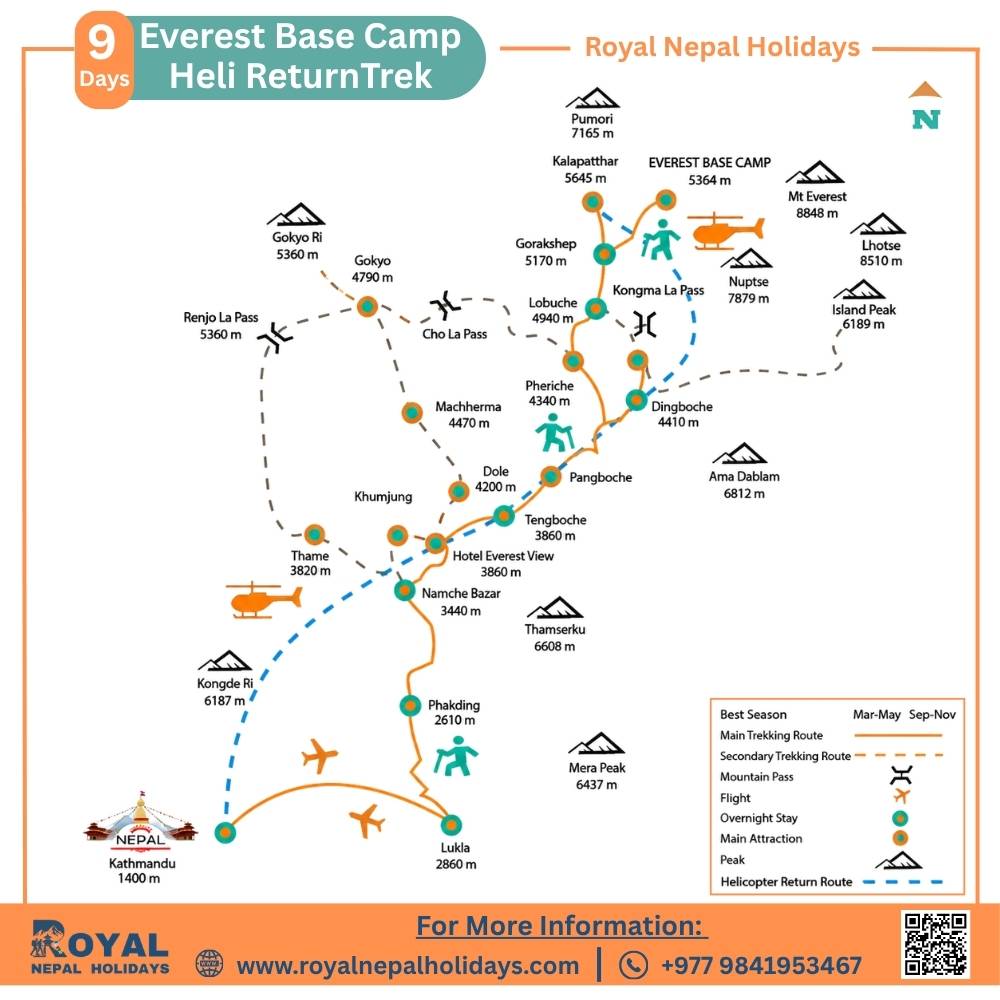
Beyond Tengboche, the landscape changes noticeably. Forest gives way to alpine scrub and then to open, high-altitude terrain as the trail climbs to Dingboche at 4,410 meters, set in a wide glacial valley beneath the towering wall of Lhotse. From Dingboche, the trail continues climbing steadily through Thukla and Lobuche, passing the somber memorial site for climbers who have died on Everest, before reaching Gorakshep at 5,164 meters — the last settlement before Base Camp and the departure point for both the Base Camp hike and the helicopter flight home.
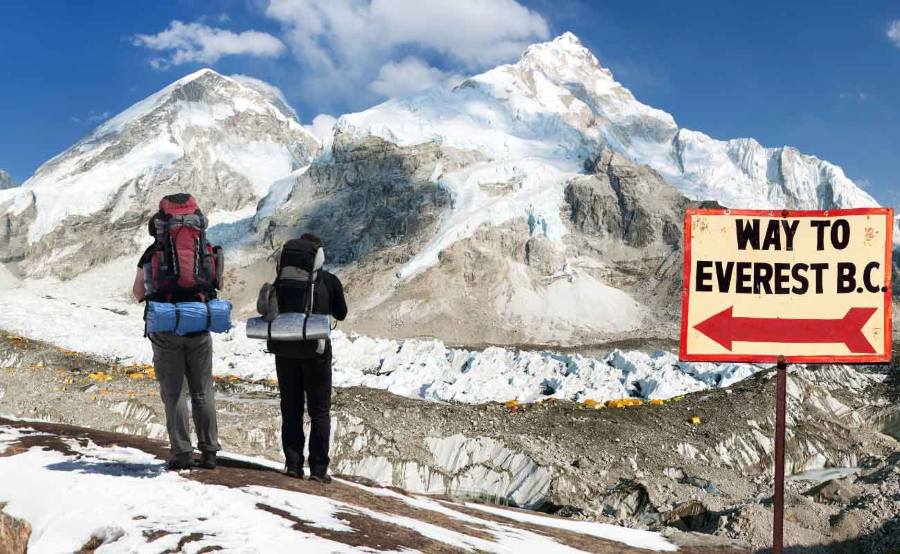
From Gorakshep, trekkers make the final push on foot to Everest Base Camp itself at 5,364 meters, walking across the lateral moraine of the Khumbu Glacier to stand at the foot of the infamous Khumbu Icefall. Many trekkers also climb Kala Patthar, a rocky viewpoint above Gorakshep at 5,545 meters, either the same afternoon or the following dawn, for what is widely considered the single best mountain panorama on the entire route.
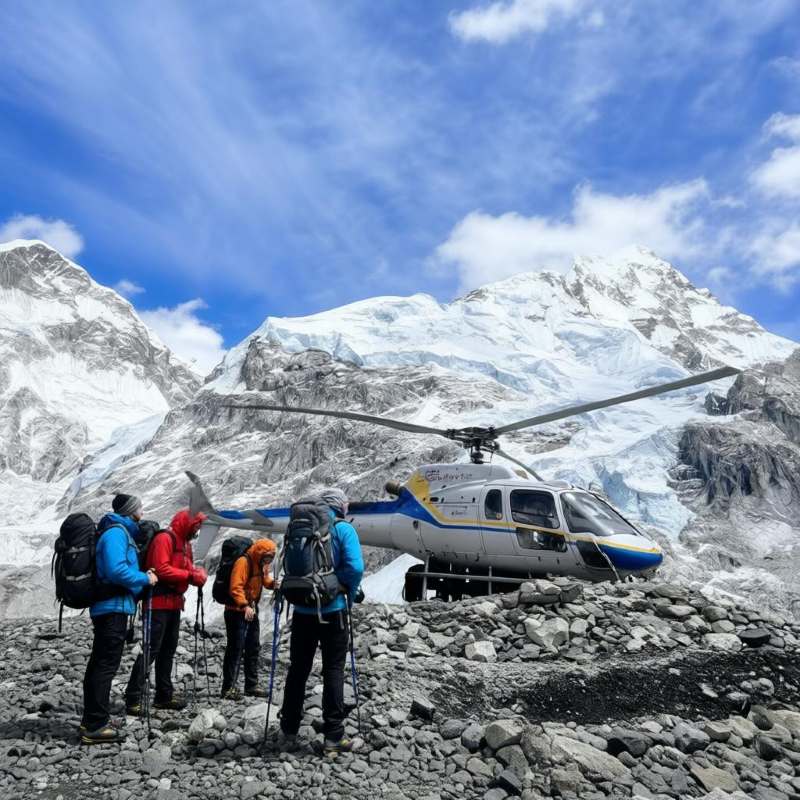
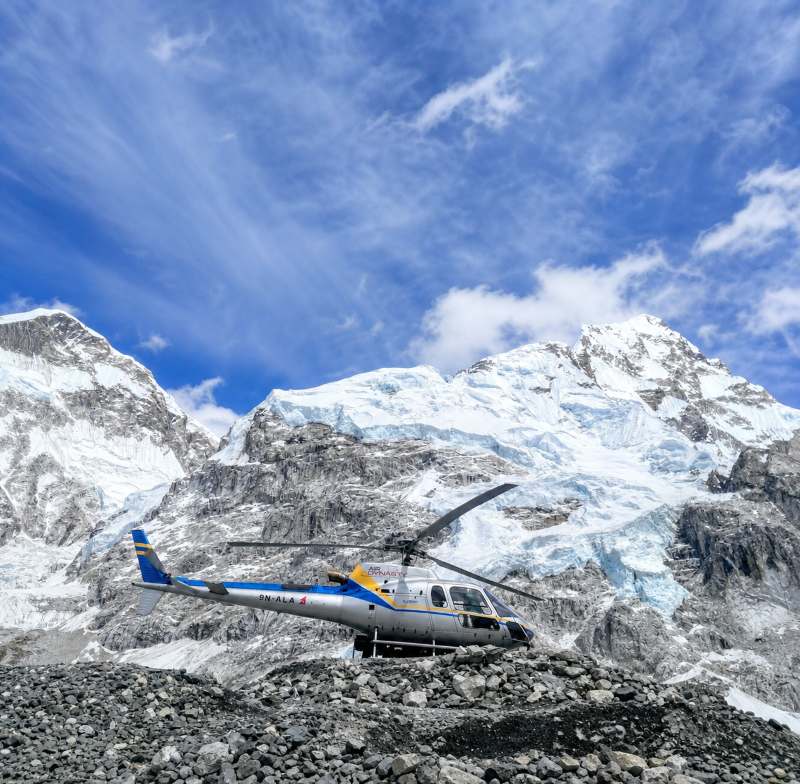
It's from Gorakshep, rather than Lukla, that this itinerary departs from the classic trek. Instead of turning around and retracing six days of trail on foot, trekkers board a helicopter that lifts off from the Gorakshep helipad and flies directly back to Kathmandu, following the Khumbu valley and passing beneath Everest, Lhotse, Nuptse, and Ama Dablam before descending into the Kathmandu valley — typically completing in under an hour and a half what would otherwise take three to four days on foot.
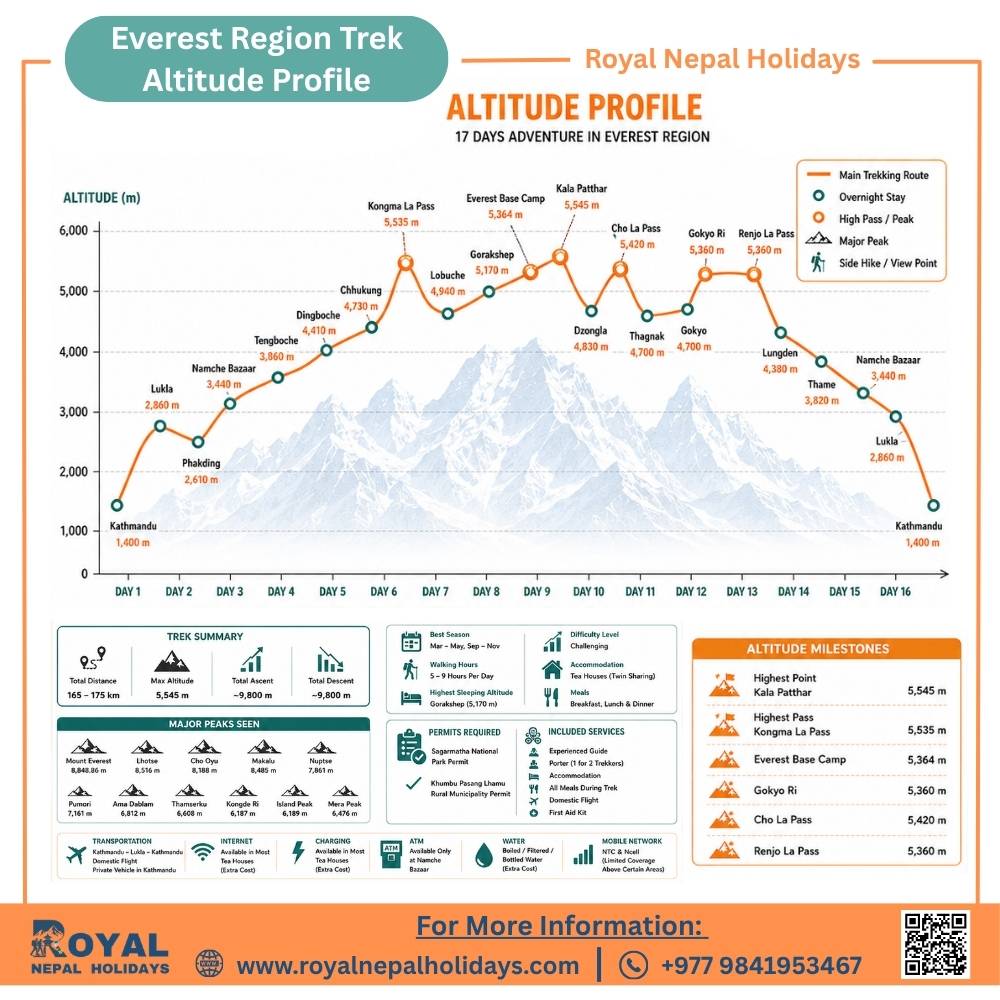
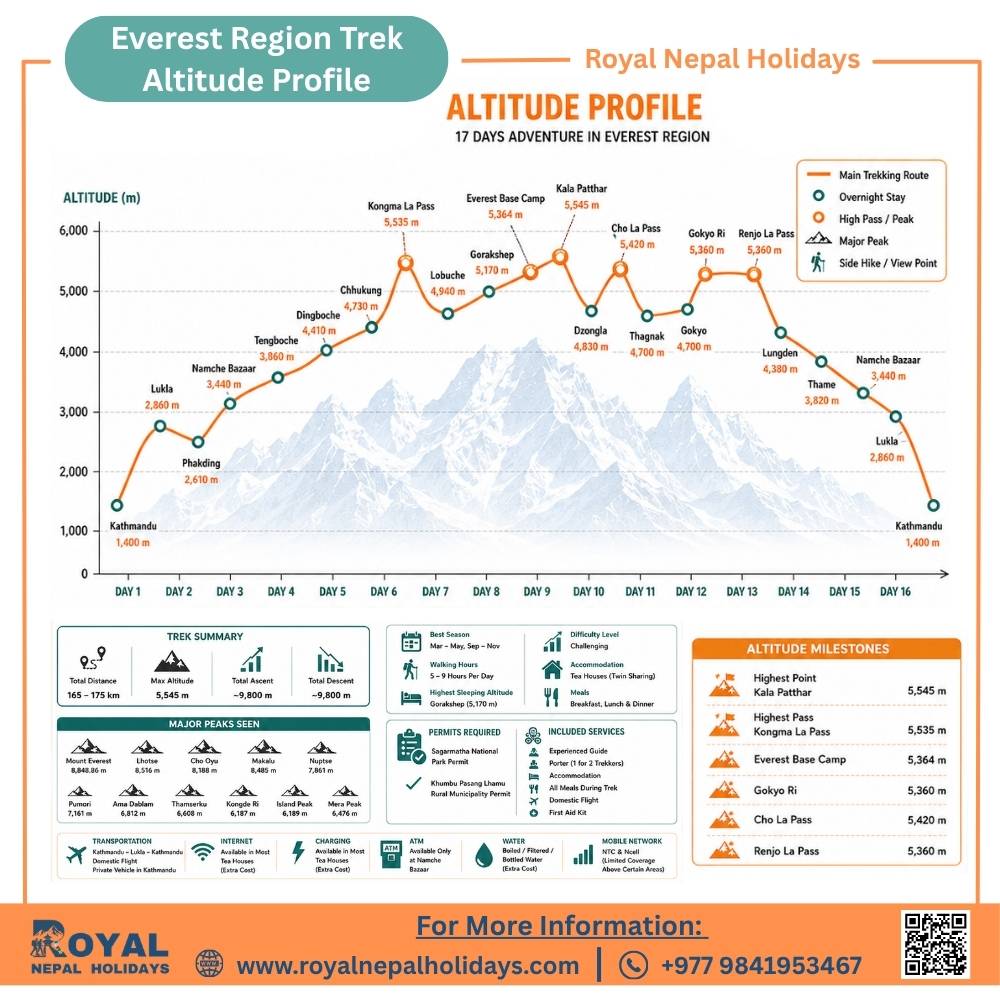
→ Here is the Altitude profile chart showing daily elevation across the 9-day itinerary
Duration: 3–4 Hours Trek
Distance: 6 km (3.7 miles)
Accommodation: Tea House
Meals: Breakfast, Lunch & Dinner
Your Everest adventure begins with an early morning scenic flight from Kathmandu to Lukla, one of the world's most famous mountain airports. During the 30 to 35-minute flight, enjoy breathtaking aerial views of the Himalayan range, including lush hills, deep valleys, and snow-capped peaks.
Upon arrival in Lukla, you'll meet your trekking crew, complete final preparations, and begin your trek towards Phakding. The trail is mostly downhill, making it an easy introduction to trekking in the Everest region. You'll pass colorful prayer flags, traditional Sherpa villages, mani walls, suspension bridges, and terraced farmland while following the beautiful Dudh Koshi River.
The peaceful walk allows your body to gradually adjust to the higher altitude. Along the way, you'll encounter friendly locals, yak caravans carrying supplies, and stunning mountain scenery. After approximately 3–4 hours of trekking, you'll reach the charming village of Phakding, where you'll spend your first night in a comfortable tea house.
Today's Highlights
Duration: 5–6 Hours Trek
Distance: 7–8 km (4.5–5 miles)
Accommodation: Tea House
Meals: Breakfast, Lunch & Dinner
After breakfast, continue trekking alongside the Dudh Koshi River, crossing several exciting suspension bridges decorated with colorful prayer flags. The trail passes through pine forests, small settlements, and scenic river valleys before entering the UNESCO-listed Sagarmatha National Park at Monjo, where your trekking permits are checked.
From here, the trail gradually becomes steeper as you ascend towards Namche Bazaar. One of today's highlights is crossing the famous Hillary Suspension Bridge before beginning the challenging uphill climb through dense forests.
If the weather is clear, you'll enjoy your first distant view of Mount Everest along with Lhotse and Nuptse before reaching Namche Bazaar. Known as the gateway to Everest, Namche is the largest Sherpa town in the Khumbu region, offering excellent cafés, bakeries, gear shops, and mountain lodges.
Today's Highlights
Duration: 3–4 Hours Hiking
Accommodation: Tea House
Meals: Breakfast, Lunch &Dinner
Today's acclimatization day is essential for helping your body adapt to the increasing altitude while preparing for higher elevations. Rather than resting completely, you'll take a rewarding hike to Hotel Everest View (3,880 m), one of the highest luxury hotels in the world.
Along the trail, enjoy panoramic views of Mount Everest, Ama Dablam, Lhotse, Nuptse, Thamserku, and Kongde Ri. You may also visit the Sherpa Culture Museum and the Everest Photo Gallery to learn about the history of Everest expeditions and the unique traditions of the Sherpa people.
After exploring the area and enjoying lunch in Namche Bazaar, you'll spend the afternoon relaxing, browsing local shops, or enjoying freshly baked pastries at one of the town's popular cafés.
Today's Highlights
Duration: 5–6 Hours Trek
Distance: 10–11 km (6.8 miles)
Accommodation: Tea House
Meals: Breakfast, Lunch & Dinner
Leaving Namche Bazaar, you'll follow a scenic ridge offering spectacular views of Everest, Ama Dablam, Lhotse, and Thamserku. The trail gradually descends to Phunki Tenga before climbing steadily through rhododendron and pine forests toward Tengboche.
Tengboche is famous for its magnificent monastery, the largest and most important Buddhist monastery in the Everest region. If time permits, you can attend the monks' afternoon prayer ceremony, providing a peaceful cultural experience against the backdrop of towering Himalayan peaks.
The panoramic setting around Tengboche is considered one of the most beautiful viewpoints on the entire Everest Base Camp Trek.
Today's Highlights
Duration: 5–6 Hours Trek
Distance: 11 km (6.8 miles)
Accommodation: Tea House
Meals: Breakfast, Lunch & Dinner
After breakfast, descend through peaceful forests before crossing the Imja Khola River. The trail then gradually climbs through Pangboche, one of the oldest Sherpa villages in the region, known for its ancient monastery and rich cultural heritage.
As you continue higher, the landscape changes dramatically from lush forests to alpine meadows and rocky terrain. Snow-capped peaks surround the valley while Ama Dablam dominates the skyline.
By afternoon, you'll reach Dingboche, a picturesque village surrounded by stone-walled fields designed to protect crops from cold winds and grazing animals.
Today's Highlights
Duration: 3–4 Hours Hiking
Accommodation: Tea House
Meals: Breakfast, Lunch & Dinner
Today is another important acclimatization day before heading toward higher elevations. You'll take a short but rewarding hike to Nagarjun Hill or another nearby viewpoint above Dingboche.
The climb offers magnificent views of Makalu, Lhotse, Ama Dablam, Island Peak, and the surrounding Himalayan landscape. Spending additional time at higher altitude before returning to sleep in Dingboche greatly improves acclimatization and reduces the risk of altitude sickness.
The remainder of the afternoon is free to relax, explore the village, or prepare for the higher-altitude trekking ahead.
Today's Highlights
Duration: 5–6 Hours Trek
Distance: 11–12 km (7 miles)
Accommodation: Tea House
Meals: Breakfast, Lunch & Dinner
Today's trail gradually ascends through alpine terrain to Dughla before climbing a steep ridge that leads to the Everest Memorial, dedicated to climbers who lost their lives on Everest. The memorial site provides both emotional reflection and spectacular views of the surrounding peaks.
Continuing along the Khumbu Glacier moraine, you'll reach Lobuche, a small settlement surrounded by towering Himalayan giants.
As you approach 5,000 meters, the landscape becomes increasingly rugged, creating an unforgettable high-mountain atmosphere.
Today's Highlights
Duration: 7–8 Hours Trek
Distance: 15 km (9.3 miles)
Accommodation: Tea House
Meals: Breakfast, Lunch & Dinner
Today is the most anticipated day of your adventure. After breakfast, trek alongside the Khumbu Glacier toward Gorakshep before continuing to the legendary Everest Base Camp.
The route follows rocky glacial moraines with unforgettable views of ice formations, towering peaks, and the massive Khumbu Icefall. Standing at Everest Base Camp is a dream come true for trekkers from around the world.
Take time to celebrate, capture memorable photographs, and enjoy the incredible surroundings before returning to Gorakshep for the night.
Today's Highlights
Duration: 2–3 Hours Hike + 1.5–2 Hours Helicopter Flight
Distance: 2–3 km (1.8 miles)
Meals: Breakfast
Rise before dawn for the unforgettable hike to Kala Patthar, the highest point of your trek and the finest viewpoint for Mount Everest. As the first rays of sunlight illuminate Everest, Lhotse, Nuptse, Pumori, and the surrounding Himalayan peaks, you'll witness one of the most spectacular mountain panoramas on Earth.
After enjoying the breathtaking sunrise and taking photographs, descend to Gorakshep for breakfast. From here, board your shared or private helicopter for an incredible flight back to Kathmandu. The return journey offers a unique aerial perspective of the Khumbu Glacier, Sherpa villages, deep valleys, and the snow-covered peaks you've spent the past week exploring.
Upon arrival in Kathmandu, you'll be transferred to your hotel or the airport, marking the end of your unforgettable Everest Base Camp Trek with Helicopter Return with Royal Nepal Holidays.
Today's Highlights
Are you interested on planning custom trip? It only takes 2 minutes.
| Add-On Service | Details |
|---|---|
| Single Room Supplement (Kathmandu) | Upgrade to a private room in Kathmandu. |
| Private Tea House Room | Private rooms during the trek where available. |
| Private Helicopter Return | Upgrade from a shared helicopter to a private charter. |
| Extra Porter Service | Additional porter (maximum 20–25 kg shared load). |
| Personal Assistant Guide | Dedicated private trekking guide throughout the trek. |
| Everest Mountain Flight | Scenic mountain flight before or after the trek (optional). |
| Luxury Hotel Upgrade | Upgrade your Kathmandu accommodation to a 4-star or 5-star hotel. |
| Extra Hotel Nights | Additional nights in Kathmandu before or after the trek. |
| Airport Fast Track Service | Meet-and-assist service for arrival or departure at Kathmandu Airport. |
| International Airport Lounge Access | Relax in a premium airport lounge before departure. |
| Helicopter Tour to Hotel Everest View | Scenic helicopter excursion before or after your trek. |
| Professional Photographer / Videographer | Capture your Everest adventure with professional photos and videos. |
| Rental Trekking Equipment | Down jacket, sleeping bag, trekking poles, duffel bag, crampons (seasonal), etc. |
| Travel Insurance Assistance | Help choosing a suitable high-altitude trekking insurance policy. |
| Oxygen Cylinder / Oxygen Canister | Supplemental oxygen for added comfort at high altitude (if desired). |
| Portable Hyperbaric Bag Support | Available for private expeditions on request. |
| Satellite Phone Rental | Stay connected in remote mountain areas. |
| Garmin inReach / Satellite Tracker Rental | Emergency communication and live location tracking. |
| Private Jeep Transfer (Airport–Hotel–Airport) | Exclusive airport transfers in Kathmandu. |
| Nepal Visa Assistance | Visa support and pre-arrival travel guidance. |
| Laundry Service | Laundry in Kathmandu before or after the trek. |
| Extra Luggage Storage | Secure luggage storage in Kathmandu during your trek. |
| Customized Trek Extension | Extend your trip with Gokyo Lakes, Chitwan, Pokhara, or a Kathmandu sightseeing tour. |
Response Time 0-2 Hours , Response Rate 100%
Boarding at Gorakshep: The helipad at Gorakshep is a short, flat walk from the tea house area. Boarding is straightforward but weather-dependent — mountain helicopters operate on strict visual flight rules, meaning clear conditions are required for takeoff, so early morning departures (before clouds typically build) are standard practice.
Flight route: The standard return route follows the Khumbu valley downstream, passing Lobuche, Dingboche, Tengboche, Namche Bazaar, and Lukla from the air before continuing over the Solu region toward Kathmandu.
Everest aerial views: Because the flight climbs to pass near several of the highest peaks in the world, trekkers get views of Everest, Lhotse, Nuptse, and Ama Dablam that are simply unavailable from any ground viewpoint on the trek, including Kala Patthar.
Safety briefing: Before boarding, your guide and the helicopter crew will run through a short safety briefing covering seatbelt use, luggage stowage, and emergency procedures, standard practice for all Himalayan helicopter operations.
Landing procedures: Depending on weather, fuel requirements, and group size, the helicopter may make one brief refueling stop (commonly at Lukla or Syangboche) before continuing to Kathmandu.
Weather considerations: Mountain weather changes quickly, and helicopter flights are more weather-sensitive than fixed-wing Lukla flights. We build a buffer into our itineraries where possible, and in rare cases of extended poor weather, alternate arrangements (including a fixed-wing flight from Lukla, reached by a shortened walk down) can be arranged.
Luggage allowance: Standard helicopter luggage allowance is typically around 5–10 kg of cabin baggage per person, with your main duffel transported separately if needed. Your guide will confirm exact limits before departure.
Shared vs private helicopter: Our standard package price includes a shared helicopter seat, where costs are split among a small group of trekkers finishing on the same day. Private helicopter charters are available at an additional cost for trekkers wanting full flexibility on timing and an exclusive flight.
| Season | Months | Conditions |
|---|---|---|
| Spring | March–May | Stable weather, warm days, rhododendrons in bloom, excellent mountain visibility, busiest season, helicopter operations generally reliable |
| Summer/Monsoon | June–August | Wet trails, frequent cloud cover, poor mountain visibility, higher risk of flight delays for both fixed-wing and helicopter |
| Autumn | September–November | Clearest skies of the year, stable weather, most popular season alongside spring, excellent helicopter flying conditions |
| Winter | December–February | Very cold, especially above 4,500 m, fewer crowds, generally clear skies but colder nights in tea houses, occasional flight delays due to cold-weather visibility |
Spring and autumn are the recommended seasons for this itinerary, both for comfortable trekking conditions and for reliable helicopter operations, since clear, stable weather significantly reduces the risk of flight delays.
This itinerary is rated strenuous. While no technical climbing skill is required, trekkers walk for 5 to 8 hours a day at increasingly high altitude for six consecutive trekking days, with only one dedicated acclimatization day built in. Daily walking hours range from 3–4 hours on the easiest days to 7–8 hours on the Everest Base Camp and Kala Patthar day. The primary challenge is not technical terrain but altitude — above 3,500 meters, reduced oxygen levels make even moderate exertion feel considerably harder, and this effect compounds daily as you climb higher. Mental preparation matters as much as physical fitness: expect cold tea houses, basic facilities, early starts, and some genuinely tiring days, and go in accepting that flexibility (including possible itinerary adjustments for weather) is part of the experience.
We recommend a baseline of regular cardiovascular exercise (hiking, running, or cycling) for at least 6–8 weeks before departure, along with some experience of multi-day hiking if possible.
Altitude sickness, medically known as Acute Mountain Sickness (AMS), is a real risk on any trek above 3,000 meters, and this itinerary reaches a maximum altitude of 5,545 meters.
| Altitude | Risk Level | Advice |
|---|---|---|
| Below 3,000 m | Low | Stay Hydrated |
| 3,000–4,000 m | Moderate | Walk Slowly |
| 4,000–5,000 m | High | Acclimatize Properly |
| Above 5,000 m | Very High | Monitor Symptoms |
Symptoms: Common early symptoms include headache, nausea, dizziness, loss of appetite, and disturbed sleep. More serious symptoms — confusion, severe breathlessness at rest, loss of coordination, or a persistent cough — require immediate descent and medical attention.
Prevention: The single most effective prevention strategy is a gradual ascent profile with built-in acclimatization, which is exactly why this itinerary includes a dedicated rest day at Namche Bazaar. Staying well hydrated, avoiding alcohol at altitude, eating enough calories, and ascending at a measured pace all reduce risk significantly.
Acclimatization schedule: This itinerary follows the widely recommended "climb high, sleep low" principle on the Namche acclimatization day, and paces daily elevation gain conservatively above 4,000 meters.
Emergency protocols: Every guide carries a first aid kit and is trained to recognize early AMS symptoms. In the event of worsening symptoms, our standard protocol is immediate descent to a lower altitude, and in serious cases, helicopter evacuation to Kathmandu — which is precisely why mandatory travel insurance with helicopter evacuation coverage is a non-negotiable requirement for this trek.
Role of guides: Our guides check in with trekkers daily regarding sleep quality, appetite, and any symptoms, and have full authority to adjust pacing or recommend descent if they have any concern about a trekker's condition, regardless of group schedule pressure.
Hotels in Kathmandu: You'll stay in a comfortable 3-star hotel in the Thamel area, with private en-suite rooms, hot showers, and WiFi.
Tea houses on the trek: Accommodation along the trail consists of family-run tea houses, which become progressively simpler as altitude increases. Rooms are typically twin-share with two single beds, basic furnishings, and shared bathroom facilities (attached bathrooms are occasionally available at lower altitudes for an extra charge).
Toilets: Most tea houses have a mix of Western-style and squat toilets, generally shared rather than en-suite, particularly above Namche Bazaar.
Showers: Hot showers are available at most tea houses for an additional local charge, typically heated by gas or solar power; above Dingboche, hot showers become less reliable and more expensive.
Heating: Common dining areas typically have a central wood or yak-dung stove in the evening, which is where most trekkers socialize and warm up; individual rooms are generally unheated.
Blankets: Tea houses provide blankets, but we strongly recommend bringing your own four-season sleeping bag, as blanket quality and warmth vary significantly by lodge.
| Meal | Options |
|---|---|
| Breakfast | Bread, Eggs, Pancakes, Tea, Coffee |
| Lunch | Dal Bhat, Fried Rice, Noodles, Soup |
| Dinner | Dal Bhat, Pasta, Pizza, Curry |
Breakfast: Typically includes options like porridge, eggs, toast, pancakes, and Tibetan bread, along with tea or coffee.
Lunch: Usually eaten on the trail at a tea house along the route, with options like dal bhat (rice, lentils, and vegetables), noodle soups, and fried rice.
Dinner: Similar to lunch, often including dal bhat, pasta dishes, soups, and momos (Nepali dumplings); dal bhat is a particularly good choice at altitude since it's freshly cooked and offers unlimited refills.
Snacks: Chocolate bars, biscuits, and energy bars are widely available for purchase along the trail, though prices increase with altitude.
Safe drinking water: Bottled water is available for purchase throughout, though we recommend bringing a reusable bottle and water purification tablets or a filter, both to reduce plastic waste and to save money, since bottled water becomes increasingly expensive at higher elevations.
| Route | Transport |
|---|---|
| Kathmandu → Lukla | Domestic Flight |
| Gorakshep → Kathmandu | Helicopter |
| Airport Transfers | Private Vehicle |
Kathmandu–Lukla flight: A short, scenic 30-minute flight on a small fixed-wing aircraft, landing at the famously short, angled runway of Tenzing-Hillary Airport.
Helicopter return: Covered in detail above — a scenic 60–90 minute flight from Gorakshep directly to Kathmandu.
Airport transfers: Private vehicle transfers are provided for both your arrival and departure at Tribhuvan International Airport in Kathmandu.
| Item | Details |
|---|---|
| Pickup Point | Gorakshep |
| Landing | Kathmandu |
| Duration | 1.5–2 Hours |
| Seating Capacity | Up to 5 Passengers (subject to weight limits and shuttle operations) |
| Flight Type | Shared or Private |
| Scenic Views | Everest, Lhotse, Ama Dablam, Khumbu Glacier |
Flight duration: Approximately 60–90 minutes from Gorakshep to Kathmandu, depending on weather and any refueling stops required.
Seating capacity: Standard mountain helicopters used on this route typically seat 4–6 passengers in shared-flight configuration.
Shared vs private: Shared flights (included in the standard package price) split the helicopter among several trekkers finishing on the same day; private charters offer full flexibility and are available at additional cost.
Baggage allowance: Generally around 5–10 kg of baggage per passenger, with excess luggage arrangements available if needed.
Weather delays: Helicopters operate under visual flight rules and cannot fly in poor visibility, so delays of a few hours (in rare cases, a day) are possible; our itineraries build in a small buffer where feasible.
Safety standards: Helicopter operators serving this route are licensed by Nepal's Civil Aviation Authority and maintain aircraft to international mountain-flying safety standards.
Clothing:
Footwear:
Electronics:
Documents:
Toiletries:
Health essentials:
Miscellaneous gear:
| Permit | Required |
|---|---|
| Sagarmatha National Park Permit | Yes |
| Khumbu Pasang Lhamu Permit | Yes |
| TIMS Card | Not Required (current regulation) |
Sagarmatha National Park Entry Permit: Required for all trekkers entering the national park; this is arranged on your behalf and included in your package price.
Khumbu Pasang Lhamu Rural Municipality Permit: A local municipality permit required for trekking through the Khumbu region, also arranged and included in your package price.
Where to obtain them: Both permits are processed by our Kathmandu office on your behalf before the trek begins — you do not need to arrange these yourself.
Current costs: Permit fees are subject to periodic revision by Nepali authorities; we recommend confirming current rates with our team at the time of booking, as this varies by year and is included in your quoted package price.
Comprehensive travel insurance is mandatory for this trek, not optional. Your policy must specifically include:
We ask all trekkers to send us a copy of their insurance policy before departure, and we can recommend insurers experienced with Nepali high-altitude trekking if needed.
| Month | Daytime Temp (Namche/Base Camp area) | Visibility | Trekking Conditions |
|---|---|---|---|
| January | -5°C to 5°C | Generally clear | Very cold, quiet trails, occasional flight delays |
| February | -5°C to 8°C | Generally clear | Cold, improving conditions toward late month |
| March | 0°C to 12°C | Good | Spring season begins, increasingly stable |
| April | 5°C to 15°C | Excellent | Peak spring season, rhododendrons blooming |
| May | 8°C to 18°C | Good, hazier late month | Warm, busy trails, pre-monsoon buildup toward end of month |
| June | 10°C to 18°C | Poor | Monsoon onset, frequent cloud and rain at lower elevations |
| July | 12°C to 18°C | Poor | Full monsoon, high flight delay risk, muddy trails |
| August | 12°C to 18°C | Poor | Monsoon continues, leeches at lower elevations |
| September | 8°C to 16°C | Improving | Monsoon tapering off, trails drying out |
| October | 5°C to 15°C | Excellent | Peak autumn season, clearest mountain views of the year |
| November | 0°C to 12°C | Excellent | Cold but very stable, ideal helicopter flying conditions |
| December | -5°C to 8°C | Generally clear | Cold, quieter trails, good visibility |
| Service | Availability |
|---|---|
| WiFi | Most Tea Houses |
| Mobile Network | Ncell & NTC |
| Charging | Extra Cost |
| Hot Shower | Extra Cost |
WiFi availability: Most tea houses offer WiFi through local providers (such as Everest Link) for a daily or per-use fee, generally reliable up to Gorakshep though speeds are slow.
Mobile networks: Nepali SIM cards (Ncell or NTC) provide coverage through much of the Khumbu, though signal becomes patchy or absent above Gorakshep and around passes.
Charging costs: Charging devices costs a small fee per hour or per device at most tea houses, increasing with altitude as fuel and solar equipment become scarcer.
Power banks: We recommend bringing at least one fully charged power bank as backup, since charging isn't always available exactly when needed.
ATMs: ATMs are available in Kathmandu and Namche Bazaar, but not reliably beyond that point — plan your cash needs accordingly.
Cash requirements: Bring sufficient Nepali rupees in cash for the entire trek beyond Namche Bazaar, covering snacks, hot showers, WiFi, charging, and tips.
Currency: The Nepali Rupee (NPR) is the local currency; USD can be exchanged easily in Kathmandu.
Tipping guidelines: Tipping is customary and appreciated, though not mandatory. A general guideline is 10–12% of the trip cost split between your guide and porter(s), though this can be adjusted based on group size and service.
Leave No Trace principles: We ask all trekkers to carry out everything they carry in, avoid single-use plastics where possible, and stay on marked trails to protect fragile alpine vegetation.
Plastic reduction: We strongly encourage reusable water bottles with purification tablets or filters instead of purchasing bottled water, significantly reducing plastic waste in a region with limited waste management infrastructure.
Respect for local culture: Simple courtesies matter greatly in the Khumbu — walk clockwise around mani walls and chortens, ask permission before photographing people or ceremonies, and dress modestly, particularly at monasteries.
Supporting local communities: We prioritize locally owned tea houses, hire local guides and porters at fair wages, and encourage trekkers to purchase snacks and support local businesses along the route rather than carrying everything from Kathmandu.
| Factor | 9-Day Helicopter Return | 12-Day Standard Trek |
|---|---|---|
| Total duration | 9 days | 12–14 days |
| Physical strain | Lower (no walking descent) | Higher (full round-trip walking) |
| Cost | Higher per day, similar overall value | Lower helicopter cost, more trekking days |
| Best for | Time-limited travelers | Trekkers wanting maximum trail time |
| Aerial views | Included | Not included |
| Factor | Helicopter Return | Walking Back |
|---|---|---|
| Time required | Under 2 hours | 3–4 days |
| Knee/joint impact | Minimal | Significant |
| Scenic value | Unique aerial perspective | Repeats trail already seen |
| Weather dependency | Higher | Lower |
| Factor | Group Join | Private Trek |
|---|---|---|
| Cost | Lower per person | Higher per person |
| Schedule flexibility | Fixed departure dates | Fully flexible dates |
| Pace | Group-paced | Individually paced |
| Social experience | Meet other trekkers | More personalized attention |
| Factor | Shared Helicopter | Private Helicopter |
|---|---|---|
| Cost | Included in package | Additional charge |
| Departure timing | Coordinated with other trekkers | Fully flexible |
| Seating | Shared with 3–5 others | Exclusive to your group |
| Ideal for | Budget-conscious trekkers | Couples, families, special occasions |
| Mountain | Height |
|---|---|
| Mount Everest | 8,848.86 m |
| Lhotse | 8,516 m |
| Nuptse | 7,861 m |
| Ama Dablam | 6,812 m |
| Thamserku | 6,608 m |
| Pumori | 7,161 m |
| Khumbutse | 6,665 m |
| Lobuche East | 6,119 m |
Ready to book your Everest Base Camp Trek with Helicopter Return? Contact Royal Nepal Holidays today to check departure dates, discuss private group options, or ask any questions about gear, permits, or altitude preparation. Our team is here to help you plan the trip safely and confidently, from your first email to the moment you land back in Kathmandu.
Excellent
This trek is rated strenuous due to sustained high-altitude walking over six consecutive days, reaching a maximum elevation of 5,545 meters at Kala Patthar. No technical climbing skills are required, and the trail itself is a well-established walking path rather than a climbing route. The primary challenge is altitude rather than terrain difficulty — reduced oxygen levels make even moderate walking noticeably harder above 4,000 meters. Good cardiovascular fitness and some prior hiking experience are strongly recommended. Daily walking hours range from 3–4 hours on easier days to 7–8 hours on the Base Camp and Kala Patthar day. Because the return leg is by helicopter rather than on foot, this itinerary is somewhat less physically taxing overall than the classic round-trip trek, since it removes the cumulative strain of a multi-day walking descent.
Our 9-day Everest Base Camp Trek with Helicopter Return is priced at USD 2,850 per person on a group-join, shared-helicopter basis. This includes domestic flights, all trekking permits, tea house accommodation, all meals during the trek, an experienced guide, porter service, and the shared helicopter flight from Gorakshep to Kathmandu. It excludes international airfare, visa fees, travel insurance, personal expenses, and tips. Private helicopter charters and fully private group departures are available at an additional cost — contact us for a custom quote.
The package includes airport transfers in Kathmandu, the Kathmandu–Lukla domestic flight, the shared helicopter flight from Gorakshep back to Kathmandu, Kathmandu hotel accommodation as specified, tea house accommodation throughout the trek, all trekking meals, a government-licensed English-speaking guide, porter service, both required permits (Sagarmatha National Park and Khumbu Pasang Lhamu Rural Municipality), a first aid kit, and applicable government taxes.
Excluded items include international flights to and from Nepal, Nepal visa fees, mandatory travel insurance, meals in Kathmandu outside the itinerary, personal trekking gear, hot showers and WiFi charges on the trek, alcoholic beverages, personal spending money, and tips for your guide and porter. A private helicopter upgrade is also excluded from the standard price.
Previous multi-day hiking experience is strongly recommended but not strictly mandatory. What matters most is a reasonable baseline of cardiovascular fitness and mental readiness for sustained daily walking at altitude. Trekkers with no prior high-altitude experience have successfully completed this trek, provided they train adequately beforehand and listen carefully to their guide's pacing advice throughout.
We recommend 6–8 weeks of regular cardiovascular training before departure — hiking, running, cycling, or stair climbing, ideally with a weighted daypack to simulate trail conditions. Building leg strength and general endurance matters more than any single type of exercise. If possible, completing one or two multi-day hikes in hilly terrain beforehand is excellent preparation.
The highest point on this itinerary is Kala Patthar at 5,545 meters. Everest Base Camp itself sits slightly lower, at 5,364 meters. Both points are reached on Day 8 of the itinerary.
Everest Base Camp sits at the foot of the Khumbu Icefall at 5,364 meters, while Kala Patthar is a rocky outcrop above Gorakshep that rises to 5,545 meters. Interestingly, Everest's summit is not visible from Base Camp at all, since it's obscured by the shoulder of Nuptse — Kala Patthar, despite being a side viewpoint rather than the mountain's literal base, actually offers the better view of Everest's summit for this reason.
After reaching Everest Base Camp and Kala Patthar on Day 8, trekkers board a helicopter at the Gorakshep helipad on the morning of Day 9. The flight follows the Khumbu valley back toward Kathmandu, passing beneath and alongside Everest, Lhotse, Nuptse, and Ama Dablam, and typically takes 60–90 minutes, sometimes including a brief refueling stop en route.
Helicopter operators serving the Everest region are licensed by Nepal's Civil Aviation Authority and operate under strict visual flight rules, meaning flights only proceed in suitable weather conditions. While all mountain flying carries inherent risk due to challenging terrain and rapidly changing weather, established operators maintain strong safety records and rigorous aircraft maintenance standards.
Helicopters operate under visual flight rules and cannot fly in poor visibility or high winds. If weather prevents departure on the scheduled day, flights are typically rescheduled for the following morning, once conditions improve. In rare cases of extended poor weather, we can arrange an alternative return via a shortened walk down to Lukla followed by a fixed-wing flight to Kathmandu.
Yes. Our standard package price includes a shared helicopter seat split among trekkers finishing on the same day. A private helicopter charter is available at an additional cost for trekkers wanting full control over departure timing and an exclusive flight experience — ideal for couples, families, or small private groups.
Shared mountain helicopters on this route typically seat 4 to 6 passengers, and seats are coordinated among trekkers scheduled to finish around the same day.
Baggage allowance is typically around 5–10 kg of cabin luggage per passenger. Your guide will confirm the exact limit closer to your flight date, and can advise on arrangements if you're carrying additional gear.
You'll stay in a comfortable 3-star hotel in Kathmandu, and in family-run tea houses along the trekking route. Tea house rooms are typically simple twin-share accommodations with shared bathroom facilities, becoming more basic as altitude increases. Hot showers, WiFi, and charging are usually available for an additional local fee.
Yes, all meals — breakfast, lunch, and dinner — are included throughout the trekking portion of the itinerary. Meals in Kathmandu are not included, except where specifically noted, giving you flexibility to explore the city's restaurant scene.
Tap water on the trek is not safe to drink untreated. We recommend bringing a reusable water bottle along with water purification tablets or a filter, both for safety and to reduce plastic waste. Bottled water is also available for purchase along the route, though prices rise with altitude.
Two permits are required: the Sagarmatha National Park Entry Permit and the Khumbu Pasang Lhamu Rural Municipality Permit. Both are arranged on your behalf by our team and are included in your package price.
Most nationalities can obtain a Nepal visa on arrival at Tribhuvan International Airport, though we recommend checking current requirements for your specific nationality before travel. Visa fees are not included in the trek package price.
Yes, comprehensive travel insurance is mandatory, and must specifically include high-altitude trekking coverage (up to at least 6,000 meters) and helicopter evacuation coverage, given that helicopter evacuation is the standard emergency response for altitude-related issues in this region.
Our guides are trained to recognize early symptoms of Acute Mountain Sickness and will monitor you closely throughout the trek. Mild symptoms are managed with rest, hydration, and slower pacing; more serious symptoms require immediate descent, and in severe cases, helicopter evacuation to Kathmandu — which is why mandatory travel insurance with evacuation coverage is required for all trekkers.
Diamox (acetazolamide) is commonly used to help prevent altitude sickness, but it should only be taken under medical guidance. We strongly recommend consulting your doctor before departure to discuss whether altitude medication is appropriate for you, and to obtain a prescription if needed.
Spring (March–May) and autumn (September–November) are the best seasons, offering the most stable weather, clearest mountain visibility, and the most reliable helicopter flying conditions. Both seasons are popular, so booking in advance is recommended.
Yes, though winter (December–February) brings significantly colder temperatures, especially above 4,000 meters, and occasional flight delays due to cold-weather visibility issues. Trails are quieter, and mountain views are often very clear, but trekkers should be prepared for genuinely cold conditions in tea houses.
We generally don't recommend this trek during the monsoon months of June through August, as frequent cloud cover significantly reduces mountain visibility, trails become muddier, and both the Lukla flight and the return helicopter flight face a higher risk of weather-related delays.
Porters typically carry up to 15 kg of luggage per trekker (shared between two trekkers per porter in our standard package), meaning you should pack your duffel bag within this limit and carry only a light daypack yourself during the day.
Your daypack should include water, snacks, a rain jacket or extra warm layer, sunscreen, your camera, personal medications, and any documents you might need during the day, since your main duffel bag will be carried separately by your porter.
WiFi is available at most tea houses up to around Gorakshep, usually through local providers like Everest Link, for a daily or per-use fee. Speeds are slow and connections can be unreliable, especially at higher altitudes or during bad weather.
Nepali SIM cards (Ncell or NTC) provide coverage through much of the lower and mid-altitude Khumbu, though signal becomes patchy or unavailable above Gorakshep and around high passes.
Since ATMs are only reliably available in Kathmandu and Namche Bazaar, we recommend carrying enough Nepali rupees in cash to cover the entire trek beyond Namche, including snacks, hot showers, WiFi, charging fees, and tips for your guide and porter.
Tipping is customary in Nepali trekking culture, though not mandatory. A general guideline is around 10–12% of your total trip cost, split appropriately between your guide and porter based on their roles and the length of the trek.
Yes. While this 9-day structure works well for most trekkers, we can adjust departure dates, add extra acclimatization days, or otherwise modify the itinerary for private groups with specific needs — contact our team to discuss a custom departure.
Our standard group-join departures typically range from 2 to 12 trekkers. Private group departures of any size can also be arranged.
You'll be accompanied by a government-licensed, English-speaking trekking guide with extensive experience on the Khumbu route. Our senior guides, including Bashu, Chandra, and Uttam, have led numerous groups on this exact itinerary and are experienced in altitude management and helicopter flight logistics.
Yes, solo travelers are welcome on our group-join departures, where you'll trek alongside other international travelers, and will have your own guide and porter arrangements throughout.
Both are highlights for different reasons. Everest Base Camp offers the historic and emotional experience of standing at the literal starting point of Everest summit expeditions, at the foot of the Khumbu Icefall. Kala Patthar, though not as famous by name, actually offers a better direct view of Everest's summit, since the peak is hidden from Base Camp by Nuptse's shoulder. Most trekkers visit both.
The Kathmandu–Lukla flight is a short 30-minute domestic flight on a small fixed-wing aircraft, landing at Tenzing-Hillary Airport, known for its short, angled runway set into the mountainside. Flights depart early morning, before mountain winds typically increase, and are occasionally delayed by weather.
Lukla flight delays due to weather are common, particularly in monsoon season. We build a small buffer into our itineraries where possible, and in cases of extended delay, our team will work with you on alternative arrangements, including helicopter transfer to Lukla if needed.
Yes, many trekkers choose to extend their stay in Kathmandu to explore the city's UNESCO World Heritage Sites, relax after the trek, or add on additional experiences like a Kathmandu city tour or Nagarkot sunrise excursion. Let us know if you'd like to arrange extra nights or additional activities.
We are a government-registered Nepali operator with a team of experienced, licensed local guides, including Bashu, Chandra, and Uttam, who know this route intimately. Owner Sushil Tiwari is directly involved in itinerary planning and safety protocols for our Everest departures, our office maintains 24/7 contact with guides in the field, and we build in genuine acclimatization time rather than cutting corners for speed. Combined with transparent, all-inclusive pricing and no hidden costs, we aim to make this one of the safest and most well-supported ways to experience Everest Base Camp with a helicopter return.
Response Time 0-2 Hours , Response Rate 100%
You may also like
Join The Everest Base Camp Trek 14 Days With Everest Helicopter Service. Explore Sherpa Villages, Stunning Himalayan Views, Kala Patthar, And Everest Base Camp. Expert Guides, Fixed Departures, And Best Price From USD 1,400 Per Person. View Details →
Experience The 10 Days Everest Base Camp Trek In Nepal With Expert Local Guides. Explore Namche Bazaar, Tengboche, Kala Patthar, And Everest Base Camp. View Itinerary, Cost, Permits, Best Time, And Book Your Unforgettable Himalayan Adventure Today. View Details →
Trek All Three Everest Passes In 17 Days With Royal Nepal Holidays. Cross Kongma La, Cho La & Renjo La, Visit EBC, Kala Patthar & Gokyo Lakes. Book Now. View Details →
 3–4 Hours Trek
 Lodge and Tea Houses
 Breakfast + Lunch + Dinner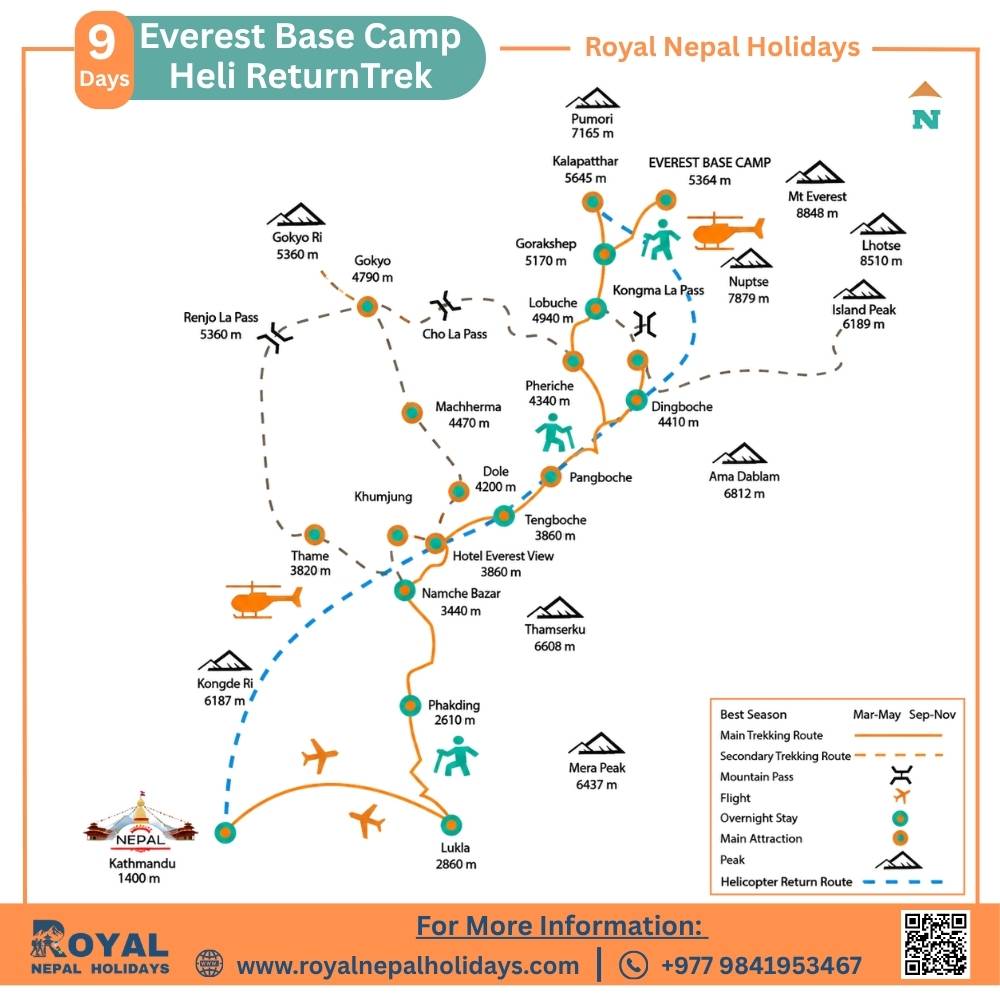




Best Decision Of The Whole Trip
I'd Wanted To Do Everest Base Camp For Years But Could Never Justify Two And A Half Weeks Off Work. This Itinerary Solved That Completely. Our Guide Chandra Was Fantastic — Patient, Funny, And Clearly Very Experienced With Altitude Pacing.
Reaching Base Camp Was Emotional, But Honestly The Helicopter Flight Back Might Have Been My Favorite Part Of The Whole Trip — Seeing Everest From The Air After Spending A Week Walking Toward It Was Incredible. Royal Nepal Holidays Handled Everything Smoothly From The Airport Pickup To The Final Drop-off.
Knees Intact, Memories Made
At 58, I Was Worried About The Descent More Than The Ascent. This 9-day Itinerary With The Helicopter Return Was Exactly What I Needed.
Our Guide Uttam Kept A Sensible Pace Throughout And Never Rushed The Acclimatization Day At Namche, Which I Really Appreciated. Kala Patthar At Sunrise Was Worth Every Early Alarm. Would Recommend This Specific Itinerary To Anyone Hesitant About The Standard Round-trip Walk.
Efficient Without Feeling Rushed
I Had Exactly Nine Days Of Leave And Genuinely Wasn't Sure Everest Base Camp Was Possible In That Window Until I Found This Package. Our Guide Bashu Made Sure We Were Never Pushing Too Hard, And The Tea Houses Booked For Us Were Comfortable And Clean.
The Helicopter Flight On The Last Day Was A Completely Different Way To See The Himalaya — I'd Genuinely Recommend It Even To People Who Aren't Short On Time, Just For The Experience Itself.
Owner Personally Checked In On Us, Great Team
What Stood Out To Me Was That Sushil, The Owner, Personally Messaged Our Group Before Departure To Make Sure Our Itinerary And Gear List Were Sorted. That Level Of Attention From Ownership Isn't Something I've Experienced With Other Trekking Companies. The Trek Itself Was Everything I Hoped For, And The Helicopter Return Over The Khumbu Valley Was Spectacular.
Perfect For A Shorter Honeymoon Trek
We Only Had About A Week And A Half For Our Honeymoon And Didn't Think Everest Base Camp Was Realistic, But This Itinerary Made It Work Perfectly. Our Guide Was Attentive To Both Of Us Throughout, Especially During The Higher Altitude Days, And Upgrading To A Private Helicopter For The Return Leg Made For An Unforgettable, Romantic Way To Finish The Trip. And Owner Sushil Was Good With Communication In Time.