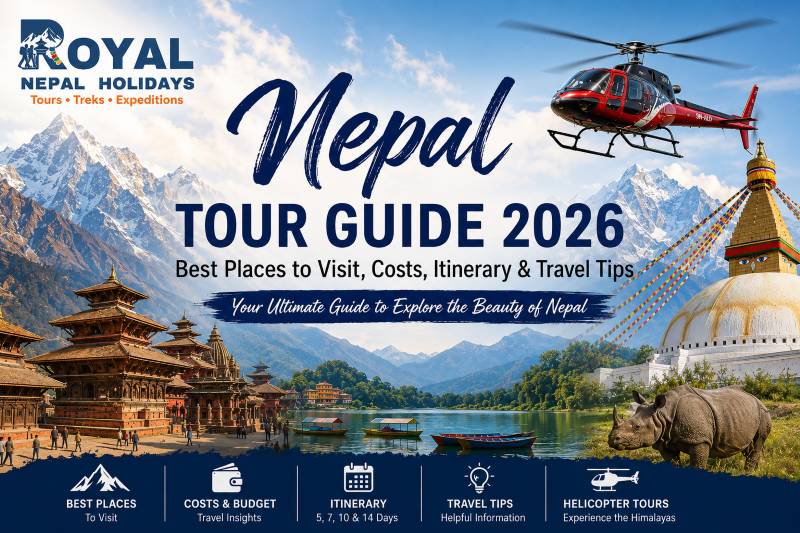
Nepal Tour Guide 2026: Best Places To Visit, Costs, Itinerary & Travel Tips
By Royal Nepal Holidays On 30 May 2026
Quick Contact
By Royal Nepal Holidays On 30 May 2026
Planning a trip to Nepal? Whether you're dreaming of standing in the shadow of Mount Everest, exploring ancient temples in Kathmandu, or spotting a one-horned rhino in Chitwan, this guide covers everything you need to know for an unforgettable Nepal tour in 2026. From travel costs and visa requirements to the best itineraries and trekking routes, we've put it all in one place.
At Royal Nepal Holidays, we specialize in crafting personalized Nepal tours — from luxury helicopter experiences to cultural immersions and wildlife safaris. Whatever your travel style, Nepal has something extraordinary waiting for you.
| Information | Details |
|---|---|
| Country | Nepal |
| Capital City | Kathmandu |
| Currency | Nepalese Rupee (NPR) |
| Language | Nepali |
| Time Zone | UTC +5:45 |
| International Airport | Tribhuvan International Airport (KTM) |
| Visa on Arrival | Available for most nationalities |
| Highest Mountain | Mount Everest (8,848.86m) |
| Main Tourist Areas | Kathmandu, Pokhara, Chitwan, Lumbini, Everest, Annapurna |
Nepal is one of the few destinations in the world where you can experience eight of the world's fourteen highest peaks, centuries-old living culture, subtropical jungles, and Himalayan glaciers — all within a single trip. Here's why 2026 is a great year to visit:
Nepal has four distinct travel seasons, each offering a different experience.
| Season | Months | Weather | Best For |
|---|---|---|---|
| Spring | March-May | Mild & Clear | Trekking, Tours |
| Summer/Monsoon | June-August | Warm & Rainy | Nature, Photography |
| Autumn | September-November | Clear & Dry | Trekking, Sightseeing |
| Winter | December-February | Cold & Dry | Cultural Tours, Helicopter Tours |
Spring is one of the two peak trekking seasons in Nepal. The rhododendron forests burst into colour — vibrant pinks and reds carpet the hillsides. Temperatures are warm and pleasant at lower elevations, and mountain views are generally clear. This is an excellent time for the Annapurna Base Camp Trek, Everest Base Camp Trek, and helicopter tours.
Highlights: Rhododendron blooms, warm weather, good mountain visibility, trekking season
Ideal For: Trekking, helicopter tours, cultural tours, wildlife safaris
The monsoon season brings heavy rainfall, particularly in the southern lowlands and mid-hills. Trekking conditions are slippery, and mountain views can be obscured by clouds. However, the landscapes turn lush green, and there are far fewer tourists. Some high-altitude rain-shadow areas like Upper Mustang remain trekking-friendly even during monsoon.
Highlights: Lush green landscapes, fewer crowds, budget deals, Upper Mustang trekking
Ideal For: Mustang treks, off-the-beaten-path travel, budget travelers
Autumn is the peak tourist season in Nepal and widely considered the best time to visit. The sky is crystal clear after the monsoon, offering the most spectacular mountain views of the year. Trails are in good condition, and the weather is ideal for trekking at all elevations. This is the most popular season for Everest Base Camp and Annapurna treks.
Highlights: Crystal-clear mountain views, perfect trekking conditions, vibrant festivals (Dashain, Tihar)
Ideal For: All trekking routes, helicopter tours, cultural festivals, wildlife safaris
Winter brings cold temperatures, especially at altitude. High passes may be snowed in. However, lower-elevation tours — Kathmandu, Pokhara, Chitwan, Lumbini — are perfectly accessible. Mountain flight experiences are excellent in winter due to very clear skies. This is also low season, meaning fewer crowds and lower prices.
Highlights: Clear mountain flight views, fewer tourists, lower costs
Ideal For: Kathmandu and Pokhara city tours, Chitwan safari, mountain flights, Lumbini
| Destination | Highlights | Recommended Stay |
|---|---|---|
| Kathmandu | UNESCO Heritage Sites | 2-3 Days |
| Pokhara | Lakes & Mountains | 2-3 Days |
| Chitwan | Wildlife Safari | 2 Days |
| Lumbini | Birthplace of Buddha | 1-2 Days |
| Nagarkot | Himalayan Sunrise | 1 Day |
| Everest Region | Everest Views | 5-14 Days |
| Annapurna Region | Trekking | 5-12 Days |
| Bandipur | Traditional Village | 1 Day |
| Mustang | Himalayan Desert | 4-7 Days |
| Janakpur | Religious Heritage | 1 Day |
1. Kathmandu Valley
Nepal's capital and cultural heart, Kathmandu Valley is home to seven UNESCO World Heritage Sites packed into a single valley. Ancient temples, medieval palace squares, and living Buddhist and Hindu traditions make this city unlike any other in the world.
Top Highlights: Kathmandu Durbar Square, Swayambhunath (Monkey Temple), Boudhanath Stupa, Pashupatinath Temple, Bhaktapur Durbar Square, Patan Durbar Square
Best Activities: Heritage walking tours, temple visits, local food tours, shopping for handicrafts
Ideal Duration: 2–3 days
Average Cost: USD 40–120 per day (budget to mid-range)
2. Pokhara
Nepal's second-largest city sits on the edge of Phewa Lake with the Annapurna massif as its backdrop. It's the gateway to the Annapurna region and one of Asia's top adventure hubs. The city has a relaxed lakeside atmosphere, excellent restaurants, and world-class adventure sports.
Top Highlights: Phewa Lake, World Peace Pagoda, Sarangkot Sunrise, Davis Falls, Gupteshwar Cave
Best Activities: Paragliding, boating, trekking, zip-lining, sunrise viewpoint hikes
Ideal Duration: 2–3 days
Average Cost: USD 35–100 per day
3. Chitwan National Park
A UNESCO World Heritage Site in Nepal's southern Terai, Chitwan is one of Asia's best wildlife safari destinations. The park protects Bengal tigers, one-horned rhinos, gharial crocodiles, leopards, and over 500 bird species.
Top Highlights: Jeep safari, elephant breeding centre, canoe rides, jungle walks
Best Activities: Safari drives, bird watching, cultural Tharu village tours
Ideal Duration: 2–3 days
Average Cost: USD 60–200 per day (includes safari packages)
4. Lumbini
The birthplace of Siddhartha Gautama — the Buddha — Lumbini is one of the most sacred pilgrimage sites in the world. The UNESCO-listed site includes the sacred Mayadevi Temple, the Ashoka Pillar, and a sprawling sacred garden surrounded by monasteries built by Buddhist nations from around the world.
Top Highlights: Mayadevi Temple, Sacred Garden, Ashoka Pillar, World Peace Flame
Best Activities: Meditation, pilgrimage tours, monastery visits
Ideal Duration: 1–2 days
Average Cost: USD 30–80 per day
5. Nagarkot
A hilltop retreat just 32 km east of Kathmandu, Nagarkot is famous for its panoramic sunrise views over the Himalayas, including the Everest range. It's a popular overnight escape from Kathmandu.
Top Highlights: Himalayan panorama (Everest range visible on clear days), sunrise views
Best Activities: Sunrise watching, hiking, nature walks, photography
Ideal Duration: 1 day / overnight
6. Bandipur
A beautifully preserved hilltop town in central Nepal, Bandipur is often called Nepal's hidden gem. The car-free bazaar area retains its 18th-century Newari architecture, and the views of the Annapurna and Manaslu ranges are stunning.
Top Highlights: Tin Dhare, Siddha Cave, Thani Mai Temple, mountain views
Best Activities: Heritage walking, cave exploration, hiking
Ideal Duration: 1–2 days
Average Cost: USD 30–70 per day
7. Everest Region
The Khumbu region is the roof of the world — home to Mount Everest (8,849 m), Lhotse, Nuptse, and Ama Dablam. Whether you trek to Everest Base Camp or take a helicopter tour, the Everest region delivers some of the most dramatic mountain scenery on the planet.
Top Highlights: Everest Base Camp, Kala Patthar, Namche Bazaar, Tengboche Monastery
Best Activities: EBC trek, Everest helicopter tour, Sherpa culture immersion
Ideal Duration: (12–14 days (trek) | 1 day (helicopter)
Average Cost: USD 1,200–2,500+ (trek) | USD 1150–1450 per person (helicopter)
8. Annapurna Region
The Annapurna Conservation Area is Nepal's most visited trekking region. It offers diverse landscapes — subtropical forests, terraced hillsides, high-altitude deserts — and iconic trails like the Annapurna Circuit and Annapurna Base Camp Trek.
Top Highlights: Annapurna Base Camp, Poon Hill, Ghorepani, Thorung La Pass
Best Activities: Trekking, helicopter tours, hot spring soaks
Ideal Duration: 7–14 days (trek) | 1 day (helicopter)
Average Cost: USD 800–2,000+ (trek)
9. Mustang
Upper Mustang, once a restricted kingdom, is one of Nepal's most remote and otherworldly destinations. Its barren, wind-carved landscape resembles the Tibetan Plateau, and ancient cave monasteries and walled medieval towns add to its mystique. A restricted area permit is required.
Top Highlights: Lo Manthang (walled city), Tiji Festival, ancient cave monasteries, Kali Gandaki Gorge
Best Activities: Trekking, jeep safari, cultural exploration
Ideal Duration: 10–14 days
Average Cost: USD 500 restricted permit + trekking costs
10. Janakpur
A vibrant religious city in the Terai plains, Janakpur is believed to be the birthplace of Goddess Sita from the Hindu epic Ramayana. The Janaki Mandir temple is an architectural masterpiece and the city is a major Hindu pilgrimage destination.
Top Highlights: Janaki Mandir, Vivah Panchami Festival, sacred ponds
Best Activities: Temple tours, cultural immersion, pilgrimage
Ideal Duration: 1–2 days
Average Cost: USD 25–60 per day
Kathmandu is one of the world's most culturally dense cities. Within a few square kilometres, you'll find temples that are over 2,000 years old, living goddess traditions, and bustling medieval bazaars.
The historic royal palace complex at the heart of old Kathmandu. Home to the Kumari (living goddess) residence, the Taleju Temple, Kasthamandap (the city's namesake structure), and dozens of carved temples. The square was damaged in the 2015 earthquake and restoration work is ongoing.
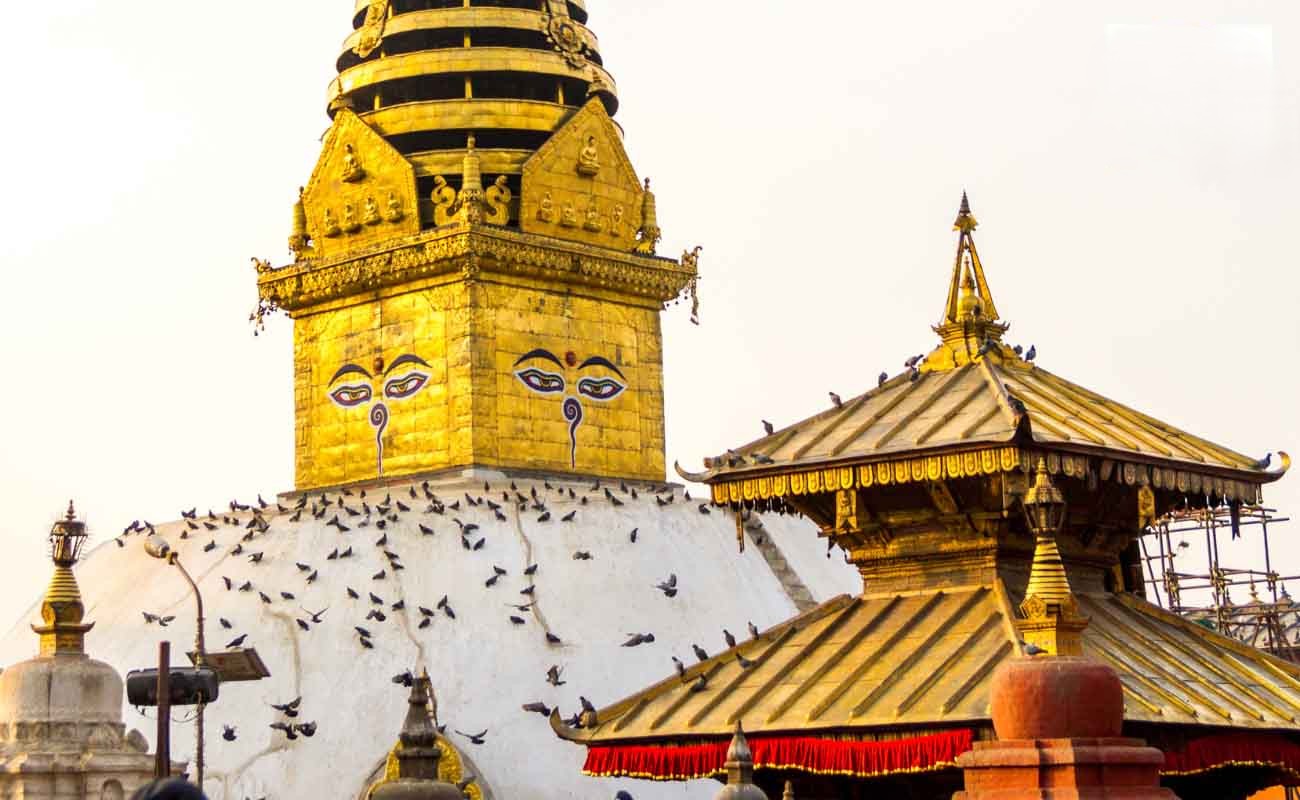
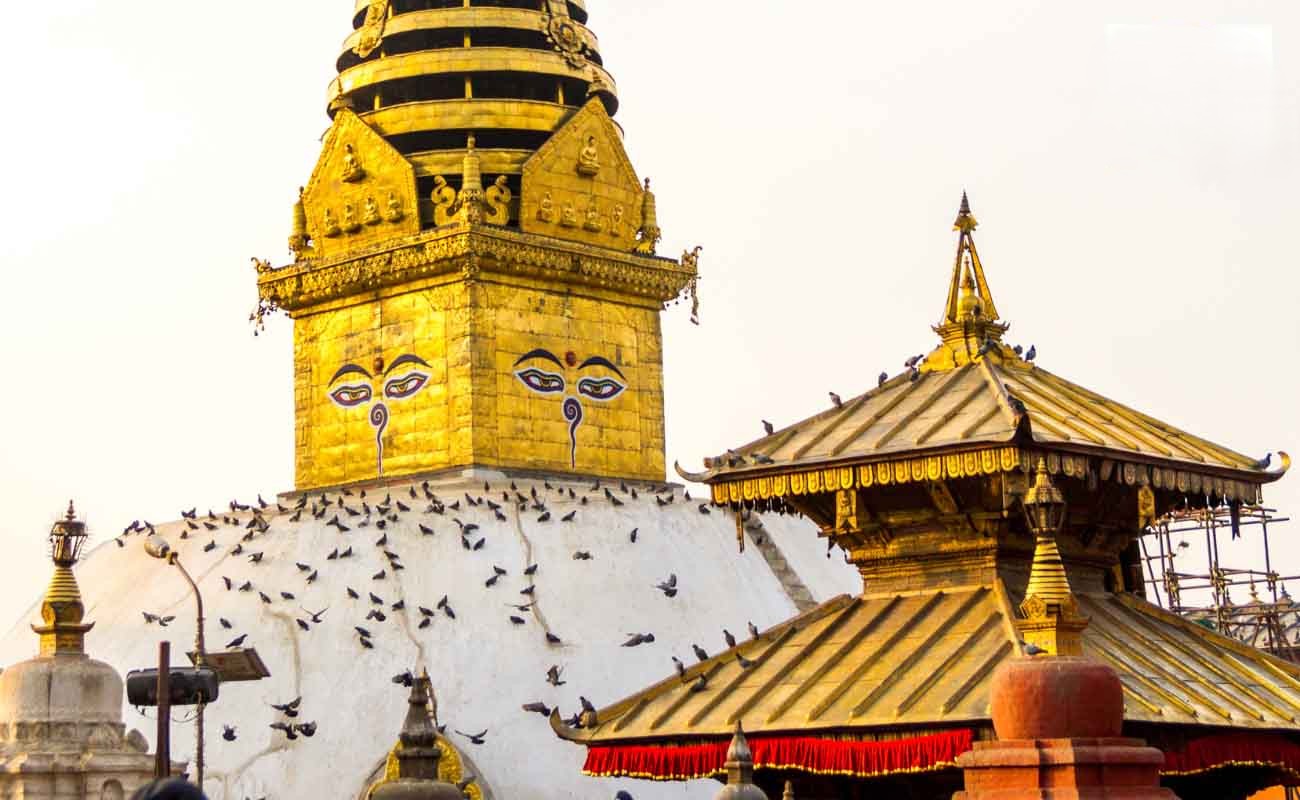
Perched on a hilltop west of the city, Swayambhunath is one of the oldest religious sites in Nepal. The all-seeing eyes of Buddha painted on the stupa's tower are an iconic symbol of Nepal. The site is shared by both Buddhists and Hindus and is populated by — as the name suggests — hundreds of monkeys.
One of the largest Buddhist stupas in the world, Boudhanath is the spiritual centre of Tibetan Buddhism in Nepal. The surrounding neighbourhood is filled with monasteries, thangka shops, and cafes. Circumambulating the stupa at dusk, when butter lamps are lit and monks chant, is an unforgettable experience.
Nepal's most sacred Hindu temple, dedicated to Lord Shiva, sits on the banks of the Bagmati River. The temple complex is a living cremation site, and witnessing the funeral ghats here is a profound, humbling experience. Non-Hindus cannot enter the main temple but can observe from across the river.
Just 5 km south of Kathmandu in the ancient city of Patan (Lalitpur), this square is considered the finest example of Newari architecture in Nepal. The Krishna Mandir, Hiranya Varna Mahavihar (Golden Temple), and the Patan Museum are highlights.
The most intact of Kathmandu Valley's three royal squares, Bhaktapur feels like stepping back into medieval Nepal. The 55-Window Palace, Nyatapola Temple (Nepal's tallest pagoda), and the pottery and weaving quarters are must-sees. An entrance fee (around USD 15 for foreigners) is charged at the city gates.
→ Explore all seven UNESCO Heritage Sites with Royal Nepal Holidays' dedicated 7 UNESCO Heritage Site Tour.
Pokhara is Nepal's most relaxed tourist city and one of the most scenic in Asia. The backdrop of Machhapuchhre (Fishtail Mountain) and the Annapurna range combined with the calm of Phewa Lake makes it a paradise for both adventurers and those simply seeking beauty.
The second-largest lake in Nepal, Phewa Lake is the heart of Pokhara's tourist scene. Rent a colourful wooden boat and row out to Tal Barahi Temple (the island temple) for a morning ritual. Lakeside restaurants line the shore with stunning mountain reflections on clear mornings.
Built by Japanese Buddhist monks, the gleaming white Peace Pagoda sits on a hilltop south of Phewa Lake. The hike or drive up rewards you with sweeping views of the lake, Pokhara city, and the Annapurna range. Sunrise from here is especially magical.
A curious waterfall in central Pokhara where the stream vanishes into a deep underground gorge. Just across the road is Gupteshwar Cave, where you can walk through stalactite-filled chambers.
Waking up at 4:30 AM for the drive or hike to Sarangkot is absolutely worth it. From this hilltop viewpoint, you get a 180-degree panorama of the Annapurna range, with Machhapuchhre dominating the foreground. The sunrise painting the snow peaks in gold and orange is something you won't forget.
Pokhara is the adventure capital of Nepal. Activities include:
Activity | Approx. Cost (Per Person, USD)
Paragliding | 80–100
Zip Lining | 60–90
Ultralight Flight | 100–150
Bungee Jumping | 80–100
White Water Rafting (Seti/Trishuli) | 35–80
Boating on Phewa | 5–10 per hour
Helicopter Tour to Annpaurna Base Camp | USD 470
Chitwan National Park, established in 1973 and declared a UNESCO World Heritage Site in 1984, is Nepal's premier wildlife destination. Covering 932 sq km of subtropical forest, grassland, and wetland, Chitwan offers one of the best chances in Asia to see Bengal tigers and greater one-horned rhinoceroses in the wild.
Wildlife of Chitwan
Safari Activities
Safari Package Comparison:
Package Type | Duration | Includes | Approx. Cost (per person)
---------------------|-----------|---------------------------------------|---------------------------
Budget Safari Package| 2 nights | Accommodation, 1 jeep safari, canoe | USD 120–180
Standard Package | 2–3 nights| Accommodation, 2 safaris, cultural show, jungle walk | USD 200–350
Premium Package | 3 nights | Luxury lodge, private safaris, all activities | USD 400–700+
Day Trip from Kathmandu | 1 day | Transport, jeep safari, lunch | USD 180–250
The Everest region — also known as the Khumbu — is the crown jewel of Nepal's tourism. Whether you choose to trek for two weeks or arrive by helicopter in under an hour, no experience in Nepal quite matches the sheer scale and majesty of the Everest landscape.
| Trek | Duration | Difficulty | Maximum Altitude |
|---|---|---|---|
| Everest Base Camp | 14 Days | Moderate-Hard | 5,364m |
| Annapurna Base Camp | 12 Days | Moderate | 4,130m |
| Ghorepani Poon Hill | 5 Days | Easy-Moderate | 3,210m |
| Mardi Himal | 5 Days | Moderate | 4,500m |
Everest Base Camp Trek
The classic Everest Base Camp (EBC) Trek is one of the world's most famous trekking routes. Starting with a flight to Lukla (2,840 m), the trail passes through Sherpa villages, rhododendron forests, and glacial moraines, culminating at Everest Base Camp (5,364 m) and the viewpoint of Kala Patthar (5,545 m).
A shorter, less strenuous alternative to the full EBC trek. The route typically goes to Namche Bazaar and Everest View Hotel (3,880 m), offering stunning views of Everest, Lhotse, Ama Dablam, and Nuptse without the full altitude challenge.
For those who want the Everest experience without the trekking commitment, the Everest Helicopter Tour is the ultimate alternative — and one of Royal Nepal Holidays' most popular offerings.
A private or shared helicopter departs from Kathmandu early in the morning and flies directly into the Khumbu, offering jaw-dropping aerial views of Everest, Lhotse, Nuptse, Ama Dablam, and the entire Himalayan chain.
Everest Base Camp Helicopter Landing Tour
The premium version of the helicopter experience includes a landing at Everest Base Camp or Kala Patthar, where passengers can step out, photograph the Khumbu Icefall and the world's highest peak, and enjoy a brief, exhilarating time at altitude — all without a single day of trekking.
Benefits of the Helicopter Tour:
→ Book your Everest Base Camp Helicopter Tour with Royal Nepal Holidays and experience the world's highest peak in a day.
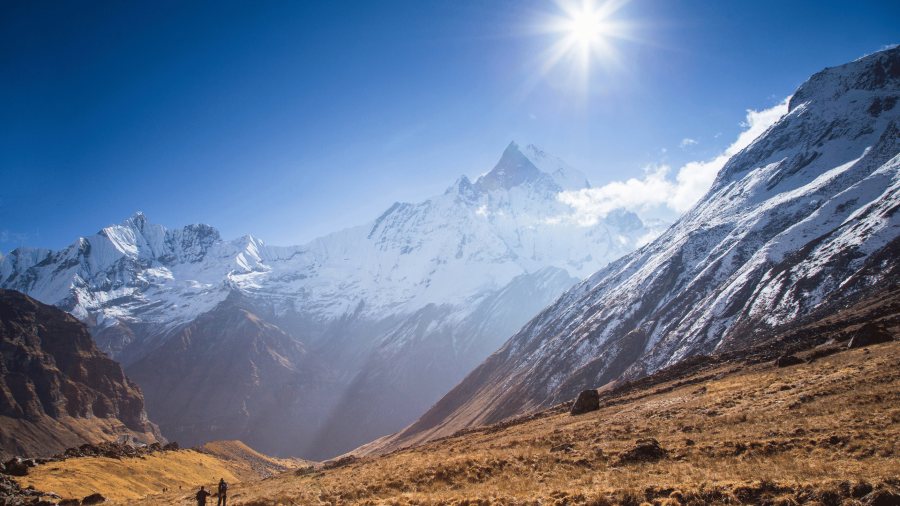
The Annapurna Conservation Area (ACAP) — the world's largest conservation area at 7,629 sq km — is Nepal's most popular trekking region. The diversity of landscapes and cultures here is remarkable, ranging from subtropical lowlands to the high alpine desert of the Annapurna Plateau.
Annapurna Base Camp Trek
One of Nepal's classic treks, the ABC Trek passes through rhododendron and bamboo forests, terraced fields, and Gurung and Magar villages before arriving at the Annapurna Sanctuary — a natural amphitheatre surrounded by peaks over 7,000 m, including Annapurna I (8,091 m), Machhapuchhre (6,993 m), and Hiunchuli.
Ghorepani Poon Hill Trek
The most popular short trek in Nepal, the Poon Hill route is ideal for first-timers and those with limited time. The sunrise view of the Dhaulagiri and Annapurna ranges from Poon Hill (3,210 m) is considered one of the best mountain panoramas in the world.
Mardi Himal Trek
A hidden gem in the Annapurna range, the Mardi Himal Trek offers close-up views of Machhapuchhre and access to the peaceful Mardi Himal Base Camp (4,500 m), with far fewer crowds than the main Annapurna trails.
Royal Nepal Holidays also offers helicopter tours to Annapurna Base Camp, delivering you to the Sanctuary for a sunrise mountain experience in a fraction of the time it takes to trek.
Trekking Difficulty Comparison — Annapurna Region:
Trek | Duration | Max Altitude | Difficulty | Best For
----------------------|-----------|--------------|---------------|----------------------------
Poon Hill | 4–5 days | 3,210 m | Easy–Moderate | Beginners, families
Mardi Himal | 6–8 days | 4,500 m | Moderate | Intermediate trekkers
Annapurna Base Camp | 9–12 days | 4,130 m | Moderate | Most trekkers
Annapurna Circuit | 14–18 days| 5,416 m (Thorung La) | Strenuous | Experienced trekkers
Nepal is genuinely budget-friendly, but there are options for every level of luxury. Here is a realistic breakdown of daily costs for different traveler types.
| Travel Style | Cost Per Day (USD) |
|---|---|
| Budget | $30 - $60 |
| Mid-Range | $60 - $150 |
| Luxury | $150 - $500+ |
Budget Traveler (USD per day)
Hotel / Guesthouse : USD 8–20
Meals (local food) : USD 5–10
Local Transport : USD 2–5
Entrance Fees : USD 2–10
Total Per Day (approx): USD 25–50
Mid-Range Traveler (USD per day)
Hotel (3-star/boutique): USD 40–80
Meals (mixed restaurants): USD 15–30
Private Transport : USD 20–40
Entrance Fees + Guide : USD 20–40
Total Per Day (approx) : USD 80–150
Luxury Traveler (USD per day)
Luxury Hotel / Resort : USD 150–400+
Fine Dining / Private Chef: USD 60–120
Private Vehicle + Guide: USD 80–150
Premium Experiences : USD 100–500
Total Per Day (approx) : USD 350–1,000+
Additional Cost Estimates:
Item | Cost (USD)
----------------------------|------------------------------
Day 1: Arrive Kathmandu | Hotel check-in | Thamel evening walk
Day 2: Kathmandu UNESCO Tour — Pashupatinath, Boudhanath, Swayambhunath, Kathmandu Durbar Square
Day 3: Day trip to Bhaktapur and Nagarkot | Overnight at Nagarkot for sunset/sunrise views
Day 4: Return to Kathmandu | Patan Durbar Square and Patan Museum | Afternoon at leisure
Day 5: Departure | Optional: Morning mountain flight before airport transfer
Best For: First-time visitors, short-trip travelers
Estimated Cost: USD 400–700 per person (mid-range, excluding international flights)
| Day | Destination | Activities |
|---|---|---|
| 1 | Kathmandu | Arrival & Sightseeing |
| 2 | Kathmandu | UNESCO Heritage Sites |
| 3 | Pokhara | Drive/Flight & Lakeside |
| 4 | Pokhara | Sarangkot Sunrise & City Tour |
| 5 | Chitwan | Jungle Safari |
| 6 | Chitwan - Kathmandu | Return Journey |
| 7 | Kathmandu | Departure |
Day 1: Arrive Kathmandu | Check-in | Welcome dinner
Day 2: Kathmandu Valley UNESCO tour (Pashupatinath, Boudhanath, Swayambhunath, Durbar Square)
Day 3: Bhaktapur + Nagarkot overnight
Day 4: Fly to Pokhara | Lakeside walk | Sunset at Phewa Lake
Day 5: Sarangkot sunrise | Pokhara sightseeing (Davis Falls, World Peace Pagoda) | Paragliding option
Day 6: Fly back to Kathmandu | Afternoon free for shopping and spa
Day 7: Departure | Optional morning helicopter tour add-on
Best For: Culture + nature combo travelers
Estimated Cost: USD 700–1,200 per person (mid-range)
Day 1: Arrive Kathmandu
Day 2: Kathmandu UNESCO heritage tour
Day 3: Drive or fly to Chitwan
Day 4: Chitwan National Park — Jeep safari, canoe, cultural show
Day 5: Drive to Pokhara via Sauraha
Day 6: Pokhara sightseeing + adventure activity
Day 7: Sarangkot sunrise | Drive to Bandipur
Day 8: Bandipur heritage walk | Return to Kathmandu
Day 9: Everest Helicopter Tour (full day experience)
Day 10: Departure
Best For: Well-rounded Nepal experience
Estimated Cost: USD 1,200–2,000 per person (mid-range, including helicopter tour)
Day 1–2: Kathmandu arrival + heritage tours
Day 3: Fly to Lukla | Trek to Phakding
Day 4: Trek to Namche Bazaar (3,440 m)
Day 5: Acclimatization day in Namche | Everest View Hotel hike
Day 6: Trek to Tengboche (3,867 m)
Day 7: Trek to Dingboche (4,410 m)
Day 8: Acclimatization day in Dingboche
Day 9: Trek to Lobuche (4,940 m)
Day 10: Trek to Everest Base Camp (5,364 m) | Overnight Gorak Shep
Day 11: Kala Patthar sunrise (5,545 m) | Trek down to Pheriche
Day 12: Trek down to Namche Bazaar
Day 13: Trek to Lukla | Farewell dinner
Day 14: Fly Lukla–Kathmandu | Departure
Best For: Adventure seekers, Everest trekkers
Estimated Cost: USD 2,000–3,000 per person (guided, all inclusive)
Most nationalities can obtain a Nepal visa on arrival at Tribhuvan International Airport in Kathmandu. Indian nationals do not require a visa to enter Nepal.
Visa Types and Fees:
| Visa Duration | Fee (USD) |
|---|---|
| 15 Days | $30 |
| 30 Days | $50 |
| 90 Days | $125 |
Always verify current visa fees before travel.
Documents Required:
You can also apply for a Nepal visa in advance through the Department of Immigration Nepal or their online e-visa portal at: https://www.immigration.gov.np
Visa extensions are available at the Department of Immigration in Kathmandu for longer stays.
Note: Visa rules and fees can change. Always verify the latest requirements before travel at the official Nepal Department of Immigration website.
Getting around Nepal involves a mix of domestic flights, tourist buses, private vehicles, and — for the ultimate experience — helicopter services.
Domestic Flights
Nepal Airlines, Yeti Airlines, Shree Airlines, and Tara Air operate scheduled domestic flights connecting Kathmandu to Pokhara, Lukla, Bharatpur (for Chitwan), Bhairahawa (for Lumbini), Jomsom (for Mustang), and other destinations. Flights are affordable (typically USD 100–200 each way) but can be delayed or cancelled due to weather — always build buffer days into your itinerary.
Tourist Buses
Tourist buses connect Kathmandu to Pokhara (approx. 6–7 hours), Chitwan (approx. 5–6 hours), and other destinations. They are comfortable, affordable (USD 8–15 per journey), and a popular option for budget travelers. Standard local buses are cheaper but significantly less comfortable.
Private Vehicles
Hiring a private car with a driver is the most flexible way to see Nepal. Most tour operators including Royal Nepal Holidays arrange private transfers for full-day and multi-day itineraries. Costs typically range from USD 40–80 per day depending on the vehicle and distance.
Helicopter Services
Helicopter tours and charter services are the premium option for travelers with limited time or those seeking a luxury mountain experience. Royal Nepal Holidays offers helicopter services for:
When is a helicopter tour worth it?
If you have limited time, want the Everest experience without trekking, have physical limitations that prevent altitude trekking, or simply want the most dramatic views possible, a helicopter tour delivers extraordinary value.
| Essential Item | Recommended |
|---|---|
| Passport | Yes |
| Travel Insurance | Yes |
| Trekking Shoes | For Trekkers |
| Warm Jacket | Yes |
| Power Bank | Yes |
| Sunglasses | Yes |
| Water Bottle | Yes |
| First Aid Kit | Yes |
Documents & Money
Clothing (Trekking)
Clothing (City / Cultural Tours)
Electronics
Health Items
Trekking Gear
1. Respect Local Culture
Remove shoes before entering temples and homes. Dress modestly at religious sites (cover shoulders and knees). Walk clockwise around Buddhist stupas and monasteries. Ask permission before photographing people.
2. Currency Exchange
Exchange money at official bank counters or licensed money changers only. The best rates are available in Kathmandu (Thamel area). Avoid unofficial street exchangers. ATMs are available throughout Kathmandu and Pokhara. Cash is essential in smaller towns and on trekking routes.
3. Mobile Internet
Local SIM cards from Ncell or Nepal Telecom (NTC) provide good 4G coverage in cities and major trekking hubs. Purchase at the airport or in Thamel. Data packages are inexpensive. Wi-Fi is available at most lodges and teahouses along popular trekking routes, though speed varies.
4. Safety
Nepal is a very safe destination for tourists. Petty theft exists in busy tourist areas — keep valuables secure. Trek only with a licensed guide from a registered trekking company. Always carry comprehensive travel insurance that covers altitude trekking and emergency helicopter evacuation.
5. Drinking Water
Do not drink tap water anywhere in Nepal. Use bottled water, filtered water stations (available on most trekking routes), or bring a filter bottle or purification tablets. Boiled water (available at teahouses) is safe.
6. Altitude Awareness
Acute Mountain Sickness (AMS) is a real concern above 3,000 m. Follow the golden rule: ascend slowly, never gain more than 500 m of sleeping altitude per day, take acclimatization days, stay hydrated, and descend immediately if symptoms worsen. Symptoms include severe headache, dizziness, nausea, loss of coordination, and shortness of breath. Carry a pulse oximeter.
7. Responsible Tourism
Avoid single-use plastics — many trekking zones have plastic restrictions. Use reusable water bottles. Hire local guides and porters. Buy locally made handicrafts rather than mass-produced souvenirs. Stay in locally owned lodges when possible. Leave no trace on the trail.
8. Tipping Culture
Tipping is customary and appreciated. A good benchmark: tip your guide USD 10–15 per day, and your porter USD 5–8 per day at the end of the trek. At restaurants, 10% is standard if service charge is not included.
| Traveler Type | Recommended Destination |
|---|---|
| First-Time Visitor | Kathmandu & Pokhara |
| Culture Lover | Kathmandu Valley |
| Wildlife Enthusiast | Chitwan National Park |
| Spiritual Traveler | Lumbini |
| Adventure Seeker | Everest Region |
| Trekker | Everest & Annapurna |
| Luxury Traveler | Helicopter Tours & Luxury Lodges |
| Photographer | Everest, Mustang & Pokhara |
Q: Is Nepal safe to visit in 2026?
A: Yes, Nepal is considered a safe destination for international tourists. The country has a well-established tourism infrastructure, and violent crime against tourists is rare. Standard travel precautions apply — safeguard your valuables, use reputable trekking agencies, and purchase travel insurance.
Q: How much does a Nepal trip cost?
A: A 7-day mid-range Nepal trip costs approximately USD 700–1,200 per person (excluding international flights). Budget travelers can manage on USD 300–500 for 7 days. Luxury itineraries with helicopter tours cost USD 2,000–4,000+ for a week.
Q: What is the best month to visit Nepal?
A: October and November are widely considered the best months due to clear skies, stable weather, and excellent mountain views. March and April are also excellent for trekking and rhododendron blooms.
Q: Do I need a visa to visit Nepal?
A: Most nationalities require a visa, which is easily obtained on arrival at Kathmandu's international airport. Fees are USD 30 for 15 days and USD 50 for 30 days. Indian nationals are exempt from visa requirements.
Q: Can beginners trek in Nepal?
A: Absolutely. Nepal has excellent trekking routes for all fitness levels. The Ghorepani Poon Hill Trek (4–5 days) is ideal for beginners and requires no special training. The Everest View Trek and Langtang Valley Trek are also manageable for reasonably fit first-timers.
Q: Is Everest Base Camp worth visiting?
A: Without a doubt. Everest Base Camp is one of the world's most iconic trekking destinations. The sense of achievement, the dramatic scenery of the Khumbu Icefall, and the rich Sherpa culture along the route make it an experience of a lifetime. If you cannot commit to the 12–14 day trek, the Everest helicopter tour delivers an extraordinary alternative.
Q: Are helicopter tours in Nepal safe?
A: Yes. Nepal's reputable helicopter tour operators use modern, well-maintained aircraft and employ experienced commercial pilots. Royal Nepal Holidays works exclusively with licensed, certified helicopter companies. Safety briefings are provided before every flight.
Q: Do I need travel insurance for Nepal?
A: Yes — strongly recommended. Ensure your policy covers high-altitude trekking (above 5,000 m if doing EBC) and emergency helicopter evacuation. Medical treatment costs in remote areas require helicopter rescue, which can cost USD 5,000–15,000 without insurance.
Q: What permits do I need for trekking?
A: Most popular treks require a TIMS (Trekkers' Information Management System) card and a national park/conservation area permit. For Everest Base Camp, you need the Sagarmatha National Park Permit and Khumbu Pasang Lhamu Rural Municipality Permit. Your trekking company will arrange all permits.
Q: How far in advance should I book a Nepal tour?
A: For peak season (October–November), book at least 3–4 months in advance to secure preferred lodges and permits. For helicopter tours during peak season, booking 2–3 months ahead is recommended. Off-season travel can often be arranged with 2–4 weeks' notice.
Q: What language do people speak in Nepal?
A: Nepali is the official language. English is widely spoken by guides, hotel staff, and in tourist areas of Kathmandu and Pokhara. In remote trekking areas, basic Nepali or Sherpa is helpful, though most licensed guides speak fluent English.
Q: Can I visit Nepal on a budget?
A: Absolutely. Nepal is one of the most affordable travel destinations in Asia. With guesthouses from USD 8–20 per night, dal bhat (the local staple) from USD 3–5, and inexpensive public transport, budget travelers can experience Nepal richly on USD 30–50 per day.
Q: What is the currency in Nepal and can I use cards?
A: The Nepalese Rupee (NPR) is the local currency. Credit and debit cards (Visa/Mastercard) are accepted at most hotels, larger restaurants, and shops in Kathmandu and Pokhara. Cash is essential outside main cities. ATMs are available throughout tourist areas.
Q: Can I extend my Nepal visa?
A: Yes. Visa extensions are available at the Department of Immigration in Kathmandu and Pokhara. You can extend your stay up to a maximum of 150 days per visa year. The fee is approximately USD 3 per day for extensions.
Q: Is solo female travel safe in Nepal?
A: Nepal is generally considered safe for solo female travelers. The tourism industry is well-established and respectful. Trekking with a licensed guide is recommended, and exercising standard precautions in crowded areas applies as it does anywhere.
Q: Are there ATMs in Nepal?
A: Yes. ATMs are widely available in Kathmandu, Pokhara, and other major towns. Most accept international Visa and Mastercard. Cash withdrawals from ATMs typically attract a fee of around USD 3–5 per transaction. There are no ATMs on most trekking routes — always carry sufficient cash before starting a trek.
Q: What vaccines do I need for Nepal?
A: Consult your doctor or a travel medicine clinic before departure. Commonly recommended vaccines include Hepatitis A, Hepatitis B, Typhoid, Tetanus, and Rabies (for longer stays or adventure activities). Malaria prophylaxis may be recommended for Chitwan and other Terai regions.
Q: What should I eat in Nepal?
A: Dal bhat (lentil soup with rice) is the Nepali staple and is delicious, filling, and safe to eat everywhere. Momos (steamed dumplings) are a must-try snack. Tibetan bread, thukpa (noodle soup), and newari cuisine in the Kathmandu Valley are also highly recommended.
With so many tour operators in Nepal, choosing the right travel partner makes all the difference. Here's what sets Royal Nepal Holidays apart:
Local Expertise
Our team is made up of experienced Nepali travel professionals who know every corner of this country — from the best sunrise spots to the hidden monasteries that rarely appear in guidebooks. We bring insider knowledge that enhances every itinerary we craft.
Professional, Licensed Guides
All our trekking guides are certified by the Nepal Government Tourism Board and hold first aid and altitude medicine training. Your safety and experience are in expert hands throughout your journey.
Custom Itineraries
We do not believe in one-size-fits-all travel. Whether you want a 3-day cultural tour, a 14-day trek, or a private luxury helicopter journey, we design every itinerary around your goals, budget, and travel style.
Helicopter Adventures
Royal Nepal Holidays is a specialist in Nepal's most extraordinary helicopter tour experiences. From Everest Base Camp helicopter landings to Annapurna, Muktinath, and beyond — we handle everything from flight booking and permits to transfers and high-altitude protocols.
Competitive, Transparent Pricing
We offer competitive pricing with no hidden costs. Every quotation includes a clear breakdown of what is and is not included, so you always know what you're paying for.
24/7 Support
From your first inquiry to your final airport transfer, Royal Nepal Holidays provides round-the-clock support. If something changes — weather, permits, flights — we adapt your itinerary and keep you informed in real time.
→ Contact Royal Nepal Holidays today to start planning your customized Nepal tour.
Nepal is a destination that stays with you long after you leave. The scale of the Himalayas is humbling, the warmth of the Nepali people is genuine, and the richness of the culture — accumulated over millennia — is impossible to fully absorb in a single trip. Whether this is your first visit or your tenth, Nepal always reveals something new.
2026 is an excellent year to visit. Tourism infrastructure continues to improve while the authentic spirit of Nepal remains intact. From the chaos and colour of Kathmandu's ancient streets to the silence of a mountain dawn at Everest Base Camp, this is a country that rewards every traveler who arrives with an open mind.
The best time to plan your Nepal tour is now. Permits, peak-season lodge bookings, and helicopter tours fill up quickly — especially for the October–November window. The earlier you book, the better your options.
Royal Nepal Holidays is ready to help you plan every detail — from visas and permits to custom itineraries, guided treks, and once-in-a-lifetime helicopter experiences. Let us make your Nepal journey everything you've imagined and more.
→ Get in touch with Royal Nepal Holidays today to request your personalized Nepal tour itinerary and quote.
USEFUL LINKS & REFERENCES
Nepal Tourism Board (Official): https://www.welcomenepal.com
Department of Immigration Nepal (Visa Information): https://www.immigration.gov.np
UNESCO World Heritage Sites — Nepal: https://whc.unesco.org/en/statesofparties/NP
Tribhuvan International Airport: https://tiairport.com.np
Discover more articles that match your interests! Explore these similar blogs packed with insights, tips, and stories to keep you inspired.
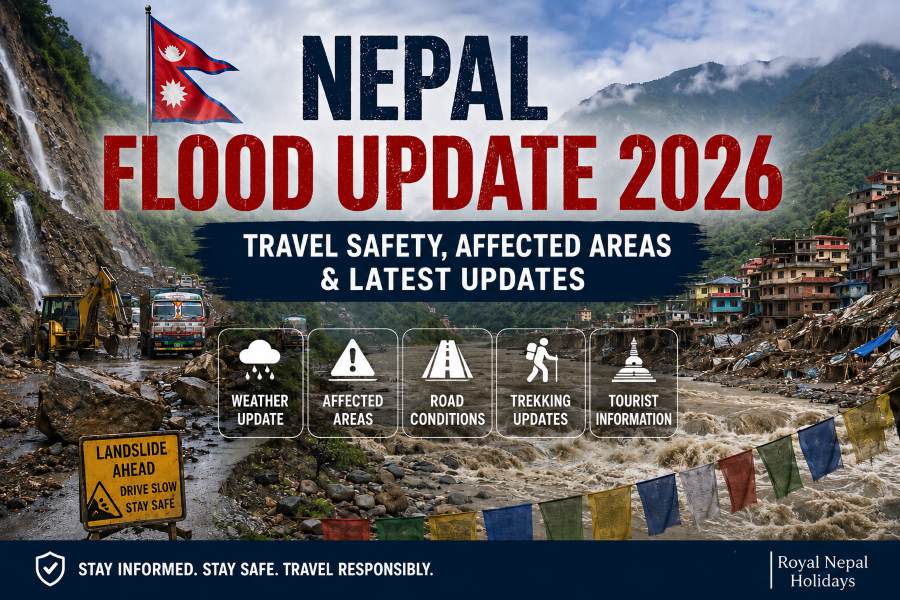
Get the latest Nepal flood update for 2026, including affected areas, road conditions, travel safety, trekking updates, ...